
85mm f/1.4 Wedding Photography: Creating Beautiful Background Blur
By Stuart Wood
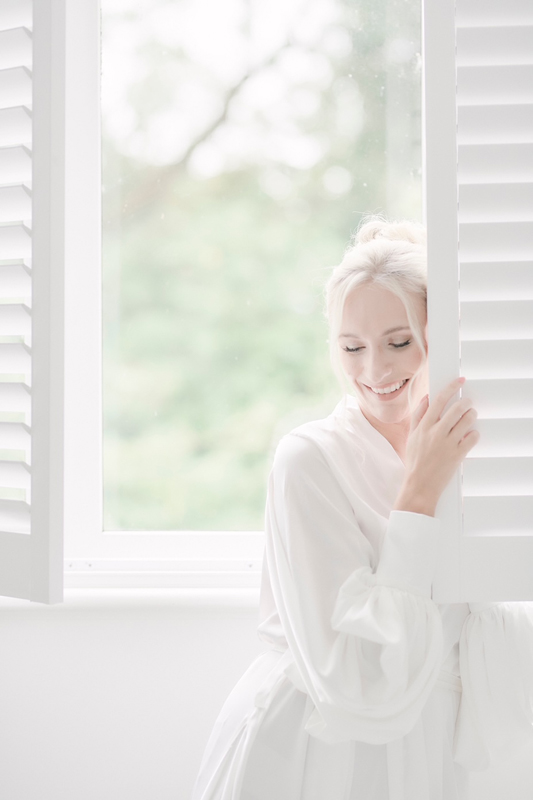
Stuart Wood explains how an 85mm f/1.4 lens transformed the way he approaches shallow depth of field, beautiful bokeh and creative wedding portraits.
There is something wonderfully addictive about shallow depth of field.
When the subject is rendered beautifully sharp while everything around them melts away into a soft, creamy blur, the photograph can take on an almost three-dimensional quality. It draws the viewer straight to the point of interest while giving the image a distinctive visual character.
For some time, I had admired this style of photography. It is relatively easy to achieve when you’re working close to your subject, but becomes much more challenging when you move further away, make your subject smaller within the frame and want to retain plenty of the surrounding environment.
That was exactly the look I wanted to explore.
So, say hello to my little friend: an 85mm f/1.4 Sigma Art lens.
Why use an 85mm lens for wedding photography?
The 85mm focal length has long been a favourite for portrait photographers, and for good reason.
It allows you to work at a comfortable distance from your subject while producing a flattering perspective. It can also help separate your subject from a busy background, particularly when combined with a wide aperture such as f/1.4.
That combination was what really interested me.
I wanted to be able to photograph a bride or groom within their environment while still creating strong separation between them and everything else in the frame.
Rather than simply photographing a person against a completely blurred background, I wanted the surroundings to remain recognisable while becoming part of the overall atmosphere of the image.
Shooting at f/1.4
The obvious attraction of an f/1.4 lens is the ability to create a very shallow depth of field.
But shooting wide open isn’t simply a case of selecting f/1.4 and pressing the shutter.
At such a wide aperture, the plane of focus becomes extremely narrow. A small movement by either the photographer or subject can be enough to take the important part of the image outside the area of sharpness.
Modern autofocus systems can make the process considerably easier, but they don’t remove the need to understand what is happening.
You need to practise.
And then practise some more.
I would strongly recommend becoming familiar with a lens like this before using it on an important commissioned shoot. You need to understand how it behaves at different distances, how quickly your subjects can move before focus becomes a problem and how your choice of composition affects the amount of the image that remains sharp.
Eventually, it becomes intuitive.
That’s when the fun really begins.
Using foreground blur to create depth
One of my favourite ways to use an 85mm lens at f/1.4 is to introduce something between the camera and the subject.
Flowers are particularly useful.
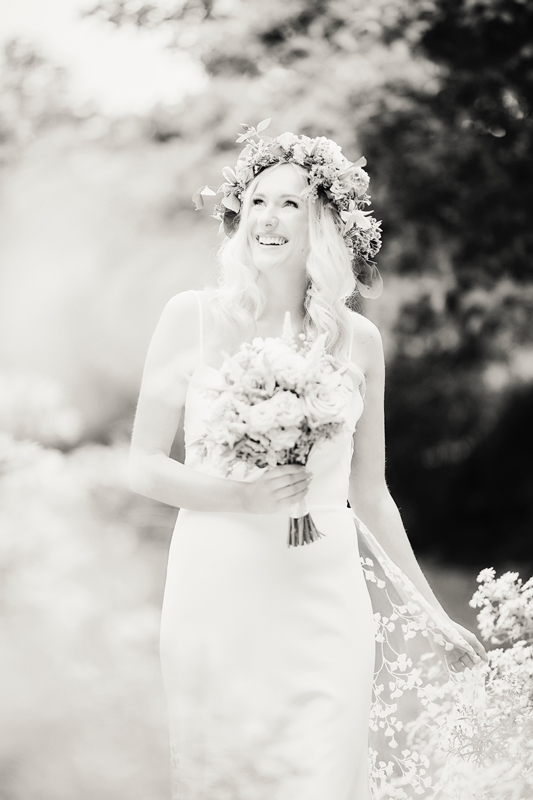
For one of my bridal shoots, I photographed Hattie outside at the magnificent Hampton Manor in Solihull. I deliberately positioned myself close to some white flowers and shot through them, allowing them to become completely blurred.
Hattie was positioned further back, with trees behind her.
Because both the foreground flowers and background trees were rendered soft, Hattie appeared to almost float within the frame.
The result has an almost three-dimensional quality.
This is one of the reasons I enjoy working with a wide aperture. Rather than simply thinking about what needs to be in focus, you start thinking about what can deliberately be allowed to fall out of focus.
Foreground blur can become an important compositional tool.
Don’t be afraid to change the aperture
Although f/1.4 can produce spectacular results, it doesn’t mean you should use it for every photograph.
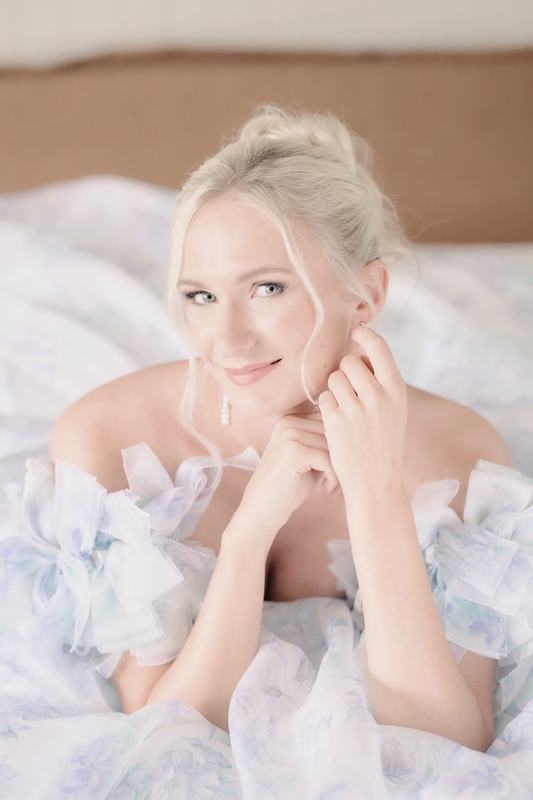
During the Hampton Manor shoot, the weather deteriorated and we moved indoors. It was October, the available daylight was already becoming weaker, and I was still able to shoot handheld at around 1/100 sec, f/2.2 and ISO 2000.
That was a useful reminder that the lens isn’t simply about shooting wide open.
Sometimes f/2, f/2.2 or f/2.8 gives you the balance you need between subject separation and depth of field.
The aperture should serve the photograph rather than become the photograph.
Taking the lens to Mallorca
A second opportunity to explore the lens came during a shoot at Sa Casa Bona in Mallorca, with the Tramuntana mountains providing a spectacular backdrop.
I wanted to make use of the beautiful early morning light, so we photographed Erika outside with a cup of coffee.
Once again, I wanted that strong separation between subject and surroundings.
I deliberately shot at f/1.4, even though the bright sunlight was encouraging me to stop the lens down.
This meant using a very fast shutter speed of around 1/500 sec at ISO 100.
The important thing for me was not simply getting the technically “correct” exposure. It was exploring what the combination of the lens, aperture, light and subject could create.
Wide apertures with moving subjects
It is relatively straightforward to photograph a stationary subject at f/1.4.
But what about people who are moving?
That’s where things become much more interesting.
I love photographing people naturally rather than relying exclusively on static poses, so I wanted to see how the lens performed when Erika was moving around the interiors of the venue.
Using continuous autofocus, I photographed her at f/1.4.
The results were among my favourites from the entire shoot.
The focused areas were beautifully sharp while the surroundings dissolved into a soft background. The images also had a timeless quality that worked particularly well in black and white.
They reminded me of the character and separation often associated with photographs made using much larger-format cameras.
Sometimes f/2.8 is the better choice
For the final image, I used the warm evening sunshine to backlight the olive trees.
This time, however, I didn’t want everything in the foreground to disappear into a hazy blur.
I wanted more detail and structure while still maintaining separation from the background.
So I stopped down to f/2.8.
This is something I think is worth remembering when working with fast lenses.
Buying an f/1.4 lens doesn’t mean that every photograph should be made at f/1.4.
The wider aperture is another creative option available to you.
Sometimes that option produces the perfect image. Sometimes stopping down gives you exactly what the photograph needs.
The importance of practising with your equipment
One of the biggest lessons I took from using this lens was the importance of getting to know your equipment.
I’m not what you would call a camera geek. I don’t spend my time studying every new camera and lens that appears on the market. I’m much more interested in looking at other photographers’ work and finding ways to develop my own.
But I am always interested in equipment that can help me take my photography somewhere new.
When you find a piece of kit that genuinely changes the way you think about making photographs, that’s when it becomes valuable.
The answer isn’t simply to buy the latest equipment and expect it to improve your work.
Use it.
Experiment with it.
Push it beyond the obvious.
And, most importantly, learn what it can do.
Creating better wedding portraits with shallow depth of field
For wedding photographers, an 85mm f/1.4 can be an extremely useful creative tool.
It can help you:
- Separate a couple from a distracting background.
- Create beautifully soft foreground and background blur.
- Photograph portraits in lower light while maintaining useful shutter speeds.
- Isolate a subject within an interesting environment.
- Create a more cinematic or three-dimensional appearance.
- Produce intimate portraits without having to work extremely close to your subject.
- Experiment with movement while retaining a strong point of focus.
But the lens itself doesn’t create the photograph.
The decisions you make about distance, composition, light, background and subject placement are what make the difference.
The lens simply gives you another set of possibilities.
My advice for photographers considering an 85mm f/1.4
Don’t buy a fast portrait lens simply because someone tells you that it will transform your photography.
Instead, think about what you’re trying to achieve.
If you love environmental portraits with strong subject separation, enjoy working with available light or want to experiment with extremely shallow depth of field, an 85mm f/1.4 could open up some interesting possibilities.
But give yourself time to learn it.
Start with static subjects. Experiment at different distances. Try f/1.4, then f/2 and f/2.8. Photograph moving subjects. Try backlighting. Look at what happens when you introduce foreground elements.
Eventually, the settings become instinctive and you stop thinking about the equipment.
That’s the moment when a new piece of kit becomes an extension of your own ideas.
And that’s when the real fun begins.
Say hello to your little friend.