
Craftsman Mindset for Photographers: How to Keep Improving
By Adrian & Bergit Barnett
The word “mindset” can sometimes make photographers nervous.
We’ve certainly been sceptical ourselves.
During the Covid lockdown, we attended an online “money mindset” seminar. We’re still not entirely sure what it was supposed to achieve. Simply changing the way you think about money doesn’t magically create more profit.
But the more we’ve studied how people learn, develop skills and build successful careers, the more interesting the idea of mindset has become.
For photographers, one concept particularly resonates with us:
the craftsman mindset.
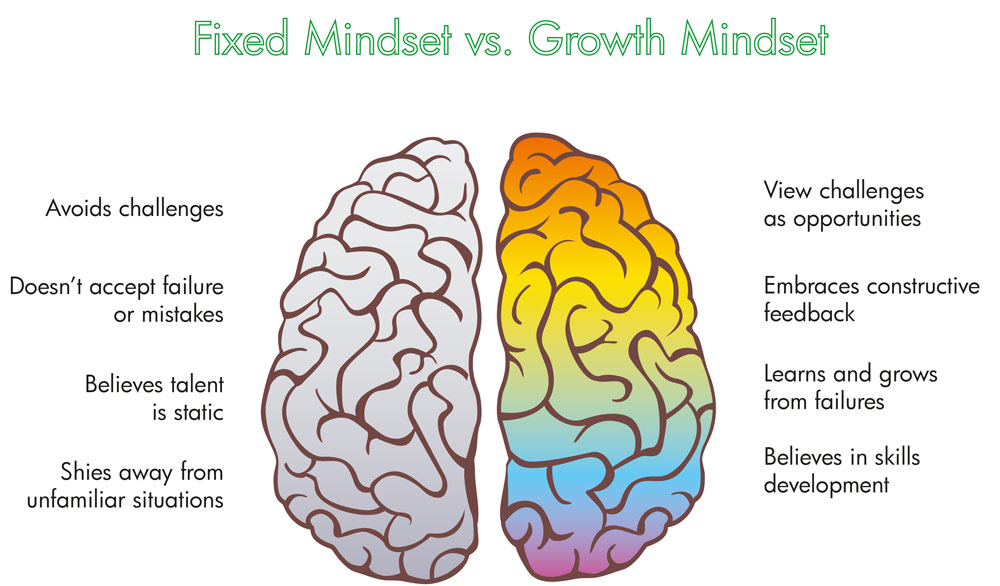
It is the idea that expertise isn’t simply something you’re born with. It is developed through practice, learning, experimentation and constructive feedback.
And perhaps most importantly, it is something you never really finish.
What does success actually mean?
Before discussing how to become better photographers, we need to consider what “success” actually means.
Is success simply having more customers?
Is it earning more money?
Is it getting more followers, awards or qualifications?
Perhaps it is all of those things.
But it doesn’t have to be.
We are often asked whether we want more business.
Honestly, not necessarily.
We need enough income for a comfortable life, but we also want time to enjoy other things: learning music, playing instruments, painting, cooking, writing and enjoying the landscape around our home in Cornwall.
Photography is also something we enjoy privately, simply for the sake of creating.
For us, satisfaction comes from continuing to improve.
And interestingly, that improvement also benefits our clients.
When you become better at your craft, people notice.
What is a craftsman mindset?
A craftsman mindset focuses on deliberate practice and mastery.
Rather than asking:
“What can photography do for me?”
the craftsman asks:
“How can I become better at what I do?”
That might mean improving your lighting, composition, posing, editing, colour management or business skills.
It could mean learning something completely outside your normal area of photography.
The important thing is that you are actively developing rather than simply repeating what you already know.
Success then becomes the result of consistent effort rather than relying entirely on talent, luck or circumstances.
In simple terms:
Learn it. Practise it. Get feedback. Improve it. Repeat.
The danger of becoming comfortable
Early in our careers, most photographers actively seek opportunities to learn.
We attend workshops.
We read books and magazines.
We experiment with new techniques.
We ask questions.
Then something happens.
We become reasonably competent.
Our clients are happy.
The photographs are good.
The money is reasonable.
And we stop pushing ourselves.
It’s easy to fall into a comfortable routine.
The setups are familiar.
The editing is quick.
We know what works.
There is nothing particularly wrong with that — but staying there indefinitely can prevent us from developing further.
Complacency is the enemy of growth.
The comfort zone, the stretch zone and the panic zone
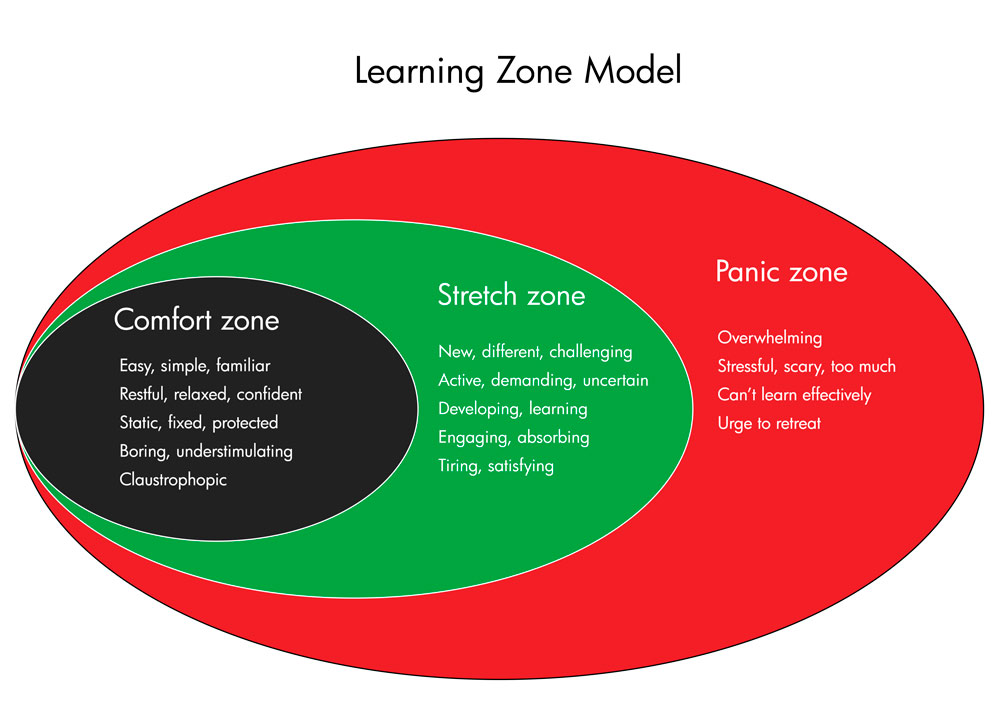
One useful way of thinking about learning is to imagine three zones.
The Comfort Zone
This is where you feel confident and in control.
You’re using skills you already understand and performing familiar tasks.
It’s safe and efficient.
But there isn’t much learning taking place.
The Stretch Zone
Just outside your comfort zone is where the interesting things happen.
Here, you’re taking on new challenges, experimenting with unfamiliar techniques and working at the edge of your current abilities.
You may feel slightly uncomfortable.
That’s often a good sign.
The Panic Zone
Push too far and you can enter the panic zone.
The challenge becomes so far beyond your current ability that you feel overwhelmed.
Stress rises and learning becomes much harder.
We’ve definitely experienced this ourselves.
When we were offered the opportunity to become the official photographers for a major European photographic convention, our first reaction was panic.
It was a much bigger responsibility than anything we’d undertaken before.
Instead of pretending we knew exactly what we were doing, we studied what had been produced previously.
We looked at what worked.
We identified what we would want to see ourselves.
Then we broke the job down into manageable pieces.
Suddenly, something that initially felt overwhelming became a challenge we could tackle.
We had moved from the Panic Zone into the Stretch Zone.
Don’t fake it — learn it
This is why we dislike the advice:
“Fake it till you make it.”
In photography, that can be dangerous.
Clients deserve to know that the person they’ve hired has the skills required to do the job.
Trying to appear competent when you aren’t can lead to disappointed clients and damage the reputation of our profession.
There is a better approach:
Don’t fake it. Learn it.
If you don’t know how to do something, learn.
If your lighting isn’t good enough, practise.
If your business skills are weak, study them.
If your photographs aren’t where you want them to be, seek constructive criticism.
Competence doesn’t come from pretending.
It comes from doing the work.
Deliberate practice makes a difference
The first part of developing a craftsman mindset is deliberately setting aside time to improve.
That could involve:
- attending workshops
- studying lighting
- learning new editing techniques
- reading photography books
- studying the work of other photographers
- practising unfamiliar techniques
- undertaking personal projects
- experimenting with new equipment
- analysing your own photographs
The important word is deliberately.
Simply taking photographs isn’t necessarily practice.
If you repeatedly do the same thing, you’re mostly reinforcing what you already know.
Real development comes from identifying something you want to improve and deliberately working on it.
Personal projects are a powerful learning tool
Personal projects are particularly useful because they remove some of the pressure of client work.
Nobody is waiting for the finished photographs.
There is no brief to satisfy.
You can experiment.
You can fail.
You can try something again.
When we began experimenting with photographing glass under different lighting conditions, we weren’t working for a client.
Our studio became a laboratory.
We tried different lighting arrangements, including single-light setups, and challenged ourselves to create images without relying on extensive retouching.
We learned a tremendous amount.
Later, when we were commissioned to photograph interior car components for luxury brands, that knowledge became extremely useful.
The experimentation had effectively prepared us for a commercial opportunity.
Sometimes the work you do for yourself prepares you for the work you haven’t been hired to do yet.
The importance of constructive feedback
Practice is only one half of the equation.
The other is feedback.
Without feedback, it’s difficult to know whether you’re genuinely improving.
Photography is particularly challenging in this respect because we can become emotionally attached to our own images.
We may see what we intended to create rather than what is actually there.
That’s why outside feedback can be so valuable.
You might:
- ask a trusted photographer for an honest opinion
- work with a mentor
- join a photography group
- enter competitions
- attend portfolio reviews
- ask clients for meaningful feedback
- compare your work with photographers you admire
The important word is constructive.
Feedback shouldn’t simply tell you whether someone likes an image.
It should help you understand why something is or isn’t working.
Photography competitions can help
Photography competitions can provide another useful form of feedback.
A judge’s comments may highlight something you hadn’t noticed.
Even if you disagree with the result, the process of analysing your image against someone else’s assessment can make you think more critically.
The objective shouldn’t simply be collecting awards.
It should be learning from the process.
The same applies to qualifications.
The real value isn’t the certificate hanging on the wall.
It’s the development required to achieve it.
Photographers are business owners too
There is another part of the craftsman mindset that photographers sometimes overlook.
Most professional photographers aren’t simply photographers.
They’re business owners.
That means we need skills beyond taking photographs.
We need to understand:
- branding
- marketing
- sales
- pricing
- customer service
- financial management
- social media
- websites
- business planning
This can be uncomfortable.
Many photographers are far more interested in cameras and lighting than spreadsheets and marketing.
But if photography is your business, those subjects matter.
Even if you eventually outsource some tasks, you remain responsible for the direction of your business.
You don’t necessarily need to become an expert in everything.
But you do need to understand enough to make good decisions.
Keep learning outside photography
Our learning doesn’t stop with photography.
Bergit, for example, makes time each morning to study.
Sometimes the subject is business.
Sometimes it’s colour theory, composition or lighting.
The important thing is to actively engage with what you’re learning.
Reading isn’t enough.
Take notes.
Ask questions.
Try something.
Then see whether it works.
That creates a feedback loop.
Learn → practise → evaluate → improve.
Over time, that process becomes part of how you work.
Small improvements add up
Continuous improvement doesn’t necessarily mean making dramatic changes.
Sometimes it’s about making small improvements consistently.
That is one of the principles behind the Japanese concept of Kaizen — continuous, incremental improvement.
You don’t have to reinvent your photography business every Monday morning.
Instead, ask yourself:
What could I improve this week?
Perhaps your website needs better images.
Perhaps your workflow is inefficient.
Perhaps your lighting needs work.
Perhaps your sales process is confusing.
Perhaps you’re relying too heavily on the same type of photograph.
Choose one thing.
Work on it.
Then move on to the next.
Over months and years, those small improvements can become significant.
Become a craftsman
The craftsman mindset isn’t about becoming obsessed with work.
It isn’t about chasing perfection.
And it certainly isn’t about working every hour simply to make more money.
For us, it’s about taking pride in what we do and continuing to learn.
It means refusing to assume that reaching a certain level of competence means the learning is finished.
There is always something else to understand.
Another technique to try.
Another weakness to address.
Another experiment to undertake.
Another photograph to make.
Don’t simply do what you do because it works.
Ask yourself whether you could do it better.
Don’t fake it. Learn it.
Don’t stop at competence. Keep developing your craft.
That is the craftsman mindset.