How Collaboration Can Help Grow Your Photography Business
By Stuart Wood FSWPP
Photography can be an increasingly solitary profession.
You might spend much of your working day behind a computer, communicating with clients by email, sending messages on social media and delivering galleries online. Even shoots themselves can sometimes involve working alone.
But there is another way to build a photography business.
Collaboration.
Working with other photographers, venues, designers, stylists, models, make-up artists, florists, planners and other creative businesses can open doors that would be difficult to access alone.
It can introduce you to new audiences, strengthen your network, produce better portfolio material and create opportunities for future work.
Recently, I experienced this first-hand when I was invited to photograph a luxury wedding showcase at Lumiere London.
Why collaboration matters for photographers
For many photographers, networking can feel uncomfortable.
We’re often told that we should be constantly promoting ourselves, attending events, contacting potential clients and building relationships.
But collaboration offers a more natural way of doing this.
Instead of simply asking another business:
“Can you send me some work?”
you can create something together that benefits everyone involved.
A photographer might provide the photography while another business provides a venue, styling, fashion, flowers, jewellery or professional services.
Everyone contributes something.
Everyone receives something.
And everyone gets the opportunity to introduce their work to a new audience.
Collaboration can increase your visibility
Small creative businesses often have relatively small audiences.
A wedding photographer might have several thousand followers. A wedding planner might have another audience. A bridal designer has another. A florist has another.
When those businesses collaborate on a project, the combined exposure can be significantly greater than any one business could achieve alone.
That doesn’t mean every collaboration will immediately generate bookings.
The real value is often longer term.
You are building relationships with people who may recommend you in the future.
You’re creating work that can be shared by multiple businesses.
You’re becoming known within a particular part of the industry.
And you are demonstrating that you can work professionally as part of a wider creative team.
A real-world example: a luxury wedding showcase
One collaboration I was involved with came through Lumiere London, a collection of luxury, design-led event venues in central London.
The project involved photographing a major luxury wedding showcase as well as creating bridal fashion images within the venue’s studios.
It brought together a team of creative professionals, including designers, a model, hair and make-up artists, a florist and jewellery specialists.
The result wasn’t simply a photography shoot.
It was a collaborative production.
Everyone brought their own expertise to the project.
Creating the photographs
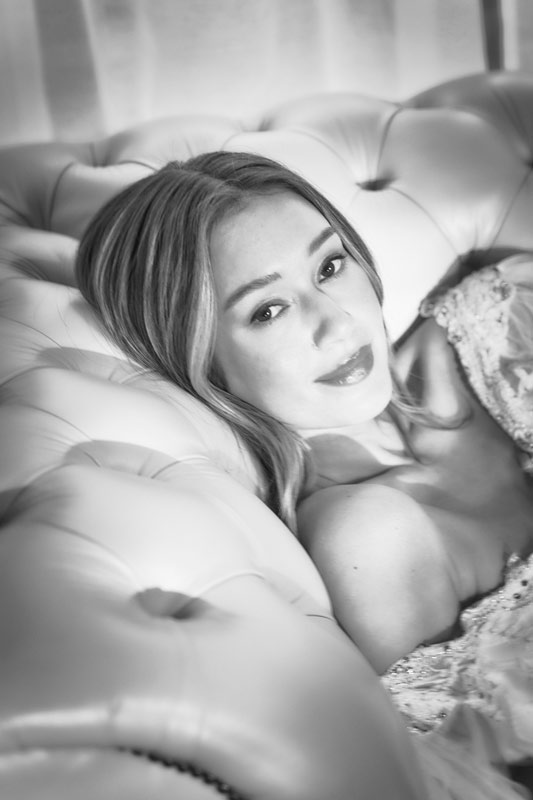
The day before the main showcase, I had the opportunity to photograph our model, May, wearing four different gowns created by couturiers Cynthia Grafton-Holt and Siân Hughes Cooke of Shimmering Ivory.
Hair and make-up were created by Graziella Vella, while accessories, shoes and jewellery were supplied by HP Diamonds of Knightsbridge.
Elizabeth Marsh Floral Design provided the flowers.
The venue itself provided another important part of the creative process.
Rather than having to construct elaborate sets from scratch, we were able to work with the architecture, windows, furniture, plants and available light within the space.
This is one of the benefits of collaboration.
You don’t have to create everything yourself.
You can bring together a group of specialists and allow each person to contribute their own expertise.
Making the most of available light
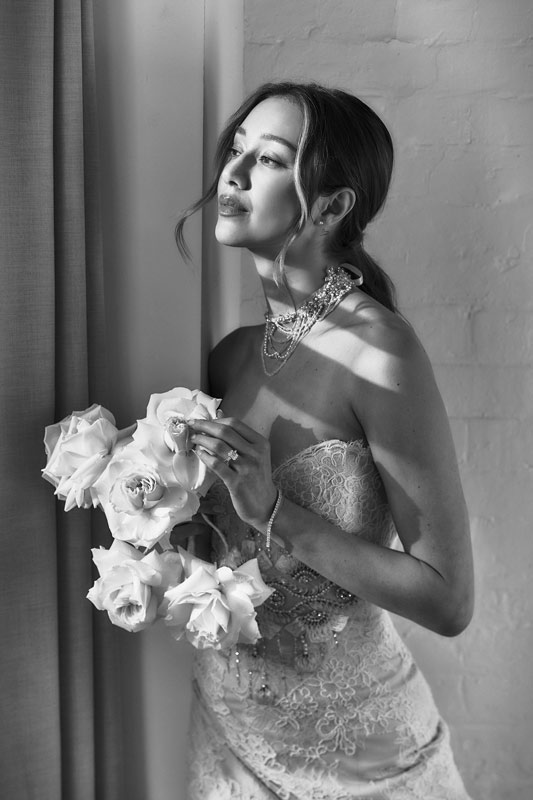
The shoot took place in early March, but we were fortunate to have beautiful sunshine and clear blue skies.
Rather than immediately reaching for complicated lighting equipment, I decided to work primarily with the available daylight, using large white poly boards as reflectors.
One of the first things I noticed was a strong highlight created by sunlight reflecting from a brightly painted building across the street.
That light was flooding through the windows and created a beautiful natural source.
I positioned May so that the reflected sunlight became the main light and used a Sigma 85mm Art lens at f/2.2 to separate her from the background.
A conveniently positioned flower arch helped frame the image and added another layer to the composition.
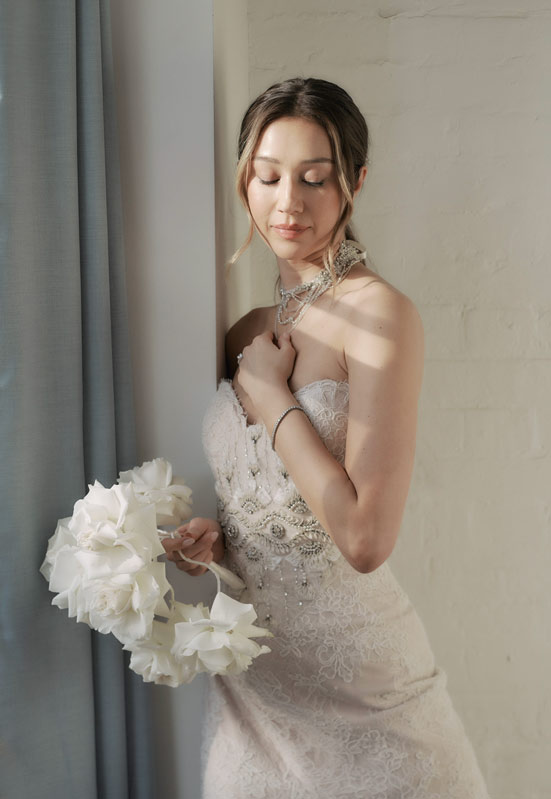
The interesting thing was that we didn’t need to completely change the set to create another look.
By moving May to the opposite side of the studio, we found another area where the directional sunlight created an entirely different image.
Two different looks from essentially the same location.
Small changes can create completely different images
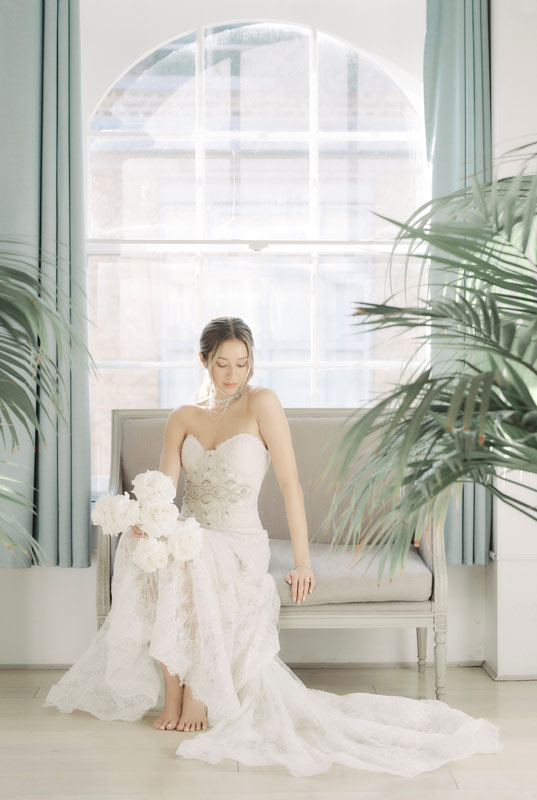
For another look, May changed into a Shimmering Ivory gown and we positioned her facing an impressive arched window.
A white rose bouquet from Elizabeth Marsh Floral Design added another element to the image.
This time, I used the window as a backlight and positioned white poly boards either side of the lens to reflect light back towards May.
The result was softer and more delicate.
By changing the aperture to f/4, May, the dress and the flowers remained sharp while the window and plants around the frame became softer.
The lesson isn’t necessarily about using a particular lens or aperture.
It’s about looking carefully at what is already available.
A good location can provide multiple photographic opportunities if you’re prepared to move around and experiment.
When the light changes, work quickly
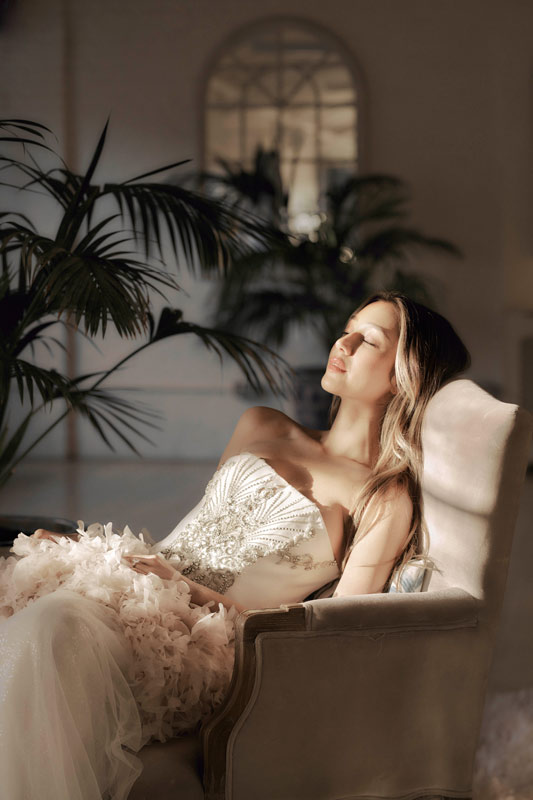
Later in the afternoon, the light changed again.
The sun was now much lower in the sky and was entering the studio at an oblique angle.
The warm light was reflecting from the wooden floor and creating a beautiful, almost painterly quality.
This was the sort of moment that couldn’t be recreated later.
The sun was disappearing behind the surrounding buildings, so everyone had to work quickly.
With the help of the team, we rearranged the studio and positioned May in the last of the available sunlight.
The result was one of the images I had been looking for.
Moments later, the sun disappeared.
Collaboration is more than creating photographs
That final moment made me think about what collaboration really means.
A successful collaborative project isn’t simply a group of businesses standing in the same room.
It’s people contributing their individual skills towards a shared result.
The designer creates the clothing.
The make-up artist creates the look.
The florist adds another visual element.
The venue provides the environment.
The model brings the concept to life.
And the photographer brings all of those elements together through the camera.
Everyone’s contribution affects the final photograph.
How photographers can find collaboration opportunities
You don’t necessarily have to wait for someone to approach you.
Look around your own industry.
Who could benefit from your photography?
If you’re a wedding photographer, consider building relationships with:
- wedding venues
- planners
- bridal designers
- florists
- hair and make-up artists
- jewellery businesses
- wedding stationery designers
- entertainers
- wedding dress boutiques
If you’re a commercial photographer, consider:
- designers
- marketing agencies
- PR companies
- product manufacturers
- stylists
- architects
- interior designers
- local businesses
The important thing is to look for mutual benefit.
Don’t approach another business simply because you want them to promote you.
Think about what you can create together.
Collaboration doesn’t always mean working for free
This is an important distinction.
Creative collaborations can be useful, but photographers should be careful not to allow “exposure” to become an excuse for constantly providing professional work for free.
Before agreeing to a collaboration, understand:
- what everyone is contributing
- what everyone expects to receive
- how the images can be used
- who owns the copyright
- whether the work will be published
- how everyone will be credited
- whether expenses will be covered
- whether the project could lead to paid work
A genuine collaborative project can be mutually beneficial.
But if one business is receiving all the commercial benefit while everyone else is simply supplying free services, that’s a different proposition.
Build relationships, not just contacts
The best collaborations can lead to relationships that continue long after the photographs have been delivered.
The wedding designer you worked with might recommend you to a future client.
The venue might invite you to photograph another event.
The florist might tag you in their social media posts.
The planner might include you on their preferred supplier list.
None of this is guaranteed.
But by working professionally and creating something worthwhile together, you increase the likelihood of being remembered.
And being remembered is incredibly valuable in a competitive industry.
Collaboration can also make you a better photographer
There is another benefit that is easy to overlook.
Working with other creative professionals can challenge your own ideas.
A stylist may introduce you to a colour combination you wouldn’t have considered.
A designer may suggest a different composition.
A model may interpret your direction differently from what you expected.
A venue can force you to find creative solutions to difficult lighting.
These experiences expand your visual vocabulary.
You aren’t simply producing photographs.
You’re learning.
The real value of collaboration
The photography industry can sometimes feel as though everyone is competing with everyone else.
But there are enormous opportunities for photographers who are willing to work with other people.
Collaboration can help you:
- expand your professional network
- reach new audiences
- create stronger portfolio work
- learn from other creatives
- build relationships with potential referral partners
- increase your visibility
- develop new creative ideas
- discover commercial opportunities
It won’t replace good photography, professional service or effective marketing.
But it can become an important part of a sustainable photography business.
In a world increasingly dominated by emails, messages, notifications and social media, there is still something powerful about getting a group of creative people into the same room and making something together.
Sometimes, the best opportunities begin with simply asking:
“What could we create together?”
About Stuart Wood

Stuart Wood is an award-winning luxury wedding photographer with more than 25 years of experience.
Known for his relaxed, fun and editorial approach, Stuart combines this with high-end lighting techniques to create a distinctive style for clients across the UK and internationally.
His editorial portfolio includes campaigns for television networks and magazines, while his clients have included organisations such as the BBC, ITV, Sky, GRAZIA, Cosmopolitan and Radio Times.
In 2024, Stuart was named Best Wedding Photographer for Europe and Asia at the RSVP Global Awards in Istanbul.