How to Get Your Photography Website Ready for AI Search with Jeff Brown, the Photographers’ Mentor
Search is changing – and it’s changing fast.
For more than 20 years photographers have relied on traditional search engine optimisation (SEO) to help potential clients find their websites. But today we are entering a new era of search powered by artificial intelligence.
If you’ve noticed changes in how Google displays results, particularly the AI summaries at the top of the page, you’re already seeing this shift in action.
For photographers who rely on their websites to generate enquiries, understanding these changes is becoming increasingly important.
The Biggest Shift in Search in Decades
When someone searches on Google today, they often see an AI overview at the top of the results page. Instead of simply displaying a list of links, Google now summarises an answer and then recommends websites that support that answer.
In many cases:
- 20–30% of all searches now generate AI summaries
- 60–70% of question-based searches trigger an AI response
This means the way your website is discovered is changing.
Search engines are no longer simply scanning pages for keywords such as “wedding photographer Manchester.” Instead, AI is looking for websites that genuinely answer people’s questions.
Many searches are now phrased conversationally, especially with voice search. For example:
- “What are the best wedding photographers in Manchester?”
- “When should I book my wedding photographer?”
- “How much does a portrait photography session cost?”
AI then looks for websites that provide helpful, clear answers.
From SEO to AEO
Traditional SEO focused heavily on technical factors like:
- Keyword density
- Backlinks
- Website speed
- Mobile optimisation
- Schema markup
These things still matter, but the emphasis is shifting toward something called Answer Engine Optimisation (AEO).
Instead of writing for search engines, photographers should focus on writing for their potential clients.
AI systems such as ChatGPT, Gemini, Copilot and Google’s AI search tools are trained on natural human language, not keyword stuffing. They understand conversational content and context.
This means your website should focus on:
- Answering client questions
- Explaining your services clearly
- Demonstrating expertise and experience
- Providing helpful information
In short, be useful.
Understanding Google’s E-E-A-T Framework
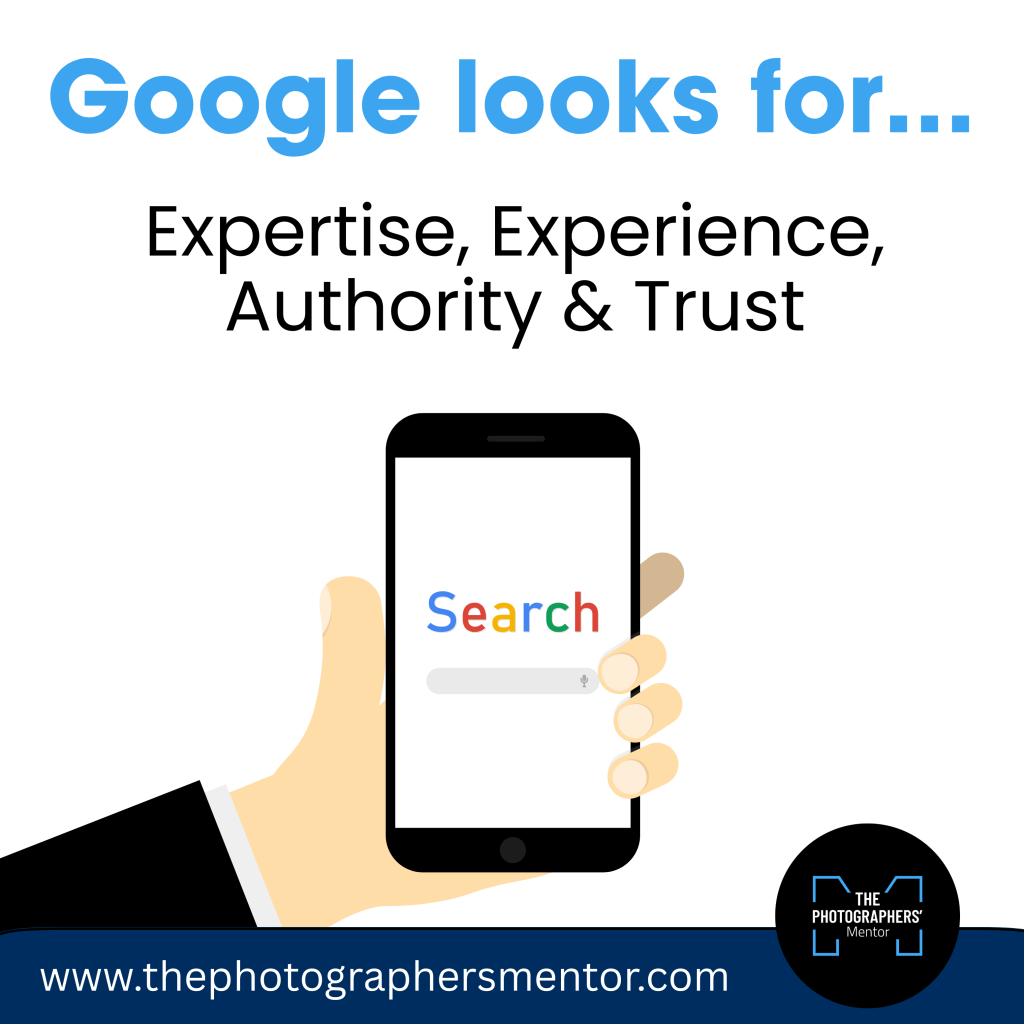
Google evaluates websites using a concept known as E-E-A-T, which stands for:
- Experience
- Expertise
- Authority
- Trust
If your website demonstrates these four elements, it is more likely to be surfaced in AI search results.
Expertise
Your website should show that you are knowledgeable and experienced.
This might include:
- How long you’ve been a photographer
- The number of sessions or weddings you’ve photographed
- Qualifications or professional memberships
- Specialist areas of photography
Authority
Authority is about reputation.
You can demonstrate this by including:
- Publications or media features
- Notable clients or venues
- Awards or qualifications
- Industry recognition
Trust
Trust is incredibly important for potential clients who have just discovered you online.
You can build trust through:
- Google reviews
- Testimonials
- Client feedback
- Clear guarantees
- Transparent information about your services
Rather than hiding testimonials on a separate page, consider placing them throughout your homepage so visitors encounter social proof while browsing.
Experience
This is about demonstrating your real-world experience with clients.
You might include:
- Case studies
- Client stories
- Behind-the-scenes explanations
- Videos or testimonials
- Details about your customer experience
These elements help potential clients feel confident about working with you.
Why FAQs Are Now One of the Most Important Pages on Your Website
If there’s one practical improvement photographers can make to their website today, it’s adding a strong FAQ page.
AI search systems love FAQs because they clearly match questions with answers.
Start by thinking about the questions clients frequently ask you:
- How long does a photography session take?
- When will I receive my photographs?
- Do you offer albums or wall art?
- Is there parking at the studio?
- Can we bring our dog to the session?
Each question should have a clear, conversational answer of around 100–150 words.
You can also group questions into sections such as:
- Booking and pricing
- Studio facilities
- The photography experience
- Product delivery
- Albums and wall art
Many website platforms automatically apply FAQ schema, which helps search engines understand that a page contains questions and answers.
Using Blogs to Attract New Clients
Blogging remains one of the most powerful ways to attract potential clients through search.
Blog posts allow you to provide deeper answers to questions your clients are researching, such as:
- When should you book your wedding photographer?
- How to choose a portrait photographer
- What to expect during a newborn photography session
- How to prepare for a family photoshoot
These types of articles are often the content that AI tools pull into search results.
Blogs also allow you to:
- Link related articles together
- Share useful advice
- Capture readers early in their decision-making journey
A blog can also feed your social media and email newsletters, giving you multiple pieces of content from a single article.
Don’t Forget Your Core Website Pages
While blogs and FAQs are important, AI also scans your core website pages.
Make sure you include detailed information on pages such as:
Services Pages
Explain exactly what your services include:
- Session length
- Number of images
- Delivery times
- Pricing structures
- Guarantees
Product Pages
If you sell albums, wall art or framed prints, dedicate pages to each product and explain:
- Sizes available
- Finishes and materials
- Pricing
- Custom options
Contact Page
Your contact page shouldn’t be just a form.
Consider including:
- Testimonials
- A short explanation of your process
- Links to Google Maps
- Your guarantee or service promise
These elements reinforce trust when someone is ready to enquire.
Write Like You Speak
One of the biggest changes in AI search is the importance of natural language.
Instead of writing awkward, keyword-heavy sentences like:
“Manchester wedding photographer affordable Manchester wedding photography services.”
Write in the same way you would speak to a client.
For example:
“If you’re planning a wedding in Manchester and wondering when to book your photographer, most couples secure their date 12–18 months in advance.”
AI systems understand this kind of language far better because it mirrors real human conversations.
The Bottom Line
The future of search is less about technical tricks and more about helpfulness.
Ask yourself:
- Does my website answer my clients’ questions?
- Does it demonstrate expertise and experience?
- Does it build trust with testimonials and reviews?
- Does it clearly explain my services?
If the answer is yes, your website is already moving in the right direction for AI search.
Want to Learn More?
This article is based on a full webinar that explores the topic in greater depth, including practical examples photographers can implement on their own websites.
Members of The Society of Photographers can watch the full webinar:
“Get Your Photography Website Ready for AI Search.”
If you’re not yet a member, joining gives you access to hundreds of business and marketing webinars, mentoring opportunities, competitions, and a range of professional resources designed to help photographers grow their business.
👉 Become a member today and unlock the full webinar archive.