Photography in Zambia: A Photographer’s Journey Through Africa
By Stuart Wood
There are some places you visit and some places that seem to reach out and grab you the moment you arrive.
For me, Zambia was one of those places.
Thanks to my Irish ancestry, my distinctly Celtic skin requires Factor 50 on most exposed body parts whenever I’m holidaying anywhere remotely exotic. I was therefore probably one of the least likely people to arrive in Africa expecting to feel completely at home.
And yet, almost immediately after arriving in Zambia, I experienced a feeling I still struggle to describe.
It felt like coming home.
First impressions of Zambia
We all build pictures in our heads of places we have never visited. My own image of Africa had been shaped by documentaries, films and television, particularly the spectacular landscapes and wildlife I had seen through the work of David Attenborough.
But there is a huge difference between seeing somewhere through a screen and actually standing there.
I had travelled extensively for work and had become somewhat accustomed to airports, long journeys and the inevitable stresses of international travel. I wasn’t expecting Zambia to affect me quite so profoundly.
Then I arrived at the magnificent Royal Livingstone Hotel.
Through the hotel reception I caught sight of the sunset over the Zambezi River.
It was, quite simply, one of the most beautiful sunsets I had ever seen.
Unfortunately, I had packed my camera equipment away for travelling.
All I had to hand was my trusty iPhone.
Of course, I took the photograph anyway.
It was a useful reminder that while photographers can spend enormous amounts of time thinking about cameras, lenses and equipment, the most important thing is still being there when something extraordinary happens.
Victoria Falls and the Zambezi
I had been invited to Zambia by my good friends Mwai and Lonah and their company, IWESPA, which promotes Zambia as a luxury wedding destination.
Within minutes of arriving, I was already completely converted.
Over the following days we experienced an extraordinary combination of hospitality, landscapes, wildlife and natural wonders.
One of the highlights was Victoria Falls.
I had never imagined that I would see the falls in person, let alone experience them from close enough to be thoroughly soaked by the spray.
Known locally as Mosi-oa-Tunya, meaning “the Smoke That Thunders”, the falls create an enormous cloud of spray as the Zambezi plunges into the gorge below.
Photographically, it is almost impossible not to be inspired by such a spectacle.
There are times when photography stops being about making the perfect image and becomes about simply experiencing what is in front of you.
We live in a world where we are surrounded by thousands of photographs every day. Images are constantly competing for our attention.
Then occasionally you encounter something so powerful that the camera almost becomes secondary.
Victoria Falls was one of those moments.
Photographing wildlife in Zambia
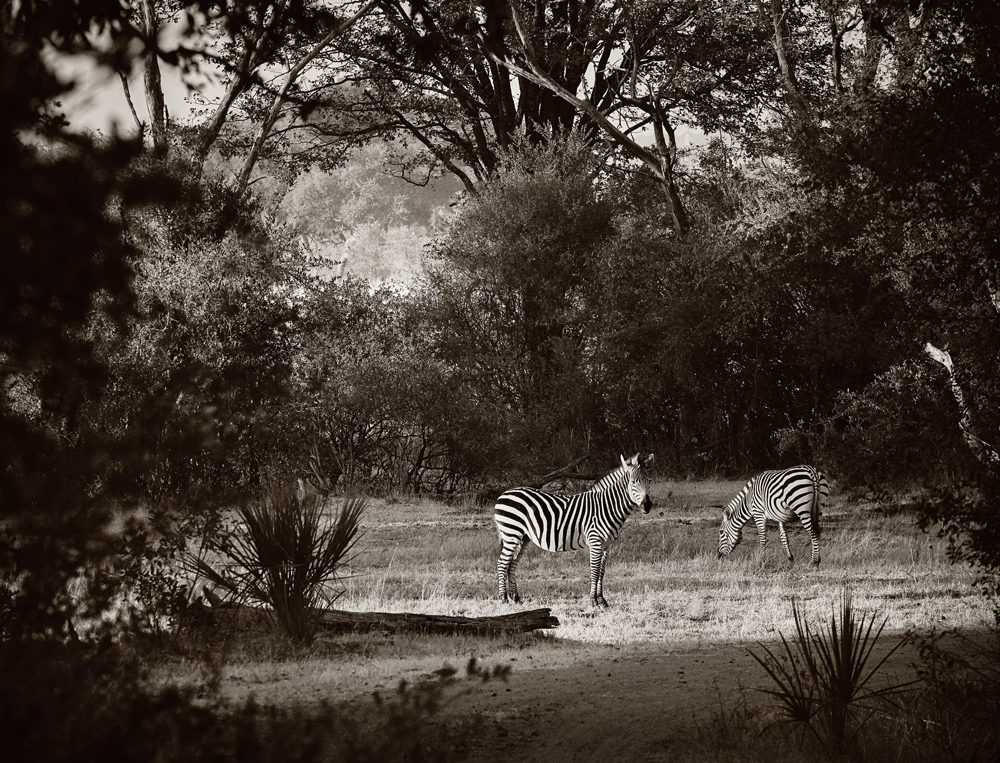
The wildlife was another matter entirely.
I never expected to see white rhinoceroses in the wild just a few feet away, or elephants feeding along the banks of the Zambezi while hippopotamuses wallowed in the river.
Even the hotel grounds became an unexpected wildlife experience.
We had been told that wild animals could sometimes be found wandering around the grounds. I imagined that, if I was lucky, I might spot a distant zebra or perhaps an impala.
Instead, on the first morning, I opened my hotel-room door and found a giraffe standing nearby, calmly breakfasting on the local vegetation.
It didn’t take long before zebras, giraffes, impalas and monkeys became a normal part of the landscape.
Although I never became quite as relaxed about the “Beware of Crocodiles” sign near one of the ponds.
For a photographer, this kind of environment presents a wonderful challenge.
Wildlife doesn’t wait for you to find the perfect composition. Light changes. Animals move. Expressions last for fractions of a second.
You have to be ready.
The camera kit I took to Zambia
I deliberately travelled relatively light.
My main camera was a Fujifilm X-T3, accompanied by three lenses:
- Fujifilm XF 16-55mm f/2.8 for wider views and environmental images.
- Fujifilm XF 50-140mm f/2.8 as my main telephoto lens.
- Fujifilm XF 56mm f/1.2, which became one of my most-used lenses.
The 56mm f/1.2 might seem an unusual choice for a trip dominated by wildlife and spectacular landscapes, but I have always loved what that lens can produce when used wide open.
It became my weapon of choice for many of my portraits, but I also found myself using it extensively for landscapes.
That is one of the advantages of travelling somewhere photographically unfamiliar.
You stop relying on the same formulas.
You start looking at familiar equipment differently.
Working with available light
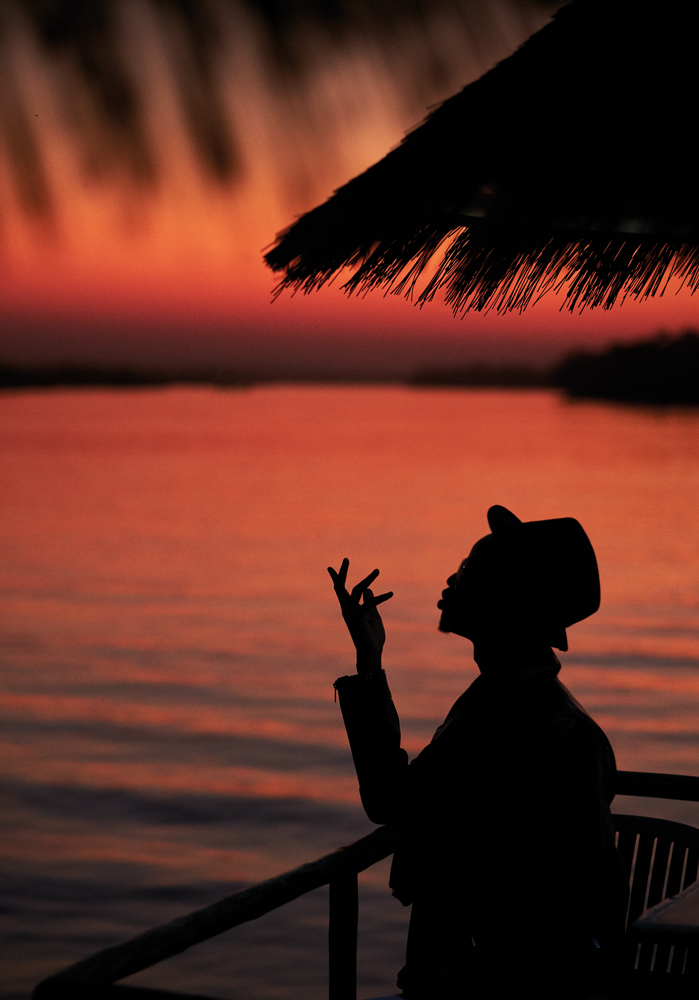
I also made a conscious decision to work entirely with available light.
On paper, that might sound like a disadvantage.
In Zambia, it certainly didn’t feel that way.
The quality of natural light was extraordinary.
Africa has a reputation for dramatic light, but experiencing it first-hand is very different from seeing it in photographs. The changing conditions around sunrise and sunset, the contrast between brilliant sunlight and deep shadow, and the colours appearing across the landscape can transform an ordinary scene into something remarkable.
For photographers, this is a useful lesson.
You don’t always need to add more light.
Sometimes the best approach is to understand the light that already exists and position yourself accordingly.
That is particularly important when photographing people. Instead of immediately reaching for flash or additional lighting, look at where the natural light is falling, how it is shaping the face and what background it creates.
Photographing people as well as places
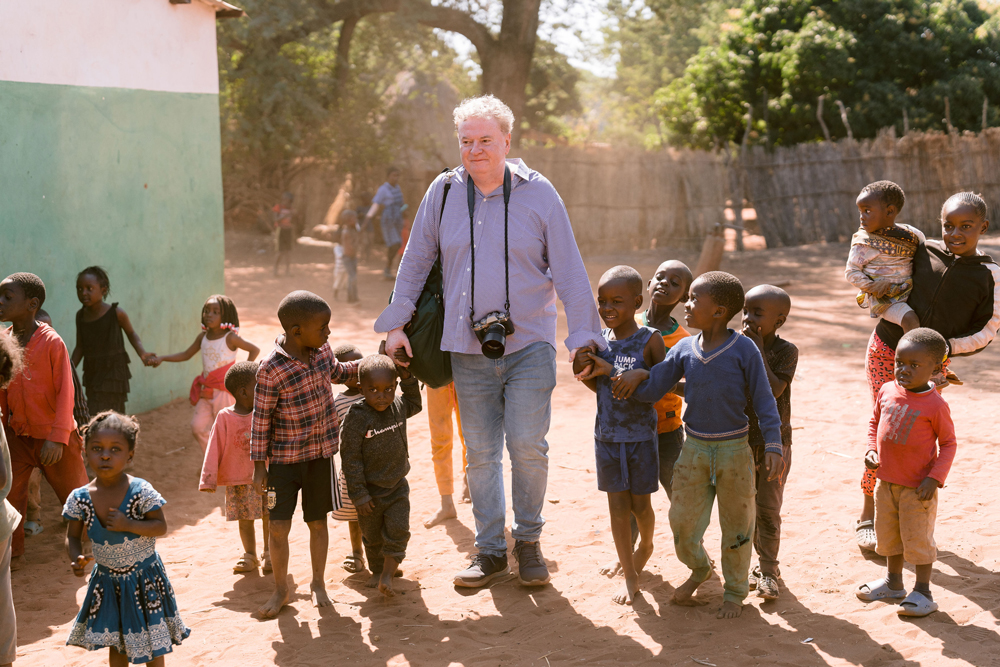
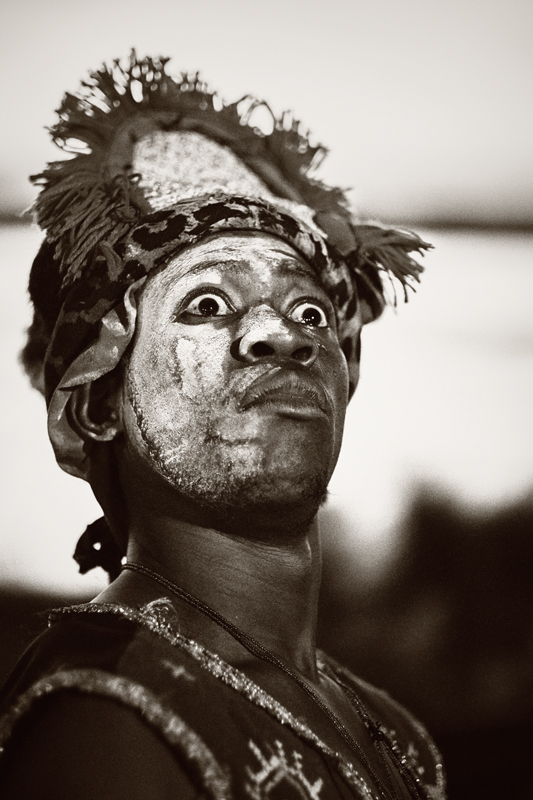
One of the most memorable parts of the trip was photographing people.
The landscapes and wildlife were extraordinary, but the warmth and openness of the people I met made just as strong an impression on me.
Karen, a Zambian television presenter I met during the trip, later commented on one of my photographs on Instagram.
She described the images as intense and said that I had a distinctive way of telling stories through pictures.
That meant a great deal to me.
It was my first visit to Zambia and my first real attempt to photograph something of the country’s character. To have someone who knew and loved the country recognise something of that in my images was an enormous compliment.
It also reinforced something I have always believed about photography.
Technical ability matters, but photography ultimately has to say something.
Finding your own way of photographing a place
When visiting somewhere as visually spectacular as Zambia, it would be easy to concentrate entirely on the obvious photographs.
The waterfalls.
The elephants.
The giraffes.
The sunsets.
The landscapes.
But a place is more than its famous sights.
The challenge for a photographer is to move beyond simply recording what is there and start looking for what makes that particular place feel different.
That might be the way light falls across a landscape.
It might be a portrait.
It might be an unexpected interaction between people and wildlife.
It might be something as simple as the expression on someone’s face.
The best travel photographs often aren’t necessarily the photographs that prove where you have been. They are the photographs that communicate how being there felt.
You have to experience it
Before I left Zambia, my friend Mwai told me something that stayed with me.
You need to experience Africa before you can begin to understand it.
After one visit, I would never pretend to understand a continent as vast and diverse as Africa.
But I do understand what she meant.
You cannot photograph a place properly by simply arriving with a camera and photographing the obvious subjects.
You have to spend time there.
You have to look.
You have to listen.
You have to meet people.
You have to experience the light, the landscape, the culture and the rhythm of everyday life.
Only then can you begin to photograph something beyond the postcard.
Photographing somewhere that changes you
I arrived in Zambia expecting an interesting trip.
I left feeling that I had experienced something much more significant.
I saw Victoria Falls.
I photographed elephants, giraffes, zebras and rhinos.
I photographed people whose warmth and generosity made a lasting impression.
I worked with a small camera kit and natural light.
But perhaps most importantly, I discovered somewhere that made me stop and look at the world differently.
As photographers, we spend much of our lives looking for the next image.
Sometimes, though, the most valuable thing we can do is put the camera down for a moment and simply experience what is happening around us.
Then pick it up again.
Because when a place moves you, there is a much better chance that your photographs will move someone else.