
How to Create a Street Photography Project
One of the most useful things a photographer can do is give themselves a project.
Having a defined project gives you a reason to pick up the camera. It encourages you to look at familiar places differently, makes you more selective about what you photograph and, perhaps most importantly, gives you something to work towards.
Street photography is particularly well suited to this approach.
The streets provide an almost endless supply of people, places, gestures, signs, buildings, vehicles and small moments. Given enough time, they also become a record of how a place and its people change.
Tom Lee FRPS explored this idea in his self-published book The 100, bringing together 100 mainly unposed monochrome street photographs made during his travels through the UK, Ireland, Malta, China, Italy and Cuba.
The book provides an interesting example of what can happen when a photographer commits to a simple idea and keeps looking.
Give yourself a reason to go out with your camera
The hardest part of many photography projects is getting started.
It is easy to tell yourself that you will go out and photograph when the weather is better, when you have more time or when you find somewhere more interesting.
A project changes that.
Instead of simply asking yourself, “What should I photograph today?”, you have a reason to go out.
Your project might be based on:
- One location
- A particular type of person
- A particular subject
- A visual theme
- Architecture
- Signs and shopfronts
- Public transport
- Working life
- Changing neighbourhoods
- A particular photographic technique
- Black and white or another consistent visual treatment
It doesn’t have to be complicated.
In fact, a simple restriction can often make a project more interesting.
Street photography is full of small stories
A good street photograph doesn’t necessarily need an extraordinary event.
Sometimes the interesting part is an ordinary moment.
A person waiting for a bus.
Someone working in a shop.
Children playing.
A dog following its owner.
A couple having an animated conversation.
Someone sitting alone.
A small interaction between strangers.
These moments can become surprisingly powerful when collected together.
One photograph might say very little about a place. A hundred photographs can begin to say something much more substantial.
Look for the details
One of the pleasures of looking through a substantial collection of street photographs is discovering details that weren’t necessarily the photographer’s main subject.
A shop sign might reveal the location.
A poster might tell us something about the period.
A website address can date a photograph.
Clothing, vehicles and technology can provide clues about when and where the photograph was made.
Even apparently insignificant objects can become part of the story.
This is one reason street photography can become a form of social documentary.
The photographer may be interested in one thing when they press the shutter, but years later the image can reveal something completely different.
Photograph the world as it is
Street photography can preserve details that people living through a particular period barely notice.
Consider how quickly everyday technology changes.
A photograph containing people looking at newspapers tells us something.
A photograph containing almost everybody looking at a phone tells us something else.
Neither needs to be staged.
The photographer is simply observing what is happening.
That makes street photography particularly valuable over time.
What looks completely ordinary today may become fascinating in twenty or thirty years.
Don’t underestimate the boring details
Some of the best documentary details are things we normally walk past without noticing.
Street furniture.
Electrical wiring.
Shop signs.
Road markings.
Posters.
Telephone boxes.
Parking signs.
Temporary barriers.
Building work.
Packaging.
The way people queue.
The way people dress.
None of these necessarily makes an exciting photograph on its own.
But together they help describe a particular place and period.
When you’re working on a long-term project, train yourself to notice these things.
Try working in monochrome
A consistent visual treatment can help bring a photography project together.
For Tom Lee’s The 100, monochrome was an important part of the approach.
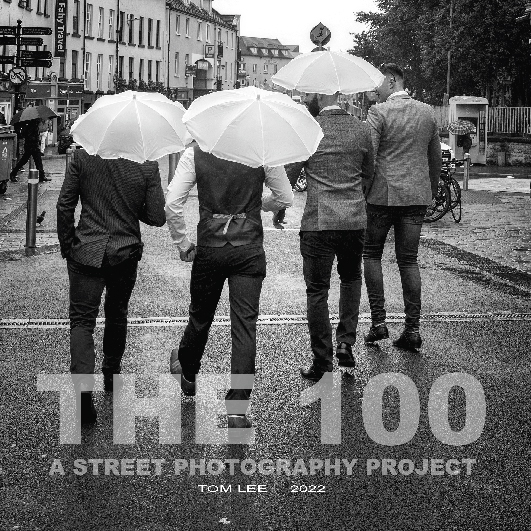
Removing colour can be particularly effective for street photography because it shifts our attention towards light, shadow, shape, gesture and expression.
It can also make photographs from different locations feel more connected.
A photograph made in Malta and one made in Manchester obviously come from very different environments. Give both the same monochrome treatment, however, and the relationship between the photographs may become stronger.
This doesn’t mean that street photography should be black and white.
Colour can be hugely important, particularly when it is part of the story.
The important thing is to make the decision deliberately.
Monochrome changes what you look for
When colour is removed, other elements become more important.
Look for:
- Strong light and shadow
- Silhouettes
- Repeated shapes
- Contrasting tones
- Leading lines
- Interesting gestures
- Texture
- Reflections
- Layers within the frame
- Strong expressions
A colourful street scene may rely on a bright red sign or yellow coat to attract attention.
In monochrome, that advantage disappears.
You have to find another way of making the photograph work.
This can be a useful discipline even if you normally shoot in colour.
Don’t photograph everything
One danger with a photography project is assuming that more photographs automatically make a better project.
They don’t.
A project needs editing.
If you’ve made 500 photographs, the final selection might contain only 50.
Or perhaps 20.
Or perhaps 100.
The important thing is that each photograph earns its place.
Ask yourself:
Does this photograph add something that the others don’t?
Does it help tell the story?
Does it fit the visual style of the project?
Would I miss it if it wasn’t there?
That last question can be surprisingly useful.
Look for connections between photographs
A strong project isn’t necessarily a collection of individually brilliant photographs.
The photographs can work together.
One image might establish a location.
Another might introduce a character.
A third might provide a detail.
A fourth might show an unexpected connection.
A photograph doesn’t always need to stand alone.
Think about how the images might sit next to each other on a page, on a website or in a book.
Does one photograph lead naturally into another?
Do you have too many images showing the same thing?
Are there gaps in the story?
This is where editing becomes part of the creative process.
A project can reveal things you weren’t looking for
One of the interesting things about long-term photography is that patterns begin to emerge.
You might start a project thinking you are photographing people.
After several months, you might realise that you’re actually photographing architecture and people within it.
Or you might think you’re interested in street portraits but discover that reflections, signs or gestures keep appearing in your work.
Don’t be afraid of this.
A project doesn’t have to remain exactly as you imagined it on day one.
Allow it to develop.
Think about what your photographs will become
It can also help to decide how you want to present the finished project.
A website is one possibility.
An exhibition is another.
You might produce a small zine or book.
You might make a set of prints.
The intended presentation can influence the way you photograph.
If you know that the final project will be a printed book, for example, you can think about how photographs will work as pairs and whether you need different orientations and compositions to create variety across the pages.
If you’re creating an exhibition, you might think more carefully about print sizes and how images relate to one another on the wall.
The project doesn’t necessarily end when you stop taking photographs.
The edit and presentation are part of the creative process too.
Printing a monochrome project
There is also an interesting technical consideration when producing a monochrome project for print.
A photograph that looks monochrome on screen can be printed in several different ways.
It can be produced using a dedicated black-only or black-dominant workflow, or it can be reproduced using a conventional CMYK process.
With process colour printing, the image isn’t necessarily made from black ink alone. Cyan, magenta and yellow can contribute to what appears to us as a neutral grey.
That can introduce subtle colour casts if the printing process isn’t carefully controlled.
A well-managed CMYK print can still produce excellent monochrome results, but there can be measurable differences in how a neutral grey behaves under different lighting conditions.
This is one reason consistency matters when producing a whole project as a physical book.
If monochrome is central to the concept, it is worth discussing the intended reproduction method with the printer before committing to the final production.
Don’t let the project become too complicated
A photography project doesn’t need a complicated concept statement.
In fact, the best projects can sometimes begin with something remarkably simple.
“Photograph people on the streets of my town.”
“Photograph my local high street for a year.”
“Photograph people using public transport.”
“Photograph the changing face of my neighbourhood.”
“Make 100 black and white street photographs.”
A simple rule can be enough to get you started.
The project then becomes interesting through what you discover along the way.
Let the project document its time
Perhaps the greatest strength of a long-term street photography project is that it can become a record.
When you make the photographs, you may simply be interested in the people and situations in front of you.
Years later, the photographs can tell a much bigger story.
The technology changes.
Businesses disappear.
Buildings are demolished.
Clothes change.
Advertising changes.
The way people communicate changes.
Even the way people spend their time changes.
A photograph can preserve all of those details without deliberately setting out to document them.
Don’t worry about making every photograph important
There is a temptation when starting a project to look for “the shot”.
The extraordinary moment.
The perfect composition.
The photograph that will define the entire project.
Those photographs are wonderful when they happen, but a long-term project is built through persistence.
Keep photographing.
Keep editing.
Keep looking.
The more photographs you make, the better you become at recognising the moments that matter.
And sometimes the photograph you almost ignored turns out to be one of the most interesting.
Make your own 100
A simple challenge is to create your own version of The 100.
Choose a subject and make 100 photographs.
You could give yourself a year, a month or simply keep going until you reach the number.
Don’t worry about whether every photograph is a masterpiece.
The challenge is to develop your eye and learn to edit.
At the end, lay all 100 photographs out together.
Look for patterns.
Look for repetition.
Look for photographs that clearly belong together.
Then start removing the weaker images.
You may be surprised by what remains.
A photography project gives you somewhere to go
The real value of a project isn’t necessarily the finished book, exhibition or collection of prints.
It’s what happens to your photography while you’re making it.
You have a reason to go out.
You start seeing familiar places differently.
You become more observant.
You learn to edit.
You begin to recognise patterns in your own work.
And, eventually, you have something that says more than any individual photograph could say on its own.
Street photography is particularly good at this because the subject is always changing.
The people change.
The streets change.
The technology changes.
The light changes.
And so does the photographer.
Start with a simple idea, give yourself a reason to keep photographing, and see where the project takes you.