Meta One: What Photographers Need to Know About Meta’s New Subscription Service
If Facebook and Instagram are part of your photography business, there is a significant change from Meta that is worth knowing about.
Meta has launched Meta One, a new subscription service bringing additional tools, AI features and business functionality to Facebook, Instagram, WhatsApp and Meta AI.
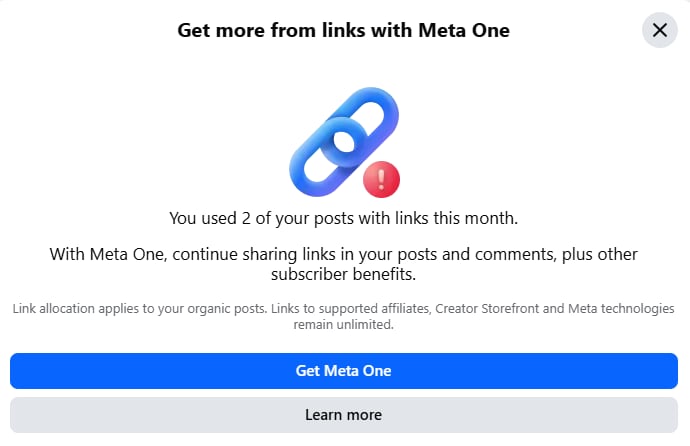
For photographers, the most noticeable change may be the growing restriction on sharing external links. Some Facebook Pages are now being limited to two posts containing external links per month, with reports that Meta is encouraging affected Pages towards paid subscriptions. Meta has been testing this restriction since 2025, and more Pages are now reporting the limit following the launch of Meta One.
But the link limit is only part of the story.
Meta is building a much broader subscription-based ecosystem around social media, publishing, analytics and AI — and some of the new features could be particularly relevant to photographers running a business.
What is Meta One?
Meta One is Meta’s new subscription service, with different plans aimed at individuals, AI users, creators and businesses.
The company says its core Facebook, Instagram, WhatsApp and Meta AI experiences will remain free, while subscriptions provide additional features and higher usage limits. Meta launched the service with more than 50 features across its platforms and says the plans will continue to expand.
For creators and businesses there are four main levels:
- Essential – from $14.99 per month
- Advanced – from $49.99 per month
- Expert – from $149 per month
- Max – from $499 per month
Meta stresses that pricing, features and availability can vary by region, app and account, so photographers should check what is actually being offered to their own account before subscribing.

The two-link limit
This is probably the part that will matter most to photographers.
Some Facebook Pages are being restricted to just two posts containing external links per month.
For a photographer, that could quickly become a problem.
You may regularly use Facebook to share:
- your latest blog article
- a new portfolio
- a wedding gallery
- a portrait booking page
- a workshop or course
- a competition
- a print sale
- an online shop
- a special offer
- a client information page
If your Page is affected, you may find that after two such posts, Facebook prevents you from publishing further link posts or prompts you towards a paid plan.
The situation is still developing and not every Page is currently affected. Meta’s official Meta One announcement lists “links in organic posts and reels” as an Advanced feature, while Facebook link restrictions have been reported separately as Meta expands its testing.
So if you haven’t seen the restriction on your Page, don’t assume you need to subscribe.
What else does Meta One offer?
The subscription isn’t simply a way of buying more links.
Meta is adding a range of tools designed to help creators and businesses manage their presence.
Scheduling and publishing
Meta One Advanced includes additional publishing features, including the ability to schedule Stories up to 30 days in advance.
For photographers who regularly plan their social-media content, this could make managing a Facebook and Instagram presence easier.
It is worth remembering, however, that Meta’s existing free publishing tools have not simply disappeared across the board. The exact features available to you depend on your account and region.
More detailed analytics
The Advanced plan also includes exportable analytics and deeper audience insights.
For a photography business, this could be useful for understanding what your audience actually responds to.
For example:
- Are people engaging more with wedding photography or portraits?
- Which Reels generate the most interest?
- Which posts result in people visiting your profile?
- When is your audience most active?
- Is your social-media activity actually helping generate enquiries?
Being able to export data could also make it easier to compare your social-media performance with other marketing activity.
More AI for photographers
AI is another major part of Meta One.
Meta is increasing access to its AI tools for creating and editing images and generating video, including tools based on its Muse models. Instagram’s Restyle feature is also included among the AI tools being expanded through Meta’s subscription plans.
For photographers, this could mean using Meta’s tools to create more social content, experiment with different versions of images or produce video content from existing material.
It also raises an interesting question for the photography industry.
As social platforms make AI-generated and AI-edited content easier to produce, photographers may increasingly need to make it clear what is their photography and what has been generated or substantially altered using AI.
That conversation is likely to become more important rather than less.
Meta is going beyond content creation
Perhaps the most interesting development isn’t actually Meta One itself.
On 29 September, Meta announced Muse for Small Business, an AI agent designed to work with the tools businesses already use.
Muse can connect to Facebook and Instagram business accounts as well as services including Canva, Dropbox, Figma, QuickBooks, Klaviyo, Notion, Shopify, Slack, Stripe and Zoom.
Meta says a business can give Muse a goal — such as improving its marketing or finding new customers — and Muse can work across connected services to help achieve it.
For a photographer, imagine being able to ask an AI assistant to:
Analyse my social-media performance and suggest what I should post next week.
Or:
Look at my recent marketing activity and suggest ways to generate more portrait enquiries.
Or:
Create a campaign for my Christmas mini sessions.
Or:
Analyse my sales and social activity and suggest where I should concentrate my marketing.
These are examples of the direction Meta is taking rather than claims that every photographer can currently perform all of these tasks through Meta One.
Meta says users remain in control and that nothing publishes, sends or spends without approval.
Does this mean you need Meta One?
No.
The fact that Meta has introduced a paid subscription does not mean that every photographer needs one.
If Facebook and Instagram are important parts of your business, it is worth looking at what your own account is offering and deciding whether the additional tools provide enough value to justify the cost.
For some photographers, the ability to publish links and access additional analytics could be useful.
For others, paying a monthly subscription simply to continue doing something they have previously been able to do for free may not make financial sense.
There is also an important point here that applies whether you subscribe or not.
Don’t build your entire business on social media
Changes like this are a useful reminder that your Facebook or Instagram following isn’t something you ultimately control.
Meta can change:
- what gets shown to your followers
- how much organic reach your posts receive
- which features are free
- which features require a subscription
- how links are handled
- how its algorithms prioritise content
Your website and your customer database are different.
Your website is somewhere you can control your portfolio, contact details, services, blog and booking information. An email list gives you a direct way to communicate with people who have chosen to hear from you.
Social media remains an incredibly useful marketing tool, but it is worth treating it as one part of your marketing rather than the whole business.
What should photographers do now?
You don’t need to make any drastic changes, but there are a few sensible things to consider.
Check your Facebook Page.
See whether you have been given the two-link restriction and what options Meta is presenting to you.
Review how much traffic social media actually generates.
Look at your website analytics rather than assuming that a large follower count automatically translates into customers.
Keep building your own audience.
Your website, email list and existing customer relationships are valuable because they aren’t dependent on a change to Meta’s algorithm.
Make your social posts useful without requiring a click.
Share the story behind an image, explain how you created it, show behind-the-scenes photographs or offer genuinely useful photography advice.
Don’t rush into a subscription.
Meta One has some interesting features, but whether they are worth the monthly cost will depend entirely on how you use Facebook and Instagram.
A changing social-media landscape
Meta One is more than a new subscription button.
It is part of a wider change in how Meta sees Facebook and Instagram — moving beyond social networks towards platforms where AI can help businesses create content, understand their audiences and eventually carry out more of their day-to-day work.
For photographers, that creates opportunities as well as questions.
AI may make it easier to create and market content, while changes such as the link restrictions could make it harder to use social media simply as a free route back to your own website.
For now, the sensible approach is to keep an eye on what is happening, understand how the changes affect your own account and make sure your photography business isn’t dependent on a single platform.
Meta One is rolling out gradually, and features, pricing and availability can vary between accounts and regions. We’ll keep you updated as Meta’s plans develop.