How to Photograph a UEFA Champions League Final: Behind the Scenes with Two Sports Photographers
Q&A with Ian Cook and Domenic Aquilina
Behind the scenes at the 2014 UEFA Champions League Final in Lisbon.
Covering a major football final is about much more than pointing a long lens at the action.
For professional sports photographers, preparation begins long before kick-off: securing accreditation, travelling with thousands of pounds’ worth of equipment, testing cameras, choosing a pitch position, understanding the players and establishing a workflow that can deliver images while the match is still being played.
For this feature, Ian Cook and Domenic Aquilina discuss how they approached the UEFA Champions League Final in Lisbon between Real Madrid and Atlético Madrid.
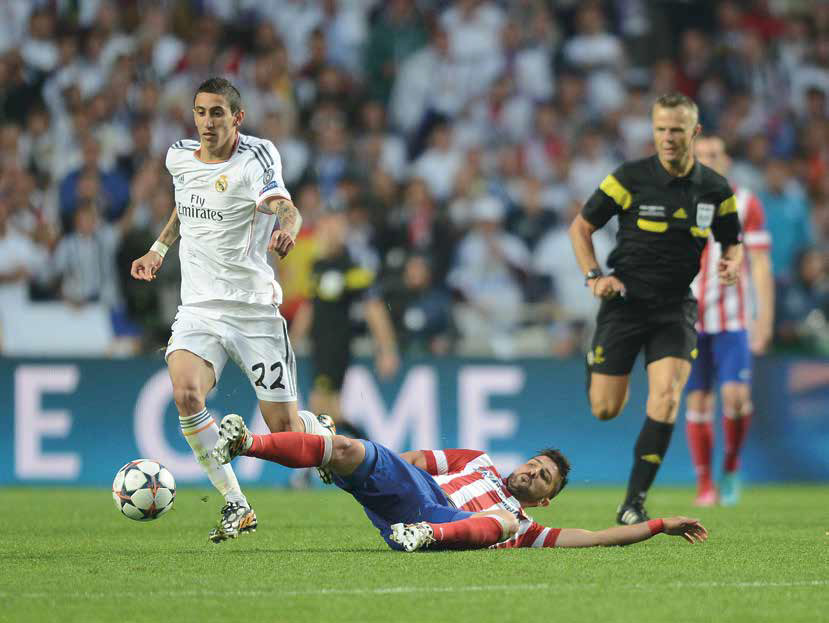
When did you get the call to cover the match and who were you working for?
Ian Cook
I knew I was down to cover the Champions League Final a year ago, although of course that depended on accreditation. CameraSport share the events out to make it fair to our staff.
I got the call about three weeks prior to the final.
Domenic Aquilina
I got my call on 9 May.
I was very busy doing another prestigious UEFA tournament during that time – the UEFA Men’s European Under-17 Championship, the first ever UEFA major tournament held in my country, Malta – so that was good news!
As always I was freelancing for UEFA in general.
This was my ninth final to date, thank God!
May was a good month to me – winning the “Sports Photographer of the Year” accolade in the Malta Journalism Awards at the beginning of the month, then being officially entrusted by UEFA themselves to be the UEFA Men’s European Under-17 Championship event photographer – which, by the way, England won – having loads of homepage photos and others on the uefa.com site and then off to Lisbon for my ninth.
Absolutely massive!
Travelling with Professional Photography Equipment
How did you fly to Lisbon and how did you get on carrying your kit on board and with security at the airport?
Ian Cook
I knew EasyJet had a carry-on policy with unlimited weight restrictions, and I use a Think Tank Airport International 2 which is designed for aircraft carry-on.
I chose EasyJet purely for the reason that my kit could be with me at all times.
The sports photographers who cover a lot of Champions League games try to use EasyJet; the thought of my kit going in the hold doesn’t bear thinking about.
I’ve heard some real horror stories about kit being damaged, bags being put onto a different flight and so on.
I want my kit with me at all times. Certain airlines have weight limits, so it would be no good for us, as the kit weighs so much.
Domenic Aquilina
A bit complicated, to be honest!
Malta to Milan Malpensa. From there to Lisbon and vice versa.
Carrying all the gear with you is always the biggest problem you face.
I divide all my equipment between baggage and cabin luggage, so no wonder my baggage weighed over 20 kilos!
Testing Unfamiliar Equipment
Nikon loaned you a new D4s for the match. How did you go about checking it over before committing to using it for such an important match?
Ian Cook
I tested it out on my son on a trampoline. I had him jumping about in different directions to test the focusing out; all was OK, so I knew the camera was good to go.
Finally, I tried it out at the pre-match training sessions of both Real Madrid and Atlético.
Also, Nikon were in attendance at the event, so if there was an issue with the camera I could have taken it in to get it fixed.
Overall, then, I felt secure using a new camera.
What Gear Did You Take to Lisbon?
Ian Cook
I had my Nikon D4, Nikon D4s (loan), Nikon D3, 400mm f/2.8, Nikon 70-200mm f/2.8 and Nikon 24-70mm f/2.8.
My colleague, Ashley, had my laptop with the Panasonic GX7, GH4, 8mm fisheye, 7-14mm f/4, 12-35mm f/2.8 and 35-100mm f/2.8, along with chargers, etc.
Domenic Aquilina
Canon 1DX, 5D Mark III bodies, Canon 300mm f/2.8 + Canon Extender x1.4 III, Canon 8-15mm f/4 L, Canon 15mm f/2.8, Canon 24-70mm f/2.8 L, Canon 70-200mm f/2.8 IS II L, Canon 16-35mm f/2.8 L and Canon Speedlite 580 EX II.
Focusing for Football Photography
Just remind the readers how you set up the focusing on the cameras.
Ian Cook
All my Nikons are set the same: AFC, and 9-point selection placed in the centre.
It’s a setting that I have used for many years, but I also use the back-focus button to focus rather than the shutter-release button.
Domenic Aquilina
The Canon 1DX is my big gun as regards action photos!
I shoot in AV mode – in this case with the coupling of the 300mm f/2.8 + Canon Extender x1.4 III, which gives me an ideal 420mm objective – and AI Servo focusing, 12fps high-speed burst and evaluative metering.
On the Custom Controls Menu, I change the function of the M-Fn button to “Switch to custom shooting mode”.
This way I can keep on shooting yet toggle back and forth from AI Servo to One Shot by the touch of the M-Fn button with my index finger.
I use the nine-point squares choice, toggling in all directions to my own needs as regards action tracking, which I have found the best choice.
Photographing Team Training Sessions
You covered the teams’ practice sessions at the Stadium of Light. Were there any restrictions on what you photographed and reported upon?
Ian Cook
None at all, really.
We had the freedom of roaming around the outside of the LED boards. We only had an hour for each team, but it was enough to get stock images of the players we needed, such as Gareth Bale, Ronaldo, Costa, etc.
Domenic Aquilina
Not really.
Training sessions are quite relaxed. It is basically just an introduction of what is to come the following day and getting into the spirit of it!
It just gives you the feel of what is set to happen the next day.
How did the practice sessions differ from the match itself? How many photographers were there and how many spectators?
Ian Cook
There were quite a lot of photographers at the training session, not as many as the final as some were flying in on the day of the game.
But all in all we all managed to get enough shots of what we needed.
Domenic Aquilina
A big difference between the practice sessions and the match itself!
The big showdown of the entire season is obviously the final itself.
I believe 129 photographers were accredited to the final and 60,976 spectators attended.
Arriving at the Stadium
The final kick-off was 8:00pm local time. What time did you get to the stadium and what did you do ahead of the match? How was security to gain entry?
Ian Cook
The day of the game was a long one.
We arrived about 12:00 noon to ensure we got a workstation and in good time for the briefing at 13:30 about the rules for the final, etc.
They went through the pre-match and post-match set-ups for photographers, etc.
Domenic Aquilina
Kick-off time was 19:45 local time in Portugal (20:45 CET).
It is always my policy to arrive very early, even when I am working UEFA Champions League group or qualifying matches.
In this case, due to time-frames set by UEFA for picking up your accreditation, I arrived at the Estádio da Luz around 13:00 hours.
Learning the Players
Real players are household names, but how did you go about memorising the names of the Atlético players?
Ian Cook
Really easy for me, as I’m sure with Domenic.
Firstly, the players have numbers on their shorts and the back of their shirts, and we had an official team sheet prior to kick-off with the team selection.
This was entered into a text file and loaded into Photo Mechanic.
Then all that was needed was to enter the code – for example \r11\ – and out would come “Real Madrid’s Gareth Bale”.
Photo Mechanic is the sports photographers’ secret weapon in captioning and selection.
Secondly, and most importantly, we are professional sports photographers and this is what we do. It’s second nature to us as we live and breathe football, so we actually know all the players by sight.
Domenic Aquilina
As I have often said before – you cannot shoot a sport without a general knowledge of the discipline or event you are shooting.
In this case Real have household names, but so do Atlético with the likes of Diego Costa and captain Gabi, to mention only a couple.
Atlético have been coming strong all season in the competition, so if you follow the UEFA Champions League you automatically get to know them well in the course of the competition.
Choosing a Pitch Position
What pitch position were you allocated and what restrictions were there on movement?
Ian Cook
The photographers were put in priority groups, 1, 2 and 3.
Group one was the big European agencies such as Getty, Action Images, Reuters, etc.
There was a projection of a pitch with white squares in certain areas around the pitch.
The photographers were called up one by one and once the photographer had chosen his spot, that white square then turned red.
So as this went on the red squares were filling up quickly.
By the time it was my turn – Priority Group 2, Photographer Number 9 – all the positions in front of the Real Madrid fans were filled.
I went on the side, second in from the corner flag.
I didn’t want to go behind the goal because the fifth linesman stands on the touchline and blocks the shot.
I could have been blocked by the sideline official, but I took my chance.
The goals were all the other end.
It’s just luck if anything comes your way!
Domenic Aquilina
You choose your allocation according to your priority selection.
In my case I chose a comfortable mid-section position between the corner flag and the centre of the pitch with a very good view of one of the goalposts, hoping I could get some goals.
It so happened that all five goals were scored at the other end!
Restrictions are that you cannot move from your assigned position.
How Many Frames Did You Shoot?
Ian Cook
I shot about 2,000 frames.
I wasn’t worried about wiring the images out because I had a photo technician, Ashley, to do that for me.
It meant I could concentrate on the game and ensure I got the highs and lows if they occurred in front of me.
Domenic Aquilina
I think I shot around 950 frames.
RAW or JPEG?
Ian Cook
JPEG.
I thought of shooting RAW but I decided against it.
My MacBook didn’t have enough space to hold all the images and it would have slowed the process down.
I also shot JPEG to keep the process going as smoothly as possible.
Domenic Aquilina
I always shoot in High RAW – never less!
The two photographers therefore took quite different approaches to the same assignment, illustrating that professional sports workflows are not necessarily identical.
Transmitting Images During the Match
Did you transmit any images during the game itself?
Ian Cook
Yes, during the game because I had a technician, Ashley.
He wired about 125 images out during the game.
That’s a lot, but because he had only got one job to focus on, it was amazing what he could achieve.
Domenic Aquilina
Yes, I did – the first Atlético goal and the immediate celebrations – and then waited until extra time to get the Real celebrations and the actual post-match Real Madrid trophy presentation and post-match party.
Following the Action
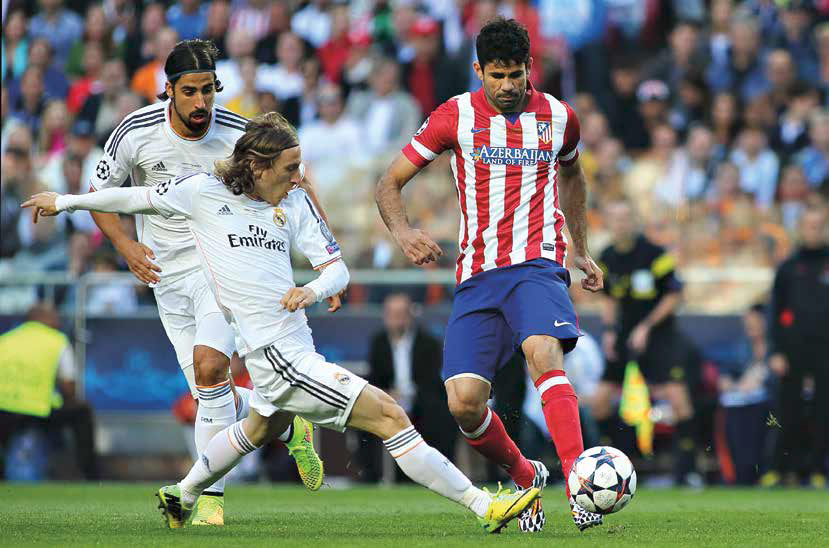
Did you track any particular player or did you follow the ball – or both?
Ian Cook
Both.
Because he is British, the UK press are interested in Gareth Bale, but also Ronaldo because of his Manchester United connections and the other ex-Premier League players.
But generally I try to get images showing action and stock shots of every player.
You don’t know if the player in front of you is the next Manchester City player, etc, so it’s important to get the stock as well as the key moments of the game.
If they happen in front of you, of course, it’s a real bonus.
Domenic Aquilina
I just follow the action.
Where the action is, so I follow.
They’re all world-class footballers, so they all know how to move the ball along!
And I do not stop there.
It is not just the action only. We need everything that is happening around the ground – both sides’ fans, coaches’ gestures, etc.
Photographing the Trophy Celebration
I could not see you on TV in the scrum at the end. Were you in there? Were you allowed free movement at the end?
Ian Cook
For the trophy lift I was on the platform in front of the stand, but when it came to the players on the pitch I was blocked – a problem of being short, I’m afraid.
Then, when the players moved to walk around, it was just a crazy scrum.
You fight your corner and give as good as you can.
Some spots I couldn’t get to just because of the number of photographers already there.
So I had to move to a more selective location, hoping they would come to me.
It worked a little, but I was a bit disappointed, if I’m honest.
Domenic Aquilina
This showdown keeps on amazing me year after year.
I saw a photographer who really surprised me, to be honest – he was wrestling and barging in the scrum to get what he needed.
I have never seen him in such a state!
You are only allowed free movement to a certain extent.
So in this case you have to use your wits.
You can still take good pictures without getting in the scrum.
How Did the D4s Perform?
Ian Cook
Great. Fantastic, actually.
The sharpness was spot on. The focusing system was really fast at locking on.
The only problem I had was I could not try it out on the 400mm f/2.8 due to the pin mechanism jamming on my D4.
Apart from that I was very impressed with its performance.
The ISO capability on this camera is crazy.
I seriously have to think now because when it goes back I will miss it, so might have to chat/pray to my bank manager to lend me some money to get one.
It is a brilliant bit of kit, but I will give a more in-depth review later on – I could go on for paragraphs about this camera!
Working Alongside Another Photographer
Did you see each other during the game or afterwards?
Ian Cook
We saw each other before, during and after.
We were at the pitch-position selection together and we were on the same side of the pitch about 20 positions away, which was not far.
And afterwards it was a case of we both had work to do, and so we did what we needed to.
I remember going to see Domenic and he was working on an image taken from a corner and it was perfectly timed with the goalkeeper punching the ball and the ball was at the end of his fist.
Amazing.
I was thinking, “I’d have liked that shot.”
Domenic Aquilina
Yes, we bumped into each other during the training session.
We could not really socialise as we might normally do at the Societies’ Convention – this was work!
Photographing Incidents Around the Pitch
There was quite a spat between Diego Simeone and the referee, Björn Kuipers, near the end. Were you close to the incident?
Ian Cook
Yes, it was right opposite me and I got shots of Simeone coming onto the pitch.
At first none of us knew what was going on.
With it being Simeone, we thought he’s just thrown his teddy out of his pram, but it turned out that Raphaël Varane had kicked the ball at the bench.
We caught the aftermath on camera.
Domenic Aquilina
I did not get the spat, but I tracked Diego Simeone quite closely.
The picture is self-explanatory for those who saw the game; Simeone was furious about the five minutes of added time.
Editor’s note in the original article.
How Long Did Post-Production Take?
Ian Cook
Not long for me.
As I have mentioned, I had Ashley and that was his job.
After the game, of course, I looked over his shoulder and gave instructions on cropping, etc, but apart from that, that’s all I did.
Ashley did a great job for CameraSport and got the images processed and sent within minutes during the game.
Domenic Aquilina
In such a final I only get to wire off around 15 pictures, not more.
The rest is post-processing at its best, at my own convenience, for possible selection by UEFA for eventual publications at a later stage.
Did Anything Get Published?
Ian Cook
I’m not aware of anything, but we won’t know fully until the payments come through, but you never know.
There were 140 photographers pitch-side.
That is the highest number I have ever seen at a football game.
It was crazy.
Domenic Aquilina
Unfortunately not on the night.
I hope for eventual selection for future UEFA publications.
From the Champions League Final to League Two
I note that almost within hours of getting back you were pitch-side at Wembley Stadium for the League Two playoff between Burton Albion and Fleetwood.
That is quite a comedown!
How did the two experiences differ?
Ian Cook
Very different!
It’s part of the job.
We would all love to cover Champions League Final games only, but the bread and butter are the games that are lower down.
I was extremely tired.
But it’s work and we do what we must to pay the bills.
The difference in football skill is miles apart, and it was a lacklustre game at times – more volleyball than football – but that’s the way it is and we get on with the job.
I’ll put the same effort into the Fleetwood game as I did at the Champions League Final, but it was harder to keep the concentration levels up with the game not being so good, and the fact I was tired from just getting back from Lisbon.
Memories of Lisbon
Of all the memories from Lisbon, which will you remember most?
Ian Cook
The game itself, the social side with all the British photographers – we all stuck together and had a good time.
But the experience of shooting such a final for CameraSport was the main privilege.
The whole experience will live with me for a long time.
Domenic Aquilina
All the finals carry a particular memory.
I had some really good captures during this final, so all in all it was another massive experience to bring along – and of course bumping into my big buddy Ian Cook!
Favourite Image
Which single image were you most pleased with?
Ian Cook
Being Welsh, and even although there is a flaw with the image due to the confetti or ticker tape putting a blur over Gareth Bale’s face, it’s my favourite because it’s a Welshman holding the most prestigious club cup in the land.
Not only that, he scored the goal that turned the game in Real’s favour.
But another favourite of mine is not an action shot or a trophy lift.
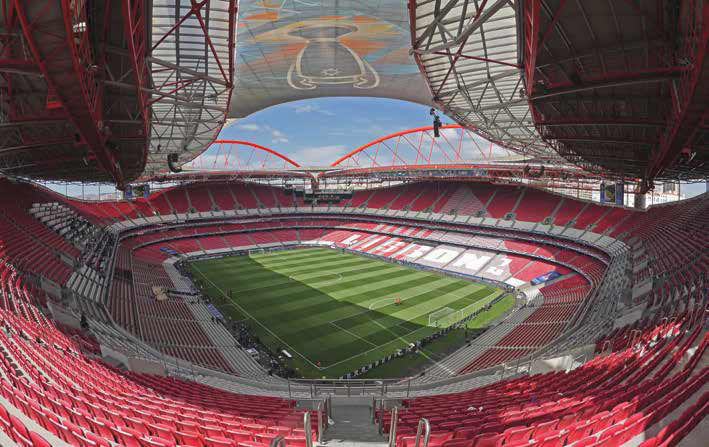
It’s a ground view of Benfica’s stadium.
I had a Panasonic Lumix GH4 with me and an 8mm fisheye, and went for a wander and took the image from right up in the corner of the stand.
It was a bit sunny on one side but even so I really like that image.
In fact, it’s now my desktop background.
Domenic Aquilina
Big question indeed!
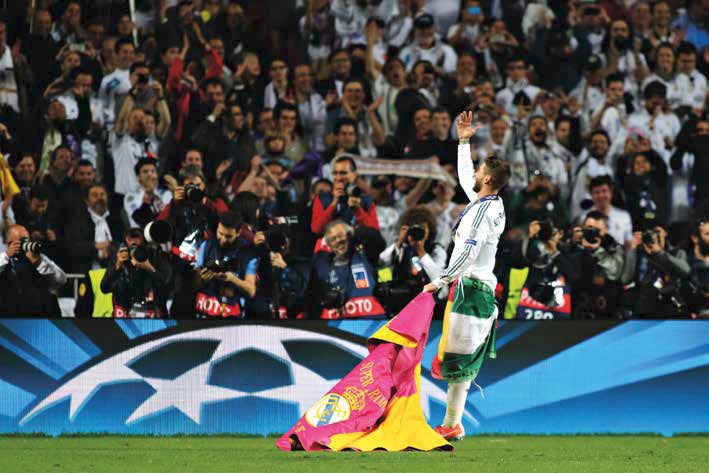
I loved the after-match photo of Real Madrid defender Sergio Ramos playing his part as “El Matador”.
Archive note
This interview was originally published following the 2014 UEFA Champions League Final in Lisbon.
The equipment, software, airline policies, accreditation arrangements, player references and workflow described are historical and should not be interpreted as current recommendations or procedures.
The value of the article lies principally in the first-hand experience of professional sports photographers working at a major international football final.