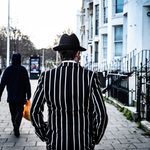
Night Photography: How to Capture Atmosphere After Dark
By Tom Lee
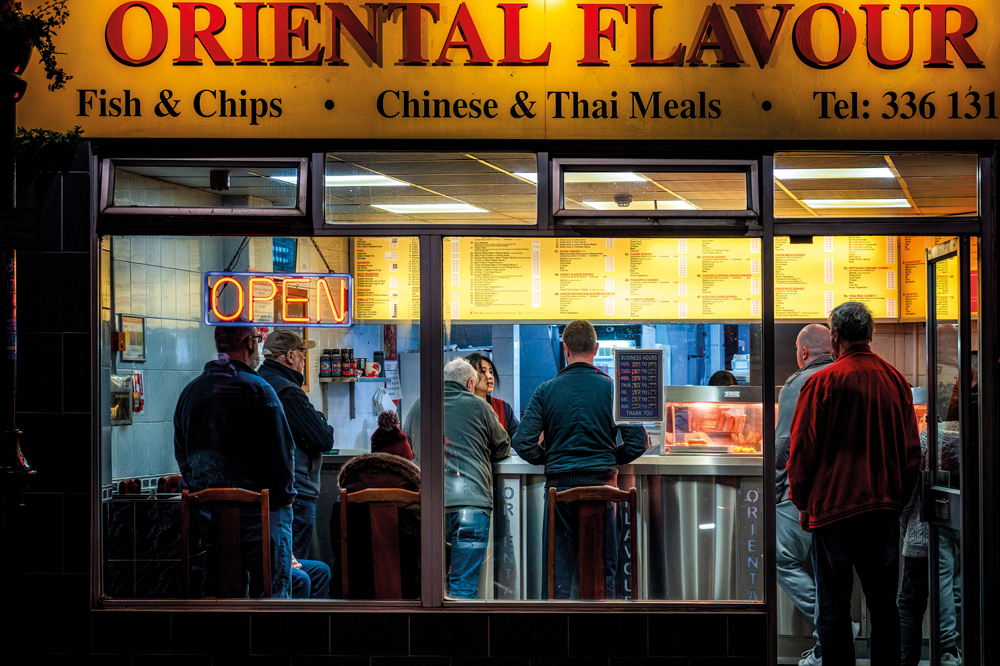
Night photography offers a completely different way of seeing familiar places. Photographer Tom Lee explains how embracing darkness, available light, high ISO and atmospheric conditions can transform ordinary scenes into compelling photographs.
Photography doesn’t stop when the sun goes down.
In fact, some photographers find that the darkness opens up an entirely different world of photographic possibilities.
Familiar streets and buildings can look completely different after sunset. Bright lights stand out against deep shadows, ordinary scenes take on a more graphic appearance, and empty spaces can become just as important as the subject itself.
For photographer Tom Lee, photographing after dark has become an important part of his work, alongside his street photography.
His approach is simple: embrace the darkness rather than trying to eliminate it.
Why photograph at night?
Night changes the visual character of almost everything around us.
During daylight, a scene may contain a huge range of detail. After dark, much of that information disappears into shadow, leaving isolated areas of light and strong shapes.
This can simplify a composition dramatically.
Streetlights, shop windows, car headlights, illuminated buildings and passing people can become the main elements of an image, while the surrounding darkness creates negative space.
The result can be almost graphic in appearance.
Winter can be particularly rewarding because darkness arrives relatively early, giving photographers plenty of opportunities to explore after sunset without having to stay awake until the early hours.
You don’t need perfect technical quality
One of Tom’s most distinctive approaches is his attitude towards image noise.
Rather than treating high ISO noise as something that must always be eliminated, he is happy to accept — and even embrace — it when it contributes to the character of the photograph.
Modern cameras perform remarkably well in low light, but photographers can still become overly concerned with achieving technically perfect files.
Sharpness, low noise and perfect exposure are useful tools, but they aren’t necessarily the things that make a photograph successful.
Sometimes a little grain can actually complement the mood.
The important question isn’t:
“Is this photograph technically perfect?”
It is:
“Does the photograph work?”
If a little noise helps create the atmosphere you’re looking for, it may be entirely appropriate.
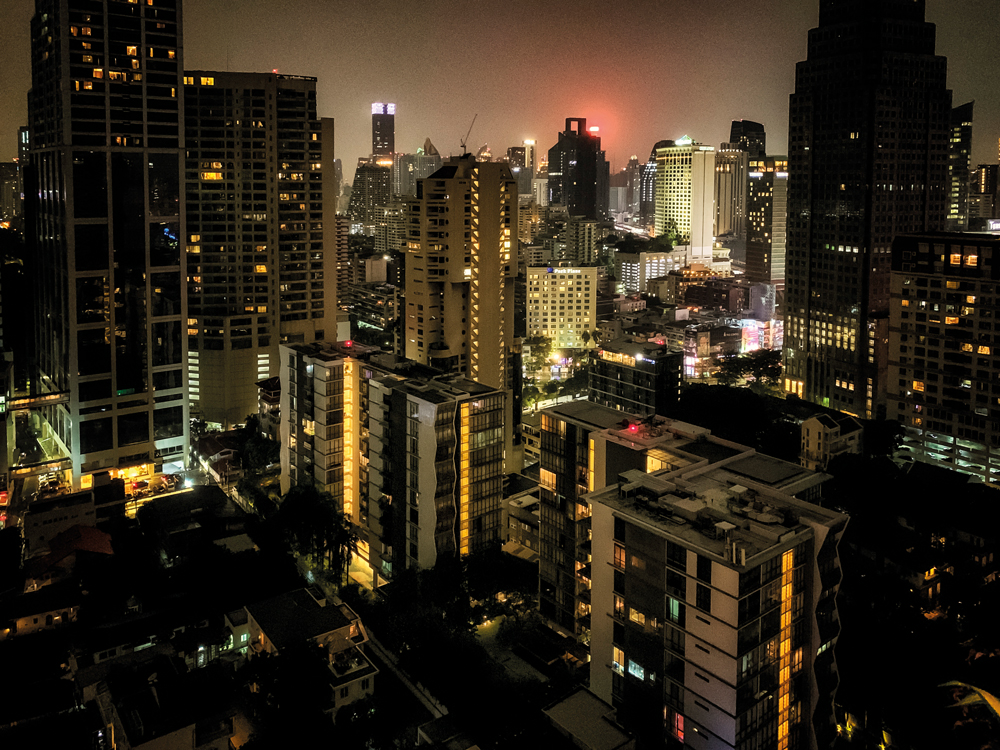
Shooting handheld at night
Many photographers automatically reach for a tripod when the light disappears.
A tripod can certainly be useful, particularly for long exposures and carefully composed landscapes, but it isn’t essential for every type of night photography.
Tom prefers to remain mobile and will often photograph handheld, using Auto ISO to allow the camera to adapt to changing light levels.
This has an important advantage for street and documentary photography: you can move quickly and respond to what is happening around you.
A tripod can make you more deliberate, but it can also make you less spontaneous.
For photographers interested in capturing people, movement or fleeting moments, staying mobile can be much more important.
Don’t be afraid of high ISO
High ISO settings have traditionally been associated with unwanted noise and loss of image quality.
Modern cameras have changed that equation considerably.
Rather than automatically choosing the lowest possible ISO, consider what the photograph actually requires.
If increasing the ISO allows you to use a shutter speed fast enough to photograph handheld, it may be the right decision.
And if the resulting image contains some visible grain, ask yourself whether that really damages the photograph.
For an atmospheric black-and-white street image, for example, grain may actually strengthen the visual character.
Technical limitations aren’t always problems.
Sometimes they become part of the aesthetic.
Make darkness part of the composition
One of the most effective ways to approach night photography is to stop thinking of darkness as empty space.
Instead, make it part of the composition.
Large areas of shadow can isolate your subject and direct the viewer’s attention towards the brightest part of the frame.
This is particularly effective when there is a strong contrast between light and dark.
Look for:
- A person passing beneath a streetlight
- An illuminated doorway surrounded by darkness
- Reflections in wet streets
- A brightly lit shop window
- Headlights approaching through the darkness
- Windows glowing in an otherwise dark building
- Silhouettes against artificial light
- Small areas of colour surrounded by shadow
The less information you show, the more important each element of the photograph becomes.

Photograph familiar places at night
You don’t need to travel somewhere exotic to create interesting night photographs.
In fact, your own town or city can be an excellent place to start.
Places that you’ve walked past hundreds of times during the day can look completely different after sunset.
A familiar high street might become a series of pools of light and shadow. A car park can become an abstract arrangement of reflections. A normally unremarkable building can take on a completely different character when illuminated at night.
Knowing the area is an advantage.
You already understand how it works, where people gather and where interesting subjects can be found.
The challenge is to look at it differently.
Learn to wait
Night street photography often involves waiting.
Rather than walking continuously and photographing everything that catches your eye, find an interesting background or source of light and wait for something to happen within it.
This can be particularly effective when there is a strong composition but no obvious subject.
A pool of light beneath a streetlamp, for example, might be visually interesting on its own. Wait for someone to walk through it and the photograph can suddenly become a story.
This is closely related to the idea of the decisive moment in street photography.
The photographer creates or recognises the composition, then waits for the right combination of subject, movement and light.
Available light can be enough
Tom has increasingly moved away from supplementary lighting and instead works with whatever light is already present.
Artificial lighting can certainly be useful, but relying on available light forces you to pay much closer attention to the environment.
Streetlights, illuminated signs, windows, headlights and architectural lighting all become potential light sources.
Instead of asking:
“How can I light this subject?”
try asking:
“What can the existing light do for me?”
You may discover that the available light creates a much more natural and atmospheric photograph.
Use colour selectively
Night photography is often associated with black and white, and monochrome can be particularly effective when the scene is dominated by strong shapes and contrast.
But colour can also work extremely well.
Modern cities are full of artificial colour: illuminated signs, traffic lights, shop windows, vehicle lights and coloured architectural lighting.
When complementary colours appear within the same scene, increasing their saturation can produce a striking, almost cinematic result.
Tom sometimes uses colour to create what he describes as a painterly, Edward Hopper-inspired atmosphere.
The key is not to add colour simply because it is available.
Look for relationships between colours and consider how they affect the mood of the photograph.
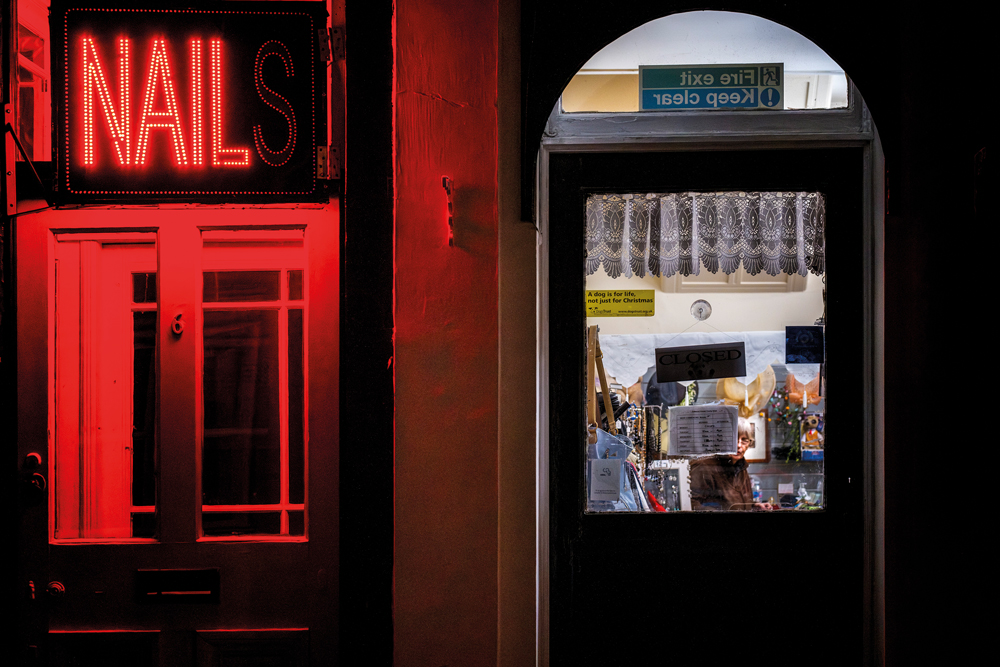
Think like a graphic designer
Night photography naturally simplifies the world.
Large areas of darkness, isolated highlights, silhouettes and strong geometric shapes can make photographs feel almost graphic.
This is an opportunity to think less about the subject itself and more about the arrangement of elements within the frame.
Consider:
Shape: What are the dominant shapes?
Contrast: Where is the brightest area?
Negative space: How much of the frame is deliberately left dark?
Lines: Do roads, buildings, railings or shadows lead the viewer through the image?
Colour: Are there complementary or contrasting colours?
Balance: Does the composition feel stable or deliberately unbalanced?
These considerations are useful in every genre of photography, but darkness makes them particularly obvious.
The influence of Pictorialism
Tom’s approach also has an interesting connection with an older debate in photography.
The Pictorialist movement of the late nineteenth and early twentieth centuries placed considerable emphasis on the artistic and emotional qualities of photography.
Rather than treating the photograph purely as a technically accurate record, Pictorialist photographers were interested in atmosphere, personal expression and the way an image made the viewer feel.
That philosophy remains relevant today.
Modern cameras make it easier than ever to produce technically excellent photographs, but technical perfection isn’t the same thing as artistic success.
A technically imperfect photograph can still be powerful.
A technically perfect photograph can still be completely forgettable.
For night photography in particular, atmosphere can be more important than absolute sharpness or noise-free shadows.
Try photographing in bad weather
Don’t assume that good weather means good photography.
Rain, mist, cloud and winter darkness can all contribute to atmospheric night photographs.
Wet streets are particularly useful because they reflect artificial light, effectively creating additional light sources within the frame.
Rain can also reduce the number of people on the streets, changing the character of familiar locations.
Rather than seeing poor weather as a reason to put the camera away, consider whether the conditions are actually providing something that you couldn’t create on a clear evening.
A different way of seeing
The biggest lesson from Tom’s approach to night photography is perhaps not about camera settings at all.
It’s about changing the way you look.
Don’t try to make darkness look like daylight.
Let the shadows remain dark.
Don’t automatically remove every trace of noise.
Don’t assume you need a tripod.
Don’t light everything.
Instead, look for the small areas of illumination, the unusual combinations of colour, the silhouettes and the spaces between things.
Night gives photographers permission to show less.
Sometimes the faintest light against a large area of darkness is enough to pull the viewer into the photograph and make them wonder what lies beyond the frame.
So the next time the sun goes down, don’t put the camera away.
Go into the dark.