
Hahnemühle Photo Paper Review: Four Papers Compared
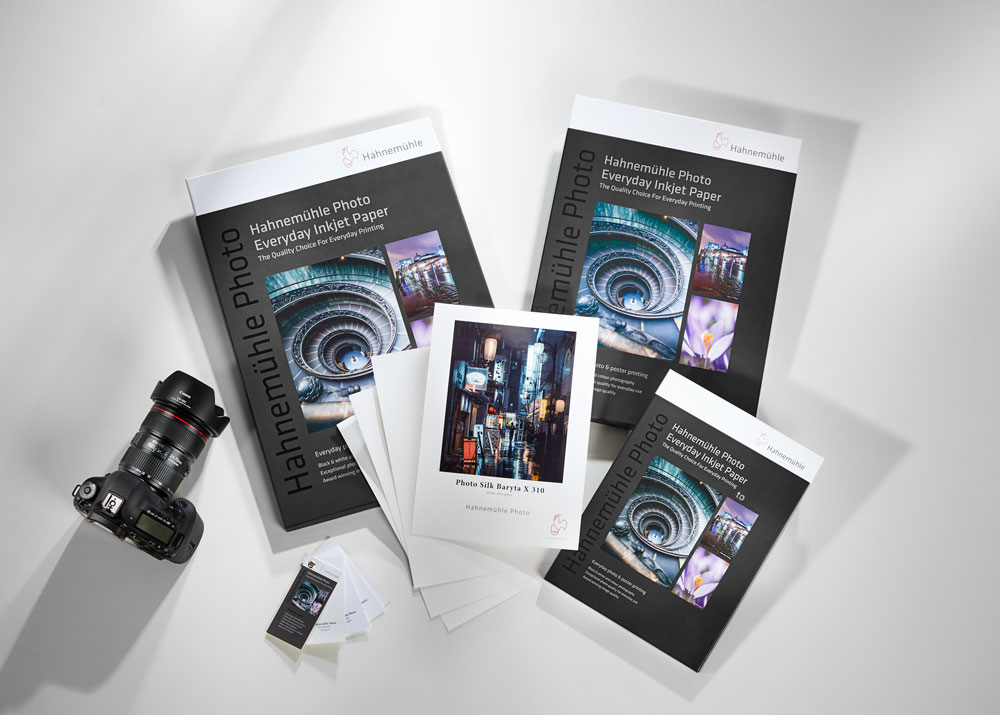
Choosing the right photo paper can have a surprisingly large effect on the appearance of a finished print. Surface finish, paper colour, texture, maximum black density and colour gamut all influence the way an image looks.
Hahnemühle has an extensive range of photographic and fine art papers, which is useful because photographers have very different requirements. A high-gloss baryta paper might be ideal for a dramatic black and white image, while a matt cotton paper may be better suited to a subtle fine art portrait.
To find out how four Hahnemühle papers compare, we put them through an extensive series of colour and monochrome printing tests.
The four papers tested were:
- Hahnemühle Bamboo Gloss Baryta 305
- Hahnemühle Photo Silk Baryta X 310
- Hahnemühle Sustainable Photo Satin 220
- Hahnemühle Photo Rag Matt Baryta 308
The tests included colour accuracy, gamut, Dmax, grey-scale reproduction, skin tones and monochrome performance.
The aim wasn’t to identify one paper that is universally “best”. Instead, the results help show which type of image is likely to benefit from each paper.
What makes one photo paper different from another?
Paper choice involves considerably more than simply comparing colour accuracy figures.
The surface finish, base colour and maximum black density can all change the visual character of a print.
For example, a bright, cool-white paper can produce strong blues and a very crisp appearance, but may not necessarily be the best choice for skin tones. Conversely, a warmer, OBA-free fine art paper may produce a softer and more traditional appearance that works particularly well for portraits, monochrome images and fine art printing.
This is why laboratory measurements are useful, but they should not be treated as the final answer.
A paper with an impressive specification sheet isn’t automatically the best paper for every photograph.
The four Hahnemühle papers tested
| Paper | Weight | Base | Surface |
|---|---|---|---|
| Bamboo Gloss Baryta | 305 gsm | 90% bamboo / 10% cotton | High gloss |
| Photo Silk Baryta X | 310 gsm | 100% α-cellulose | Silk gloss |
| Sustainable Photo Satin | 220 gsm | 100% α-cellulose | Satin |
| Photo Rag Matt Baryta | 308 gsm | 100% cotton | Matt |
There are also significant differences in the papers’ use of optical brightening agents (OBAs), texture and intended visual character.
Understanding Dmax
One of the specifications photographers often encounter when comparing inkjet papers is Dmax.
Dmax is a measurement of the maximum optical density that can be produced by a print. In practical terms, it gives an indication of how deep the darkest blacks can become.
Gloss and baryta papers generally achieve a higher Dmax than matt fine art papers.
That doesn’t mean a high-Dmax paper will automatically produce a better photograph.
The human visual system adapts to the overall tonal range of a print, and a well-made matt print can look excellent despite having a lower maximum black density.
This is particularly important when printing fine art or monochrome photography. The quality of the tonal transitions and the ability to distinguish subtle shadow detail can be more important than the headline Dmax figure.
Hahnemühle Bamboo Gloss Baryta
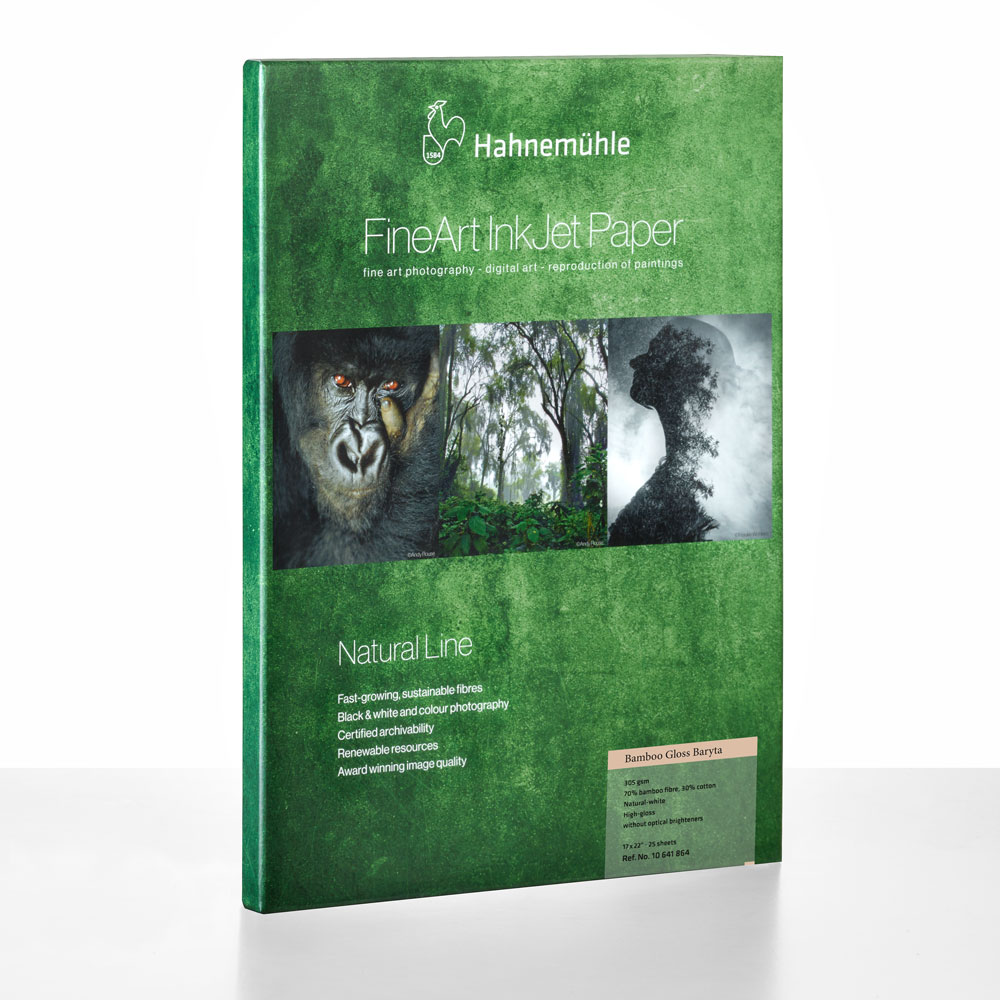
Bamboo Gloss Baryta is a 305 gsm paper made from 90% bamboo fibres and 10% cotton, with a high-gloss baryta inkjet coating.
The paper has a natural, warmish white base and contains no optical brighteners. Its surface and tonal character are intended to evoke the appearance of traditional baryta photographic papers.
In our colour testing it produced a gamut volume of more than one million and performed particularly well with skin tones.
The measured skin-tone error was 2.29 ΔE00, while the Dmax reached 2.53 during the colour testing.
That combination makes Bamboo Gloss Baryta particularly interesting for photographers who want strong blacks and the distinctive appearance of a traditional gloss baryta print.
Bamboo Gloss Baryta for black and white photography
The monochrome testing was particularly impressive.
Using the Epson Advanced Black and White driver, the paper produced a Dmax of 2.67, one of the highest values measured during our testing.
The resulting prints were rich and deep, with a subtle warm ivory character.
For photographers who like the traditional appearance of fibre-based darkroom papers, Bamboo Gloss Baryta is an especially compelling choice.
The textured gloss surface does introduce some character of its own, however. Depending on the viewing angle, this can produce variations in the apparent sheen of the print.
There was also a practical consideration when printing. The thickness of the paper was close to the Epson SC-P5000’s design limit, and the top manual feed was preferable during testing.
Hahnemühle Photo Silk Baryta X
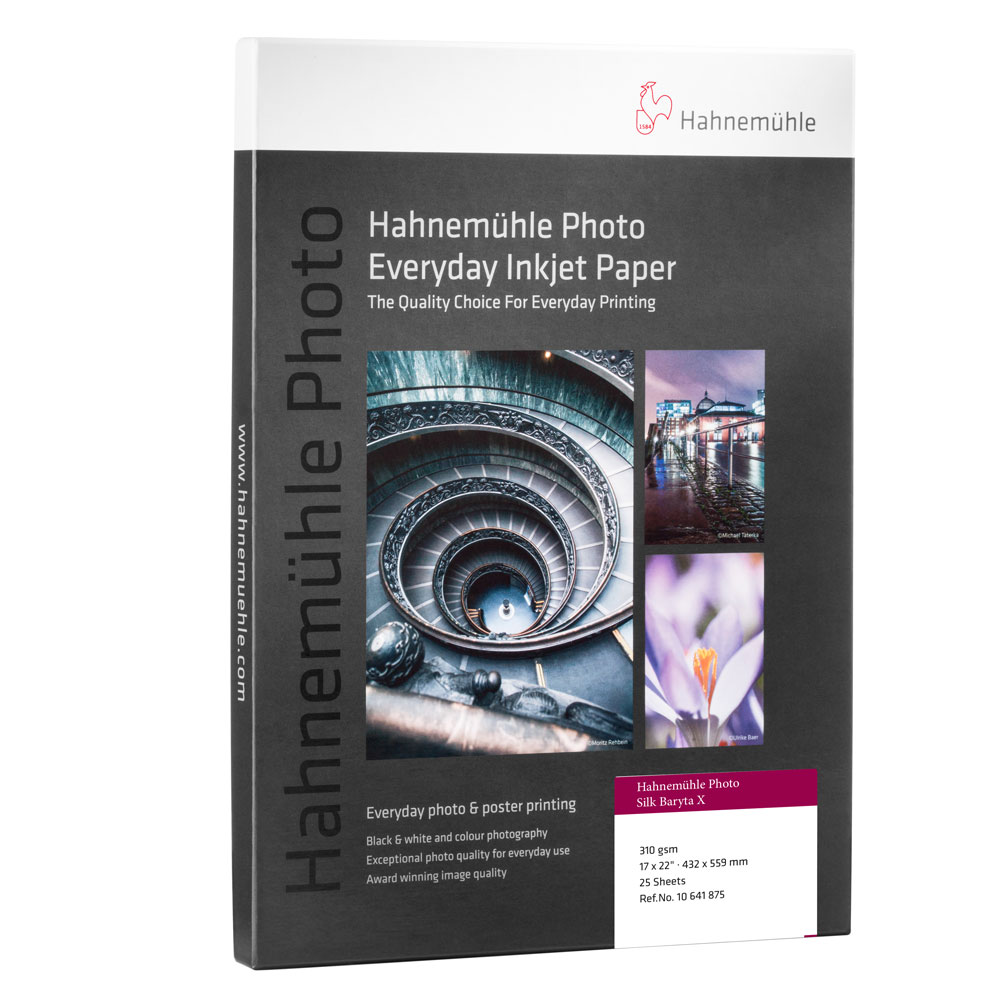
Photo Silk Baryta X was our favourite of the four papers.
This is a 310 gsm, 100% α-cellulose paper with a smooth silk-gloss baryta surface.
The appearance is reminiscent of traditional silver-halide photographic paper, but the smooth surface makes it particularly versatile for both colour and monochrome photography.
The colour testing produced excellent results.
The average error across the full 216-patch test set was 2.11 ΔE00, while the grey and skin-tone measurements were particularly strong.
The measured luminance error across the 216-patch set was only 0.08%, effectively negligible for practical printing.
The paper also produced a Dmax of 2.39 using the ICC profile.
Photo Silk Baryta X for black and white
The monochrome results were equally impressive.
Using the Epson Advanced Black and White driver, the measured Dmax increased to 2.42, compared with 2.39 using the ICC profile.
The deeper blacks and strong shadow separation make this an excellent option for monochrome images where rich, intense shadows are important.
It was also possible to see differences between the papers in the shadow regions of the tonal response.
For a low-key photograph containing important information deep into the shadows, Photo Silk Baryta X has a significant advantage.
It also produced the rich, traditional appearance that many photographers associate with classic darkroom baryta papers.
One issue observed during testing was slight bronzing under high viewing illumination and certain viewing angles. This wasn’t visible in normal straight-on viewing conditions and was absent when the test target was printed using a full-colour ICC profile.
Hahnemühle Sustainable Photo Satin
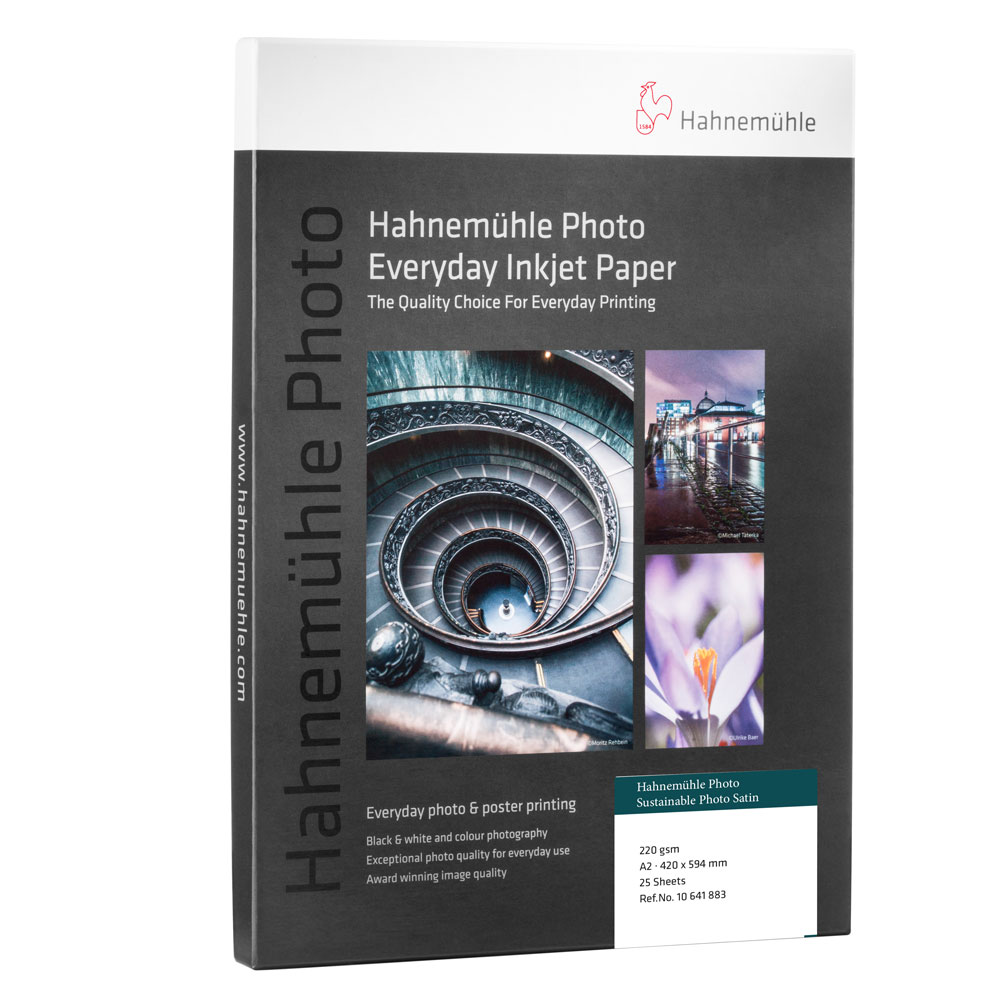
Sustainable Photo Satin is rather different from the two baryta papers.
At 220 gsm, it is considerably lighter and uses a smooth, non-textured satin finish.
It is made from 100% α-cellulose and is designed with sustainability in mind. Unlike papers with plastic-based components, the paper can be disposed of through the wastepaper recycling system.
The paper has a bright white base and uses optical brighteners.
Despite its positioning as an everyday printing paper, the performance during testing was very good.
The measured gamut volume was over one million, while the colour audit showed only nine clipped Pantone patches using both the generic and bespoke profiles in our testing.
The Dmax measured 2.51.
The paper produced slightly darker results than the target during profiling, although this may have been influenced by the Epson media setting used during testing.
Who is Sustainable Photo Satin for?
This is an attractive option for photographers who want good image quality without necessarily requiring the weight, texture or cost associated with a premium fine art paper.
It is also worth considering if environmental factors form part of your paper choice.
The main limitation is simply its lighter 220 gsm weight. For presentation prints where a substantial, rigid fine art paper is important, one of the heavier papers may be more appropriate.
Hahnemühle Photo Rag Matt Baryta
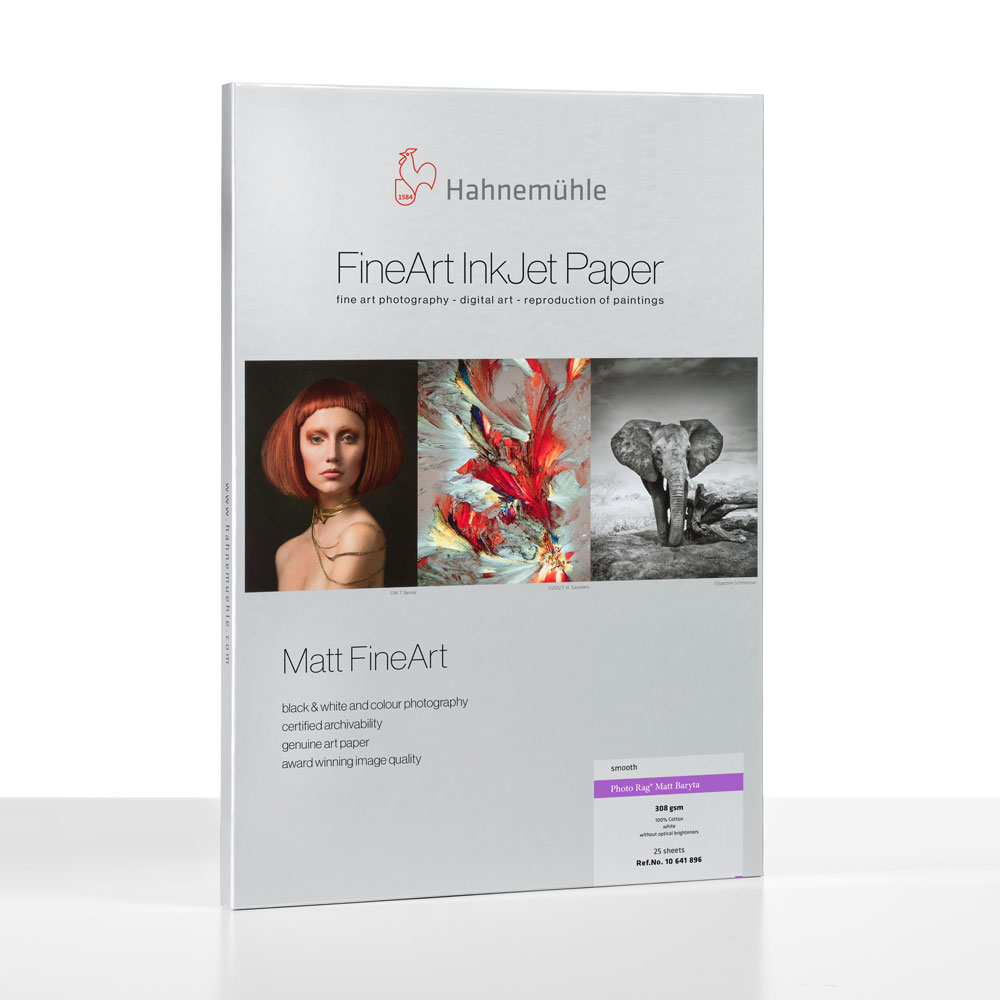
Photo Rag Matt Baryta combines a traditional cotton rag base with a matt baryta coating.
It is 308 gsm, 100% cotton, with a very fine, discreet surface and no optical brighteners.
The matt surface is particularly effective when you want a fine art appearance without the reflections associated with glossy media.
One of the advantages of the very fine surface is its ability to retain detail without introducing significant surface texture.
The measured Dmax was 1.66, considerably lower than the gloss baryta papers.
That is expected from a matt surface and should not be interpreted as a failure.
The skin-tone result was particularly impressive, with an average error of just 1.64 ΔE00.
The matt surface does, however, compromise some of the deepest tones. During testing, average tones were approximately 2% too bright and chroma was reduced by around 3% in the HiGAM test.
For many fine art images this will be irrelevant. In fact, the softer tonal character may be exactly what the photographer wants.
Photo Rag Matt Baryta for black and white
The monochrome results showed the same fundamental difference between matt and gloss papers.
The paper produced a Dmax of 1.70 using the Epson Advanced Black and White driver and 1.66 with the ICC profile.
Shadow areas therefore don’t have the same visual depth as they do on the gloss baryta papers.
But the matt surface is remarkably resistant to changes caused by viewing angle.
For high-key images, portraits, fine art photography and photographs where subtle tonal transitions are more important than maximum black density, this can be a very attractive characteristic.
Which Hahnemühle paper is best for black and white photography?
There isn’t a single answer because it depends on the image.
For deep blacks and dramatic shadow detail, Photo Silk Baryta X and Bamboo Gloss Baryta have the advantage.
Bamboo Gloss Baryta produced the highest measured Dmax in the monochrome tests at 2.67, while Photo Silk Baryta X reached 2.42 using the Epson ABW driver.
Photo Rag Matt Baryta produced a much lower Dmax, but its matt surface provides a very different aesthetic and remains capable of excellent tonal reproduction.
For a high-key portrait or fine art image, the matt paper may actually be the more appropriate choice.
This illustrates an important point about photo paper testing: the paper with the highest specification isn’t necessarily the paper that produces the best print.
ICC profiles versus the Epson Advanced Black and White driver
There are two important approaches when printing monochrome images on a professional inkjet printer.
One is to use a properly constructed ICC profile.
The other is to use the printer’s Advanced Black and White (ABW) driver.
A bespoke ICC profile can produce extremely accurate colour and tonal reproduction, but creating one requires suitable measurement equipment and profiling software.
The Epson ABW driver provides a relatively straightforward alternative for monochrome printing.
It is designed to control the printer’s black and grey ink channels while reducing the influence of strong colourants that could introduce a colour cast.
The driver also provides controls that allow the photographer to deliberately alter the appearance of the monochrome print.
Understanding the Epson ABW Tone settings
The Epson ABW driver provides several tone presets, including:
- Lighter
- Normal
- Dark
- Darker
- Darkest
During our tests, the Dark setting generally produced the result closest to the tonal aim established by the bespoke ICC profile.
However, that doesn’t mean Dark is always the correct setting.
Photography is not simply a matter of hitting a numerical target.
The visual appearance of a print depends on the image, viewing conditions and photographer’s intentions. A deliberately lighter or darker tonal response can produce a more successful print even if it is technically less accurate.
How paper surface affects shadow detail
The difference between matt and gloss papers becomes particularly obvious in the deepest shadows.
Gloss baryta papers can produce extremely deep blacks, allowing the printer to establish a greater separation between dark tones and the paper’s limiting black.
Matt papers have a lower Dmax, meaning that the darkest tones are closer together.
However, the difference is not simply a matter of counting stops and declaring one paper better.
The eye adapts to the tonal range of the print.
This means a well-produced matt print can still appear rich and detailed, even though its measured Dmax is considerably lower than that of a gloss paper.
The key question is therefore:
Where does the important information in your photograph sit?
If the image contains critical detail deep into the shadows, a high-Dmax baryta paper may be preferable.
If the photograph is predominantly high-key or relies on delicate mid-tone transitions, the characteristics of a matt fine art paper may be more beneficial.
Paper white matters too
The colour of the paper itself has an influence on the appearance of the finished photograph.
A cool, blue-white paper can appear brighter and cleaner, while a warmer paper can create a more traditional or subtle appearance.
Optical brightening agents can also make a paper appear significantly whiter.
This becomes particularly important when viewing a print under different lighting conditions.
The surrounding mount or window mount also affects perception. A cool white paper can look less attractive when surrounded by a warm mount, while an OBA-free fine art paper can work particularly well with a warmer, cream-coloured mount.
The print and mount have not physically changed colour, of course. What changes is the way our eyes perceive their relationship.
Why viewing conditions matter
Print evaluation is not completely independent of lighting.
During testing, the illumination level was varied between approximately 280, 500 and 2,000 lux.
The ability to distinguish very dark tones changes with illumination, while surface effects such as bronzing can become more apparent under stronger lighting.
This is one reason professional print assessment should be carried out under controlled viewing conditions whenever accurate comparisons are important.
A print that looks perfect under normal room lighting may reveal characteristics under a high-intensity viewing booth that would otherwise go unnoticed.
The importance of the printer and ICC profile
Paper performance cannot be considered independently from the printer and printing conditions.
Inkset, printer driver, media settings and ICC profiles all influence the final result.
For these tests, an Epson SureColor SC-P5000 was used with the 11-ink Light Light Black configuration.
The media settings were selected according to previous experience and Hahnemühle’s recommendations.
A bespoke ICC profile was also created using a 727-patch test target.
This is important because the figures in a paper review should not be interpreted as universal numbers that every printer and setup will reproduce identically.
Your own printer, inkset, profile and media settings will affect the final print.
So, which Hahnemühle paper should you choose?
The four papers occupy quite different positions.
Choose Bamboo Gloss Baryta if:
- You want very deep blacks.
- You enjoy the appearance of traditional baryta photographic paper.
- You primarily print dramatic colour or monochrome images.
- You prefer a warm, natural paper base.
- You want an OBA-free gloss paper.
Choose Photo Silk Baryta X if:
- Colour accuracy is particularly important.
- You want an excellent all-round baryta paper.
- You print both colour and black and white.
- You want rich blacks without an extremely high-gloss finish.
- Shadow detail is important to your images.
Choose Sustainable Photo Satin if:
- You want a lighter-weight photographic paper.
- You prefer a satin finish.
- Sustainability is an important consideration.
- You want very good colour performance for everyday printing.
- You don’t require the substantial feel of a 300 gsm fine art paper.
Choose Photo Rag Matt Baryta if:
- You prefer a matt fine art appearance.
- You print portraits, fine art or high-key images.
- You want minimal surface reflection.
- Subtle tonal transitions are more important than maximum black density.
- You prefer an OBA-free cotton rag paper.
The final verdict
All four Hahnemühle papers tested here are capable of producing excellent photographic prints, but they have distinctly different characteristics.
Photo Silk Baryta X was our overall favourite, largely because of its combination of colour accuracy, tonal performance and versatility.
For the deepest blacks and a classic baryta appearance, Bamboo Gloss Baryta is particularly impressive.
Photo Rag Matt Baryta demonstrates why maximum Dmax isn’t everything. Its lower black density is balanced by a beautiful matt surface and excellent fine art characteristics.
And Sustainable Photo Satin offers surprisingly strong performance in a lighter, more environmentally conscious package.
Ultimately, the best photo paper is the one that complements the image.
Rather than asking which paper has the highest Dmax, largest gamut or lowest colour error, photographers should ask a more useful question:
What characteristics will make this particular photograph look its best?
That is where paper testing becomes much more useful than simply comparing specifications.