How to Stand Out as a Wedding Photographer
By Stuart Wood
There is a lot of wedding photography out there.
That makes it increasingly difficult to stand out if your portfolio looks much like everybody else’s. The same poses, the same locations, the same compositions and the same ideas can quickly turn a photographer’s portfolio into a sea of very competent but forgettable images.
So how do you become recognisable?
The answer isn’t necessarily to do something completely outrageous. It is to develop a point of view and create photographs that feel like they could only have been made by you.
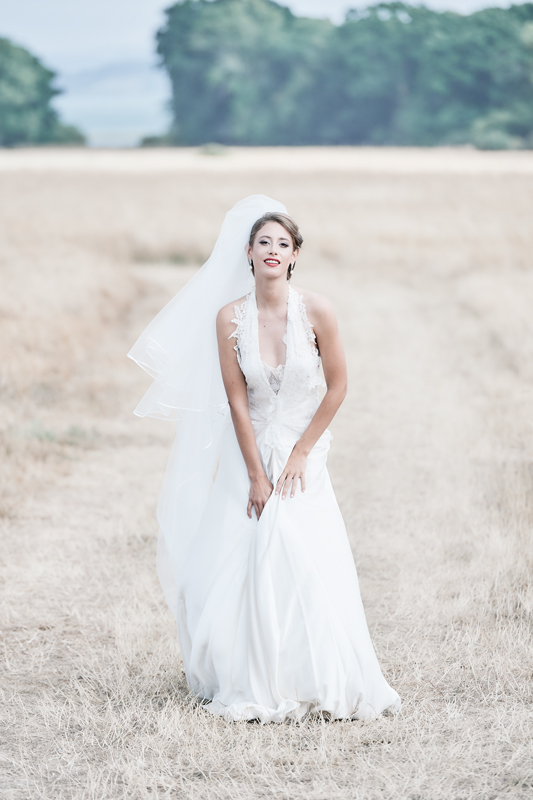
Photographer Stuart Wood has spent much of his career developing exactly that approach. A styled shoot at Pylewell Park in Hampshire provides a good example of how careful planning, lighting and a willingness to do something different can come together.
Don’t simply follow the wedding photography crowd
Styled shoots can be a fantastic way for photographers to create portfolio material, work with other wedding suppliers and experiment without the pressure of a real wedding.
But there is a danger.
Look through enough styled wedding shoots and you will start to see the same visual language repeated: a bride with a bouquet, a couple walking towards a venue, a beautiful dress against an attractive backdrop.
There is nothing wrong with those photographs. The problem comes when everyone is producing essentially the same work.
If you want clients to choose you because of your photography, rather than simply because you happen to be one of several photographers available on their date, your portfolio needs to give them something distinctive to remember.
Start by asking what makes you different
Before planning your next shoot, ask yourself a simple question:
Why would somebody choose my photography rather than somebody else’s?
It is a surprisingly difficult question to answer.
Your style might come from the way you use light, the way you compose photographs, your approach to colour, your use of black and white, the way you direct people or simply the way you see a location.
It doesn’t have to be a gimmick.
The important thing is that your work feels like yours.
That was one of the reasons Stuart deliberately pushed his own style forward. Rather than abandoning everything he had done previously, he wanted to develop his work while retaining the elements that had already become part of his visual identity.
That is often a more productive way of developing a style than trying to reinvent yourself overnight.
Look outside wedding photography for inspiration
Photographers can become trapped by their own genre.
If you only look at wedding photography, it is very easy to end up producing wedding photography that looks like everyone else’s.
Stuart increasingly looked towards fashion photography for inspiration, regularly studying leading fashion photographers and magazines.
This makes sense. Fashion photographers have spent decades thinking about clothing, shape, lighting, movement, location and how to create a strong visual identity around a subject.
There is no reason a wedding photographer can’t learn from that.
The same principle applies to almost any genre. Portrait photographers can study cinema. Landscape photographers can study painting. Commercial photographers can look at architecture.
You don’t have to copy what you see. You simply need to ask yourself why it works and consider whether the idea could influence your own photography.
Give a styled shoot a creative purpose
A styled shoot becomes much more useful when it has a clear idea behind it.
For Stuart’s shoot at Pylewell Park, the aim wasn’t simply to photograph a beautiful wedding dress in a beautiful location.
The shoot deliberately played with the character of the venue and the elegance of the dress, creating something with an English country-house feel but with a slightly more playful edge.
That decision was made before the camera came out.
This is important.
If you arrive at a venue without an idea and simply start photographing everything that looks attractive, you can easily end up with a collection of technically good photographs that don’t have much relationship with each other.
Instead, decide what you are trying to create.
What is the mood?
What should the viewer feel?
What makes the location interesting?
How can the dress, styling, model and lighting work together?
And perhaps most importantly: what can you do that is different from the photographs already filling your portfolio?
Photograph for the portfolio you want
One of the biggest advantages of a styled shoot is that you can photograph the type of work you want to be commissioned for.
You don’t have to wait for a real wedding to give you permission.
If you want to attract luxury clients, create photographs that demonstrate the level and style of work you want to produce. If you want more editorial commissions, make your portfolio look editorial. If you want to be known for dramatic black and white portraits, create them deliberately.
Your portfolio is not simply a record of what you have photographed.
It is also a statement about what you want to photograph next.
Don’t be afraid to shoot specifically for black and white
For the Pylewell Park shoot, Stuart made a deliberate decision to create some of the work specifically for black and white.
That decision influenced the lighting.
Black and white removes colour from the equation, leaving the photographer to work much more directly with brightness, contrast, shape, texture and light.
That can be particularly effective with wedding dresses, where texture and detail can otherwise be lost among the surrounding colours.
If you know from the beginning that an image is intended to become monochrome, you can light it accordingly rather than simply converting a colour photograph afterwards and hoping it works.
You don’t always need lots of lights
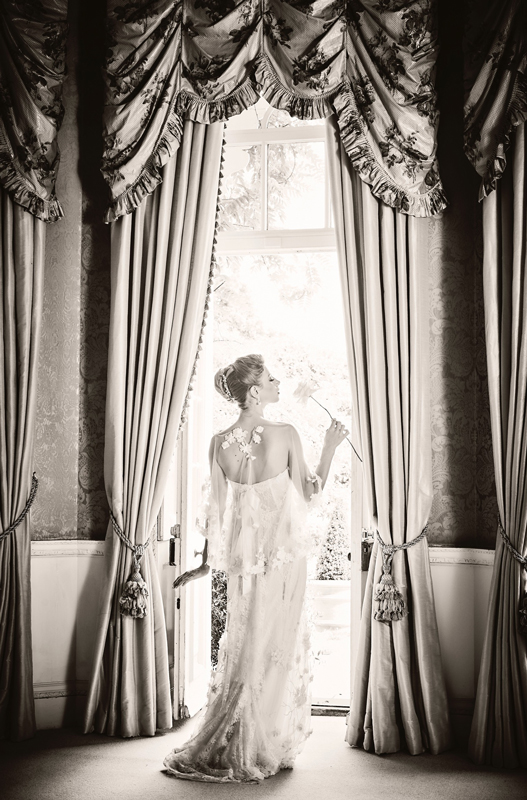
The main image from the shoot was created using a single flash source.
The challenge was familiar to anyone who has photographed indoors with daylight coming through windows: the brightness outside can be dramatically greater than the ambient light inside.
Rather than filling the room with lights, Stuart used one Elinchrom ELB 500 positioned to the side and aimed into a large white reflector.
The reflector effectively became a large soft light source.
This gave him control over the light falling across the scene while also helping to pick out the texture of the wedding dress and the surrounding drapes.
It is a useful reminder that adding more lights isn’t automatically the answer.
A single carefully positioned light can often produce a more controlled and interesting result than several sources competing with one another.
Use the environment rather than fighting it
The position of the light was also chosen with the environment in mind.
The light was kept to the side rather than being fired directly towards the subject or into reflective surfaces. This helped define the texture of the dress and avoided unnecessary reflections.
Good lighting isn’t simply about where the light comes from.
It is also about understanding what the light will do when it reaches everything around your subject.
Walls, ceilings, floors, windows, mirrors and even the colour of the room can all become part of the lighting setup.
Sometimes the best solution is simply to position your light so that the environment does some of the work for you.
Control the balance between daylight and flash
The daylight coming through the windows was an important part of Stuart’s vision.
He wanted the finished photograph to retain the feeling of a bright English summer’s day rather than turning the windows into distracting white areas.
Shutter speed provided control over the amount of ambient daylight recorded by the camera, while the flash provided the additional interior illumination.
This is a useful principle for anyone mixing flash with daylight: the two sources can be treated separately.
The ambient exposure controls the environment and background, while the flash controls the subject.
Once you understand that relationship, balancing natural light and flash becomes much more predictable.
Don’t photograph everything
Beautiful venues can create another problem: there is simply too much to photograph.
A large country house may have gardens, staircases, rooms, windows, corridors, fireplaces, entrances and countless attractive backgrounds.
It is tempting to use all of them.
But a stronger portfolio doesn’t necessarily come from photographing every possible corner.
After working at venues repeatedly, Stuart found that a natural sequence developed in terms of where and when to shoot. Experience helped him become more selective.
That selectivity is important.
You don’t need twenty photographs from one location when three great photographs will do.
Build a recognisable body of work
A distinctive style rarely appears in a single photograph.
It develops through repetition.
The more deliberately you photograph, the more you begin to recognise the things that consistently appear in your work: the way you use light, the compositions you favour, the expressions you look for, the colours you avoid, the moments you notice and the subjects that genuinely interest you.
Look back through your portfolio and ask:
- Which photographs feel most like me?
- What do they have in common?
- Is there a particular way I use light?
- Do I consistently prefer certain types of composition?
- Which photographs would I be happy to put my name to without explanation?
- Which images look like everyone else’s?
- What would I like to do more of?
The answers can tell you a great deal about your developing style.
Don’t confuse originality with being different for the sake of it
Standing out doesn’t mean deliberately making strange photographs simply to get attention.
There is a difference between being distinctive and being gimmicky.
A photograph should still work.
The styling, location, lighting and post-production should support the idea rather than distract from it.
The best unusual photographs often feel obvious in hindsight. They are different because the photographer saw an opportunity that other people overlooked, not because they deliberately tried to make something bizarre.
Make your work recognisable
One of Stuart’s clients, Shimmering Ivory, described his work as having a “unique style” and highlighted the way his creative approach showed off the detail in their dresses.
That is an important distinction.
A photographer’s style isn’t simply something that makes their portfolio look attractive. It can become part of the reason another business wants to work with them.
For a wedding photographer, that could mean a venue recommending you because they know exactly what your photographs will look like. A dress designer may want to work with you because your lighting shows their work particularly well. A wedding planner may value your ability to create something different for their portfolio.
Your style can therefore become a business asset.
Use styled shoots to experiment
A styled shoot doesn’t have to produce a hundred portfolio images.
It can be an opportunity to try something you’ve been thinking about.
Perhaps you want to experiment with:
- dramatic side lighting
- black and white
- fashion-inspired posing
- unusual compositions
- movement
- environmental portraits
- a particular lens
- working with hard light
- using a single light source
- creating a more editorial look
The important thing is to experiment deliberately.
Choose one or two ideas and explore them properly rather than trying to test everything at once.
Your next shoot should have a reason
Before you organise your next styled shoot, don’t start with the question:
“What can I photograph?”
Start with:
“What am I trying to say?”
That one change can completely alter the result.
Think about the photographer you want to become, the clients you want to attract and the work you want your portfolio to contain.
Then create photographs that move you in that direction.
The goal isn’t to become the photographer who does something nobody else has ever done.
It is to become the photographer whose work people can recognise.
In a crowded wedding photography market, being good is important. Being recognisable can be what makes people remember you.