Canon 1D X vs Nikon D4s: The Flagships Engage in Battle
We put two of the era’s flagship professional DSLRs head to head, combining real-world experience from sports photographers and wildlife photographers with technical testing of the Canon 1D X and Nikon D4s.
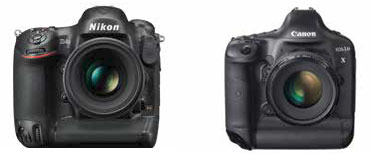
HMS D4s versus USS 1Dx
There are plenty of magazines and websites which would offer a view on which of these two cameras was the ‘better’, assigning slightly arbitrary numbers to different features to end up with a measure of excellence that has no real relevance. We would not lower ourselves to such base thoughts and in any case it is almost inconceivable that a professional would jump ship for the sake of an extra stop in the murky world of 200,000 ISO or a couple for frames per second beyond an already rapid 10 fps. All this does not prevent the teasing which goes on between devotees of the two camps and if it makes them strive to do better then it is all to the good. On a more serious note, the Canon 1Dx was launched in October 2011 and so the Nikon D4s is almost three years its junior.
Technology in cameras tends to move in phase across the marques (often because the underlying components are the same) but sometimes the early adopters suffer from unforeseen problems.
The fact that Domenic Aquilina and Ian Cook sat yards apart at the European League Cup Final and were each using the subject cameras only served to add an edge to any comparison. In the event it could be argued that the difference in position (pitch side) influenced the amount of cropping needed and that had more influence than other things. Ian Cook also took the D4s to the London Triathlon which gave additional material and Jon Ashton waded in with recent experience shooting nature subjects on the Canon.
Both cameras are the flagships of their brand, essentially top-end, robust and fast professional cameras intended for serious work and with high price tags. Each carries the hall marks of a press camera: very fast motor drives, high burst depth, fast in-camera image processing, high ISO capability, metal bodies and full weather sealing. Each, of course, is backed by a vast array of lenses and accessories for every conceivable assignment.

One feature which crops up time and time again is the focussing speed and accuracy. The faster on-board computing power has made faster framing rates possible while deepening the burst depth and, in the case of the D4s allowing huge numbers of Raw files to be captured. Even so this capability is spurned by many sports photographers who stay on JPEG because it gives them all that they need for the job in hand. This focus ability is critical, there is no point in having low-noise, high ISO and high framing rate if all it does is create greater numbers of fuzzy images.
As explained in the following piece Canon have worked hard on their algorithms for focusing, resulting in a rather large set of instructions.
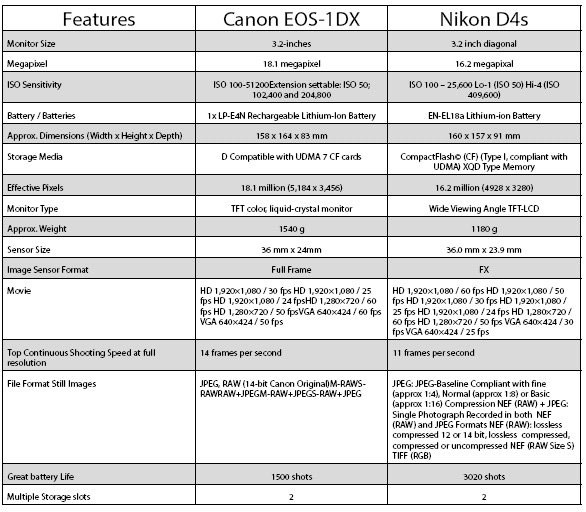
On the matter of burst depth (ie how many frames can you shoot before the buffer fills and the camera stutters?) the situation is a little murky. The reviews are rather silent (or self contradictory) which is interesting because it was noticeable at the Tour de France that my D700 quite definitely ran out of puff before the peloton had passed by. Having said that the Canon can do 400 JPEGs and the Nikon 200 which should be enough for most causes! The D4s can do 176 Raw files which is an innovation. The D4s also has twice the battery frame life which is indicative or more efficient use of capacity. DxOMark who conduct well engineered experiments on image quality rate the D4s slightly higher but as we said at the outset such subtleties are probably lost in the mist when you throw focus, camera shake and cropping into the equation!
Suffice to say on all this – there ain’t much difference between the two, both are fabulous cameras but neither should cause an established user to change ship. If you are a newcomer my advice is hold the cameras and go with what you like the feel of. Failing that add up how much you need to buy and compare what it is going to cost you – street prices not RSPs!
Canon 1Dx Initial thoughts and impressions
Regular contributor, Jon Ashton, recently changed up to the Canon 1Dx. Here are his impressions after using the camera out in the wild for a few weeks. His work is in stark contrast to that of our other 1Dx user in this issue, Domenic Aquilina, but when you get down to it, many of the requirements actually overlap.
The 1Dx weighs almost 200g heavier than a 7D with twin battery pack – this sounds a lot but in practice I have not noticed a difference at all because most rigs I carry are fairly weighty in any event, ie body and 500mm f4 or 100-400mm zoom or the 180mm macro.
Build quality, indeed, everything about the camera is well made and built to last. All controls are in familiar places and the handling of the camera is very intuitive because much of the ergonomic layout is similar to a 7D. A big advantage in program selection is that two controls have to be selected to change program so there is no longer any unintentional switching of programs as the camera is taken from a bag, etc.
The view finder is noticeably larger, brighter and clearer, the best I have ever seen; the information in the viewfinder can be tailored to individual need. Many of the operating programs and procedures can be tailored to individual needs; for example the metering system can be spot, centre biased or evaluative but you can set the camera to have any or all of these available to cycle through. The same goes for the AF pattern; there are five patterns, you may decide you are only likely to use three so you can select three for quick availability as opposed to having to cycle through five. Your preferences can of course be selected for the My Menu tab so all your key settings that you may require quick access to can be found quickly.
The AF system would appear complex to anyone who had not previously handled a Canon camera but it is simple to use once you realise there are six preset versions of AF to choose from. Each of these is recognised by an Olympic athlete icon and the info button can be depressed to show the type of subject best suited to each setting. The info button is available for most controls that require interpretation – very handy so you do not have to carry the handbook with you.

The AF system has much in common with the Canon 5D Mk111, as I understand it the principal difference is that the 1DX has a larger more powerful battery and it makes the AF system quicker. In my hands I did not find the 5D Mk111 a whole lot better than the 7D – many people will disagree with this observation but I repeat, in my hands, using the camera in my locality, photographing my kind of subjects, I did not notice a big improvement of the 5D Mk111 over the 7D.
The 1DX, however, is a different kettle of fish. You might expect me to say that after shelling out the best part of £5,000 but it is true! The system is very quick and for me, more importantly, very decisive; by that I mean it very quickly acquires focus without continual hunting.
Every time I take the camera out I am blown away with its AF capabilities, this includes times when a TC is added to the main lens. I think you will find, wherever you read a critical appraisal of the 1DX, the comments regarding the AF system will be equally positive.
NOTE: The AF system is so sophisticated that it even carries its own setting guidebook, which is a mere 54 pages in length. Ed.
The image files produced are, as might be expected, very clean and show superb detail. The full frame chip opens up a whole new world to anyone who has only ever used a ‘crop sensor’ camera. The obvious advantage here is that if the light is a little low you just turn up the ISO setting, in fact it goes to what are, for me, unimaginatively high settings. This translates to a whole new ball game, for example, when taking macro shots of insects, previously I would always recommend using a monopod or tripod, I still do but having said that it is possible to get excellent images hand-holding the 1DX, in other words there is less to carry. I also have no reservations whatever in hand-holding the camera with a 500mm and 1.4TC attached. In many cases I find ISO 800 a good starting point, in fact it is my new routine ISO and if I need 1600 or 2000 or 3200 then it is no problem.
When I bought the camera I did wonder if I would miss the crop factor as I photograph mainly wildlife; well so far it has not been a problem and I have even had good results using the 500mm with a 2xTC, I simply ensure that I use it at f11 and with a commensurately fast shutter speed.
The camera has two compact flash slots; by no means is this unique but it is the first camera I have owned to have this function so if I have a 32GB card in each slot I can almost guarantee I will have enough memory with me without having to change cards in any one day.
In a nutshell the camera has been a revelation to me, it does everything I want and the quality is outstanding. Would I recommend it – yes to the sort of person who would learn how to use it. If you cannot be bothered to read the handbook this camera will be wasted, in fact if you don’t use it properly you will be disappointed because the results will not be the best.
Do I hear you say what is the downside? Well for me nothing at all … apart from the price!
Mike’s Techie bit
Time did not allow much in the way of technical testing. Normally we run a bracket sequence, shooting at a Macbeth chart and determine the characteristics of both colour reproduction and exposure judgement. In the event our inexperience led us to fail miserably. Despite thinking we had shot a bracket set we had not in fact done so. Even so this was not much of an embarrassment and the data we obtained were excellent.
We employed the Rags Gardner scripts to assess the colour accuracy. This delivered a delta E of 2.5 (?Eoo) right out of the box from an exposure that was, for all practical purposes, spot on.
Some of the hue and saturation errors registered as zero, the largest errors were in the highlight and shadow tones (ie the very light tones including white and the dark tones including black).
Overall this mismatch between contrast in the target and that in the image generated the highest errors but as we have already said they were small enough to be ignored by most users.