
Visual Storytelling in Photography: How to Create Images With Meaning
A photograph can be technically excellent and still leave a viewer with very little to think about.
The photographs that stay with us often do something more. They tell a story, communicate an idea or create questions in the viewer’s mind.
This is the power of visual storytelling in photography.
A successful narrative photograph doesn’t necessarily need a long caption explaining what we are looking at. Through composition, lighting, expressions, objects, colour and symbolism, a photographer can provide clues that encourage the viewer to interpret the image.
Sometimes a title can add another layer to the story.
The result is a photograph that becomes more than a record of a moment. It becomes a visual narrative.
What is visual storytelling in photography?
Visual storytelling is the use of photographic elements to communicate a story, idea, emotion or message.
The story might be obvious immediately, or it might require the viewer to spend time examining the image and working out what is happening.
This distinction is important.
If every part of an image is explained immediately, there may be little left for the viewer to discover. On the other hand, if the photographer provides no clues at all, the intended message may be lost.
The strongest narrative images often find a balance between the two.
The viewer is given enough information to understand the subject, but enough ambiguity to encourage them to look more closely.
How can a photograph tell a story?
Photographers have many tools available when constructing a narrative image.
These include:
- Composition
- Lighting
- Colour
- Location
- Props and objects
- Body language
- Facial expression
- Clothing
- Background details
- Juxtaposition
- Symbolism
- Titles and captions
None of these elements needs to tell the entire story by itself.
Instead, they can work together to create a collection of visual clues.
A skull, for example, can suggest mortality. A dead flower might suggest loss or decay. A mirror can represent reflection or identity. A butterfly may suggest transformation.
The meaning isn’t always fixed, however. Symbols can have different meanings depending on culture, context and the circumstances in which they are used.
Photography symbolism: using objects to add meaning
Symbolism has been used in visual art for centuries.
Artists have frequently used recognisable objects to represent ideas that would otherwise be difficult to communicate visually.
Photography can use exactly the same principle.
A carefully selected object can completely change how an image is interpreted.
Common symbolic objects in photography
| Symbol or object | Possible associations |
|---|---|
| Apple | Temptation, knowledge |
| Skull | Mortality |
| Candle | Time, life, passing |
| Flowers | Life, growth, beauty or loss |
| Seashell | Birth, purity, fertility |
| Mirror | Reflection, identity, the soul |
| Butterfly | Transformation, change |
| Bird | Freedom, death, wisdom or power depending on species and context |
| Musical instrument | Beauty, creativity or transience |
| Gold or silver | Wealth, luxury or status |
| Colour | Emotion, symbolism or cultural meaning |
These associations shouldn’t be treated as universal rules.
A photographer’s job is not to insert a symbol and expect every viewer to reach exactly the same conclusion.
Instead, symbols provide another layer of information for the viewer to interpret.
Why butterflies are powerful photographic symbols
Butterflies and moths are particularly interesting examples of symbolism.
Because of their transformation from caterpillar to winged insect, butterflies can represent change, transformation, rebirth and the human soul.
Artists have used butterflies in symbolic compositions for centuries.
The Pre-Raphaelite painters were particularly interested in detailed symbolism, often placing apparently minor objects within their compositions to provide additional meaning.
In Holman Hunt’s The Hireling Shepherd, for example, a death’s-head moth forms part of a much larger visual narrative.
In John Everett Millais’ The Blind Girl, a butterfly appears on the girl’s clothing, providing another layer of interpretation.
Dante Gabriel Rossetti also used butterflies in Sybilla Palmifera, where they contribute to the painting’s symbolism.
These examples demonstrate an important principle for photographers: small details can carry enormous narrative weight.
An object doesn’t have to dominate the frame to influence how an image is understood.
Don’t underestimate the background
One of the easiest ways to add narrative to a photograph is through the background.
Photographers naturally concentrate on their main subject, but everything surrounding that subject can contribute to the story.
A background can tell us:
- Where the photograph was taken
- What has happened
- What might happen next
- Something about the subject’s circumstances
- Whether the image is realistic or surreal
- What the photographer wants us to notice
This is particularly important in conceptual and illustrative photography.
A carefully chosen background can turn an otherwise straightforward portrait into a much more complex image.
Composition can control the story
Composition is another important part of visual narrative.
Where you place a subject within the frame can influence how the viewer interprets the photograph.
For example, a subject surrounded by empty space can create a very different feeling from one that fills the entire frame.
Similarly, foreground objects can provide context, while a carefully chosen viewpoint can establish relationships between different elements within the scene.
When constructing a narrative photograph, ask yourself:
What do I want the viewer to notice first?
Then ask:
What should they discover second?
That simple exercise can help you think about an image as a sequence of visual information rather than a collection of objects.
The importance of the title
A photograph’s title can be surprisingly powerful.
A title can reinforce what the viewer is already seeing, introduce another interpretation or provide information that isn’t immediately obvious from the image.
However, titles shouldn’t simply explain everything.
A strong title can make the viewer look again.
Consider the difference between a photograph titled “Pollution” and one given a more ambiguous or playful title. The second may encourage the viewer to search the image for additional clues.
This is particularly effective when the title has a double meaning.
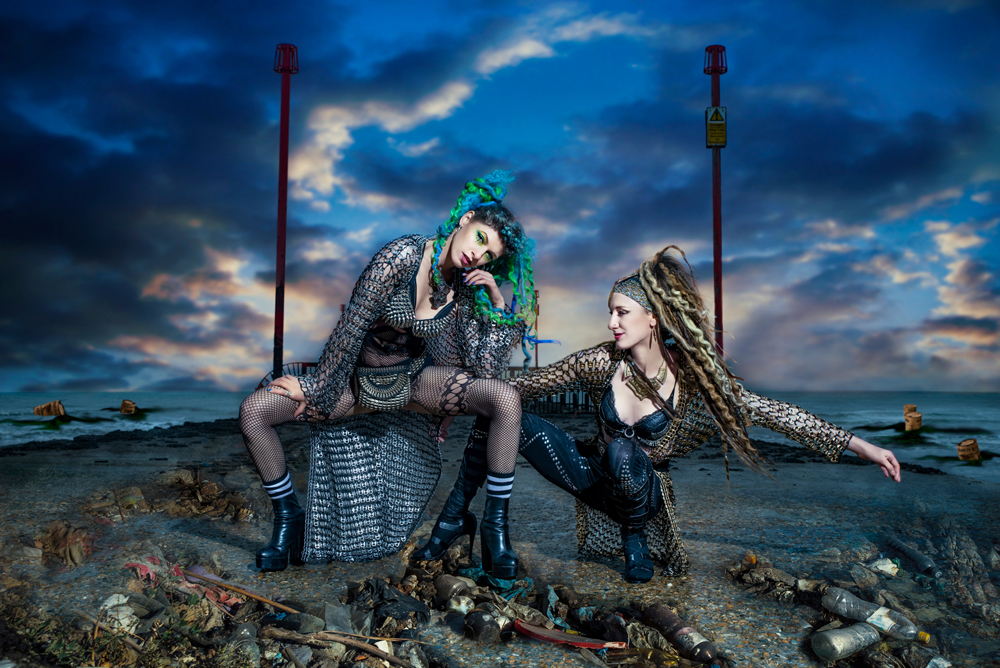
A case study in visual storytelling: On the Pull
A particularly interesting example of photographic narrative is Emma Joanne’s image On the Pull.
The photograph was entered into The Societies’ 20×16 Print Competition in the Illustrative category.
At first glance, the image is striking and provocative.
The models are posed in an unusual environment, with a deliberately unattractive foreground and an apocalyptic-looking sky.
There are also oil barrels in the sea.
Each of these elements provides another piece of the puzzle.
But there is considerably more to the photograph than might initially be apparent.
Looking beyond the obvious
The clothing worn by the models is made from beverage-can ring pulls.
That detail changes the way the entire photograph can be interpreted.
The garments were created by Filipino communities through the Purple Community Fund, a charitable project founded by Jane Walker.
The organisation’s work has included education, healthcare and sustainable employment within communities living around the garbage dumps of Manila.
Suddenly, the photograph’s apparently unusual styling becomes part of a much deeper environmental and social narrative.
The oil barrels, polluted-looking water, unusual clothing and post-apocalyptic sky all begin to make sense as components of the wider message.
Even the title On the Pull adds another layer, referring both to the ring-pull material used in the clothing and the more suggestive meaning of the phrase.
This is a good example of how a photograph can contain multiple levels of information.
Why narrative makes an image memorable
Without its background, a viewer might simply see an unusual fashion or conceptual photograph.
Once the story behind it is understood, the image becomes considerably richer.
This is one of the great strengths of visual storytelling.
A narrative can encourage the viewer to return to the photograph and examine details they may have previously overlooked.
It can also create an emotional connection between the viewer and the subject.
For competition photographers, this can be particularly valuable.
Judges may spend only a limited amount of time with an image, so the photograph needs to communicate effectively. However, an image that contains additional layers for closer inspection can reward extended viewing.
Should you explain the story behind your photograph?
There is an ongoing debate among photographers about how much information should accompany an image.
Some photographers prefer to leave the interpretation entirely to the viewer.
Others provide detailed statements explaining exactly what the photograph represents.
There isn’t necessarily a right answer.
However, if your photograph is intended to communicate a specific message, it is worth asking whether the viewer has enough information to discover it.
If the narrative is so obscure that nobody can find it without reading a lengthy explanation, the visual storytelling may need strengthening.
Equally, if the caption explains every single detail before the viewer has had an opportunity to interpret the image, some of the mystery can disappear.
How to create a narrative photograph
If you want to create your own storytelling image, start with the message rather than the camera.
Ask yourself:
What am I trying to say?
Then consider how you can communicate that idea visually.
1. Decide on your message
Before setting up the photograph, establish the central idea.
It could be about:
- Environmental issues
- Relationships
- Identity
- Loss
- Social inequality
- Climate change
- Consumerism
- Freedom
- Memory
- Time
- Transformation
2. Choose visual symbols
Think about objects that could represent your idea.
Don’t simply choose the first obvious symbol. Look for something that adds another layer to the photograph.
3. Build the environment
The setting should contribute to the narrative rather than simply provide somewhere to place the subject.
Ask what the location tells the viewer.
4. Consider colour
Colour can influence emotion and meaning.
Warm and cool colours, for example, can produce very different emotional responses.
Colour symbolism also varies considerably between cultures, so consider your intended audience when relying heavily on it.
5. Think about what isn’t immediately obvious
Look for details that reward closer inspection.
A small object in the background may ultimately become one of the most important parts of the photograph.
6. Choose the title carefully
A good title can provide a final clue.
It might reinforce the message, introduce a second meaning or encourage the viewer to reconsider what they have seen.
Narrative photography doesn’t have to be complicated
Creating a storytelling photograph doesn’t necessarily require an elaborate studio production.
Street photography can tell stories through gestures and interactions.
Documentary photography can communicate powerful narratives through a single moment.
Portraits can reveal something about a person’s character.
Landscape photographs can communicate ideas about isolation, scale, climate or the relationship between people and the environment.
Even a simple still life can contain symbolism.
The important question is not how complicated the photograph is.
It is whether every element has a reason for being there.
Give your viewer something to discover
The most successful narrative photographs often reward a second look.
At first glance, the viewer sees the overall image.
Then they notice another detail.
Then another.
Eventually, those individual elements begin to connect and reveal a larger story.
That’s when a photograph can become particularly powerful.
Instead of simply showing the viewer something, you’re inviting them to participate in the process of discovering its meaning.
And that may be the real strength of visual storytelling in photography.
This article is adapted and substantially rewritten from material originally published in Professional Imagemaker.