PermaJet Baryta Rag 310 Review: Fine Art Print Quality Tested
By Mike McNamee
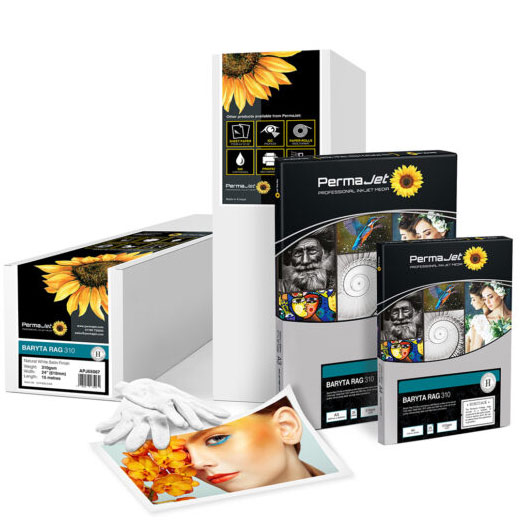
PermaJet Baryta Rag 310 is a 100% cotton rag-based fine art inkjet paper with a zero-OBA coating and a substantial 310gsm weight. It has a lightly satin surface that produces a refined finish when printed, making it particularly interesting for photographers looking for high-quality colour and monochrome prints.
We originally tested Baryta Rag 310 in November 2022, when it produced very strong results. However, some of those tests were affected by scum dotting caused by a software glitch rather than a problem with either the printer or the paper. We therefore decided to repeat the testing to establish whether the excellent performance could be improved further.
What is PermaJet Baryta Rag 310?
Baryta Rag 310 belongs to PermaJet’s Heritage Range and combines a 100% cotton rag base with a baryta-style coating.
At 310gsm, it has a substantial feel that will appeal to photographers producing exhibition, portfolio and fine art prints. The paper has a light satin finish rather than a high gloss surface, while its zero-OBA construction gives it a naturally stable appearance under ultraviolet examination.
The unprinted surface initially appears relatively flat and matt. Once printed, however, the ink produces a subtle, fine lustre finish that adds to the visual quality of the final print.
Paper tone and surface
One of the characteristics we look at closely when testing fine art papers is the base tone.
Baryta Rag 310 has no optical brightening agents (OBAs) and appeared optically neutral under UV examination. Its measured tone was approximately two Lab points towards yellow, giving the paper a very slightly warm or creamy appearance while remaining close to neutral.
This is useful for photographers who want a fine art paper with some warmth without introducing an obviously warm colour cast.
The surface also proved durable, with the subtle lustre produced by the ink giving the finished print an attractive appearance.
Colour accuracy
The colour audit produced an exceptionally strong set of results.
Using the 216-patch test set, the average colour error was just 1.57 ΔE00. The Macbeth ColorChecker CC24 test produced an average error of 1.11 ΔE00, placing the result around the threshold of human visual detection.
The 50% lightness patch reproduced at 50.17%, while the deepest measured shadow was 2.64%. The resulting Dmax was 2.48, demonstrating the paper’s ability to produce deep blacks.
The greyscale was also highly linear, with an R² value of 99.97%. The overall error across the greyscale was sufficiently low for the result to be considered a useful reference standard.
These are excellent results for a photographic inkjet medium.
Gamut performance
The paper also performed extremely well when the colour gamut was examined.
The measured gamut volume exceeded one million, while only nine Pantone GOE patches were clipped. Seven of those clipped colours were located in the red region of the gamut, with one occurring in the purple-blue region.
Importantly, almost all of the clipped patches still had errors below 2 ΔE00.
The largest individual error was measured in cyan at 5.32 ΔE00. Around 90% of that error was attributable to the Lightness channel, which was approximately 6% too dark.
This particular area is not entirely unexpected given the characteristics of the HDR printer ink set used for the test.
Overall, the colour performance was outstanding.
Black-and-white printing
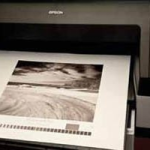
Baryta Rag 310 is also an excellent choice for monochrome printing.
Although the custom colour profile produced an extremely good black-and-white result, we also tested the paper using Epson’s Advanced Black and White (ABW) driver.
Using the PLPP260 media setting with Neutral and Darker tone settings produced a slightly higher Dmax of 2.63. As expected when using the ABW driver, metamerism increased slightly, with a CII value of 2.51.
The 50% tone patch reproduced at 49.4%.
For photographers using the Epson ABW workflow, Neutral Dark provides a useful starting point, although individual photographers may prefer a lighter or darker setting depending on the image and their preferred appearance.
The linearity of the tone ramp was very close to that achieved using the colour-managed profile.
The two grey ramps also showed only minor differences in neutrality. In practical terms, the residual colour bias was below anything likely to be noticeable in a normal print.
How good is the PermaJet ICC profile?
Not everyone wants to create a bespoke ICC profile for every combination of printer, ink and paper.
We therefore also tested the generic ICC profile supplied by PermaJet for Baryta Rag.
The results were excellent.
The average colour error increased to 2.28 ΔE00, which is comparable with some bespoke profiles, although it did not quite match the performance achieved with our own profile.
Interestingly, the measured gamut volume was slightly higher and the number of clipped Pantone GOE colours fell from nine to just five.
For photographers who want a straightforward workflow using the manufacturer’s supplied profile, this is very encouraging. The generic PermaJet profile produced results that are more than suitable for high-quality photographic printing.
What happens without colour management?
We also tested Baryta Rag 310 using a printer-managed colour workflow.
This is effectively the simplest approach, handing colour management over to the printer driver rather than using an ICC profile.
The printer’s Baryta media setting was used for this test.
The results demonstrate why colour management is important when producing high-quality fine art prints.
The average error increased to 3.21 ΔE00. More significantly, the HiGAM error increased from 1.58 ΔE00 using the bespoke profile to 7.73 ΔE00 without colour management.
The largest HiGAM error reached 17.5 ΔE00.
The problem wasn’t simply a small reduction in colour accuracy. Both saturation and hue were affected, with colours moving significantly inwards towards the centre of the gamut.
For photographers who want predictable, accurate reproduction of their image files, this is not a workflow we would recommend.
Overall verdict
PermaJet Baryta Rag 310 produced an outstanding set of test results.
Its combination of a 100% cotton rag base, zero OBA content, substantial 310gsm weight and attractive satin surface makes it a compelling option for photographers producing high-quality fine art prints.
Colour reproduction was exceptionally accurate when using a suitable ICC profile, while the paper also performed extremely well for monochrome work. The supplied PermaJet profile produced results that were very good, making the paper accessible to photographers who don’t want to create bespoke profiles.
The testing also demonstrated the importance of proper colour management. Although the printer-managed workflow was convenient, the resulting loss of colour accuracy was significant compared with the profiled workflow.
For photographers looking for a premium paper for exhibition, portfolio or fine art printing, PermaJet Baryta Rag 310 is a highly capable medium and one that performed exceptionally well in our testing.