How Peter Li Creates Dramatic Vertical Panoramas of Cathedrals
Peter was interviewed by Cristina Pascu-Tulbure and Mike McNamee
Peter Li’s photographs of cathedrals and historic interiors have a distinctive quality.
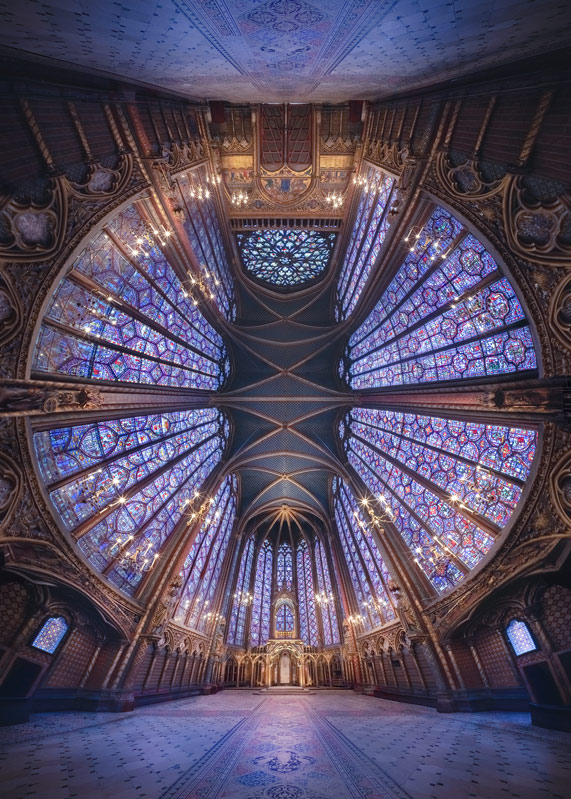
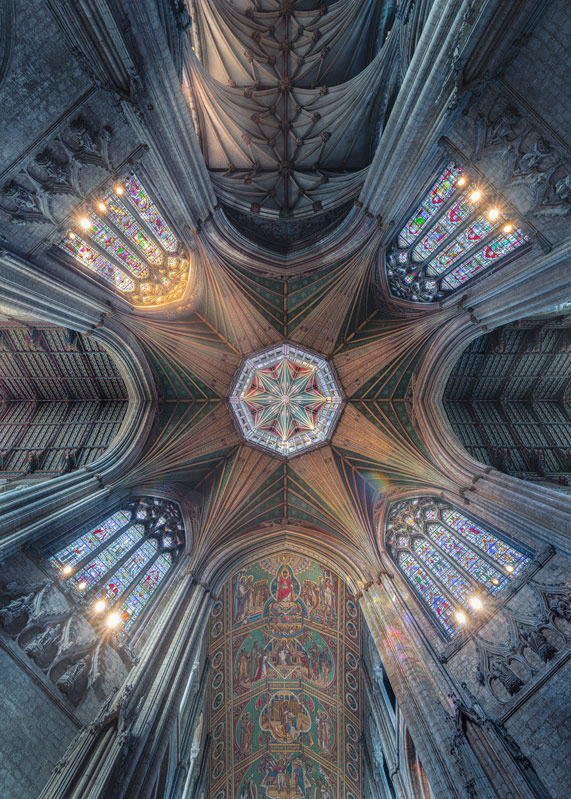
Rather than simply documenting the architecture, he creates wide-angle vertical panoramas that transform enormous interior spaces into immersive, almost otherworldly images.
His work sits somewhere between architectural record and fine-art photography, combining careful technical planning with a highly personal approach to colour, light and composition.
Peter is an award-winning fine-art architecture photographer based in London. His work has included cathedral interiors across the UK and Europe, with collaborations involving St Paul’s Cathedral and Ely Cathedral and commissioned work for York Minster.
He has also won first place in the Built Environment category of the Epson International Pano Awards in 2018 and 2022.
But the technique behind his images is perhaps just as interesting as the finished photographs.
Why photograph cathedrals?
For Peter, cathedrals represent much more than impressive buildings.
They are enormous works of art, engineering and craftsmanship, often taking generations to construct.
“They don’t build them like they used to,” is essentially the starting point for his fascination.
Coming from Hong Kong, Peter’s early fascination with medieval architecture was influenced partly by the castles and imaginary worlds he encountered through video games and fantasy films.
That interest eventually developed into a fascination with real architectural spaces.
The influence of painting is equally important.
Artists such as J.M.W. Turner, with his atmospheric treatment of light, helped shape Peter’s desire to create images that feel ethereal rather than simply documentary.
His objective isn’t just to show what a cathedral looks like.
It is to recreate something of the feeling of standing inside it.
Discovering panoramic photography
Peter began photography in 2014.
One of his early challenges was deliberately restricting himself to a single 85mm lens during his daily commute.
That limitation encouraged him to look differently at the world around him and eventually sparked his interest in panoramic photography.
He later expanded his approach to wider lenses, including 28mm and 10mm lenses.
Symmetry became an increasingly important part of his visual language.
Rather than photographing an entire 360-degree scene, Peter often works with one or three columns of images.
This gives him the width required to capture a large architectural space without producing the exaggerated “little planet” appearance associated with some 360-degree panoramic photography.
What is a vertical panorama?
A panorama doesn’t have to be a long horizontal photograph.
For architecture, a vertical panorama can be particularly effective.
A cathedral interior may be far taller than it is wide, with columns, arches and windows leading the eye upwards.
A conventional wide-angle photograph may struggle to capture the entire space without introducing severe distortion.
A vertical panorama provides another solution.
Peter can capture multiple frames and stitch them together, creating a much larger final image while retaining the proportions and detail of the architecture.
The technique does, however, require precision.
Shooting the panorama
Peter has experimented with several focal lengths and panoramic systems.
His current equipment includes a Nikon Z8 with lenses including the Z 50mm f/1.8 S, Z 14-24mm f/2.8 S and an extremely wide 10mm lens.
He also uses specialist panoramic equipment, including a Nodal Ninja panoramic head, alongside a rotating lens holder.
The choice of lens affects the technique.
An extremely wide lens can capture more of the scene in fewer frames, but it leaves less margin for error.
A longer lens may require several rows and columns of photographs but can provide greater control over the final image.
Overlap between frames is essential because the individual photographs need sufficient common information for the software to stitch them accurately.
Stitching the photographs
Peter originally learned to stitch panoramic photographs in Lightroom.
He has experimented with other applications, including Capture One, Panoweaver and PTGui, but continues to use Lightroom as an important part of his workflow.
Once the individual photographs have been combined, the resulting panoramic image can be exported as a DNG, allowing further editing while retaining considerable flexibility.
The stitching process is only the beginning, however.
For Peter, the creative work starts after the panorama has been assembled.
Photographing light inside a cathedral
Cathedral interiors present some difficult lighting problems.
There can be intense light coming through stained-glass windows alongside relatively dark architectural details.
Natural and artificial light can also exist within the same space.
This often makes exposure challenging and can require bracketing to capture sufficient information across the tonal range.
But Peter doesn’t necessarily want to eliminate these differences.
Instead, he uses them as part of the creative process.
Light becomes something to interpret rather than simply correct.
Editing for atmosphere
Peter’s approach to editing has evolved over time.
Earlier in his photography career, he might photograph, edit and publish an image immediately.
Now he often allows photographs to sit for weeks or even months.
That distance changes the way he sees them.
He can return to the image without being influenced quite so strongly by the excitement of taking the photograph.
The editing process becomes experimental.
He may work on small sections of the image, exploring how the light falls, how different colour treatments affect the architecture and whether particular areas need to be emphasised or subdued.
Colour grading and split-toning techniques help him develop the atmosphere he is looking for.
Eventually the different experiments come together into a final colour palette.
Perspective is part of the process
One of the challenges of photographing architecture with very wide lenses is perspective distortion.
Vertical lines can converge or bend, while floors and walls can appear distorted.
Correcting perspective is therefore an important part of Peter’s workflow.
But there is a balance to find.
The objective isn’t necessarily to make the photograph mathematically perfect.
Instead, the correction needs to support the way the viewer expects the architecture to look.
Too little correction can make the building appear distorted.
Too much can make the image feel unnaturally stretched.
This is where technical knowledge and artistic judgement meet.
Photography as interpretation
Peter’s work raises an interesting question about architectural photography.
At what point does a photograph stop being a record of a building and become an artistic interpretation?
For Peter, the answer lies partly in the editing.
The camera records the space, but the final image is created through decisions about composition, colour, light and perspective.
The photographer is not simply showing what was there.
They are deciding what the viewer should feel when looking at it.
That is particularly important when photographing historic buildings.
A cathedral can be documented objectively, but it can also be interpreted creatively.
Peter’s work deliberately leans towards the latter.
Why printing matters
For Peter, the finished photograph isn’t necessarily complete when the digital file has been created.
Printing is an important part of the process.
He has experimented with papers including Hahnemühle Fine Art Pearl and more textured fine-art papers such as Watercolour and Photo Rag.
The choice of paper changes how the image is perceived.
A highly detailed architectural panorama can benefit from a surface that provides sufficient depth and vibrancy without introducing distracting reflections.
Peter’s large prints are intended to encourage the viewer to move closer.
From a distance, the image establishes the scale and architecture.
Up close, the viewer can discover the detail.
That changes the relationship between the photograph and the person looking at it.
Think bigger with your photography
There is also an interesting lesson here for photographers who routinely print their work at relatively small sizes.
Large photographic prints can have an entirely different impact.
An image that appears impressive on a monitor may become far more immersive when displayed at substantial physical scale.
Peter’s cathedral panoramas are particularly suited to this approach because they contain an enormous amount of detail.
The larger the print, the more the viewer can explore the image.
Rather than treating photography as something that exists only on a screen, printing turns the image into an object that occupies physical space.
Developing your own visual language
Perhaps the most valuable lesson from Peter’s work isn’t the particular camera, lens or panoramic head he uses.
It is the importance of developing a personal way of seeing.
Peter’s fascination with symmetry, monumental architecture, atmospheric light and painterly colour has gradually developed into a recognisable style.
The equipment makes the technique possible.
The artistic decisions make the photographs his.
That’s an important distinction for any photographer.
There will always be another camera, another lens or another piece of software.
Developing a consistent visual language takes considerably longer.
From record to artwork
Peter Li’s cathedral panoramas demonstrate how technical photography can become fine-art photography.
The process starts with a physical building and a camera, but it doesn’t end with an accurate record of the architecture.
Multiple exposures are stitched together.
Perspective is corrected.
Light and colour are interpreted.
The image is allowed to develop over time.
Finally, the photograph is printed at a scale that encourages the viewer to step into it and explore.
The result is neither simply a photograph of a cathedral nor an attempt to reproduce the building exactly as the eye sees it.
It is Peter’s interpretation of the space.
And perhaps that is the real lesson of panoramic photography: the wider the view, the more choices the photographer has to make about what they want the viewer to see.