
How Photography Competitions Can Make You a Better Photographer
Photography competitions can be intimidating.
You put an image you’ve worked hard on in front of experienced judges, submit it alongside photographs from other photographers and then wait to discover how it has performed.
But competitions don’t have to be about trophies, titles or comparing yourself with somebody else.
Used properly, they can be one of the most effective ways to improve your photography.
Entering regularly encourages you to create with purpose, examine your work critically and learn from experienced photographers. Over time, that process can improve everything from your composition and lighting to your technical skills and visual storytelling.
For photographer, educator and mentor Kelly Brown, the real value of competition is not necessarily the award at the end.
It’s the opportunity to keep getting better.
Don’t expect it to be easy
One of the first things to understand about photographic competitions is that achieving a high award should be difficult.
That’s part of the point.
If every image received the highest possible score, the process wouldn’t give photographers much of a benchmark.
A lower score doesn’t automatically mean an image is bad. It may simply highlight areas where the photograph could be stronger.
Rather than concentrating entirely on an individual result, look at your performance over time.
One of the best pieces of advice Kelly received from fellow photographer Tony Hewitt was to aim to beat your previous year’s average.
That’s a much healthier approach than trying to win every time you enter.
The objective becomes continuous improvement rather than chasing a single award.
What do photography judges look for?
While judging systems vary between competitions, there are several areas that regularly contribute to the assessment of a photograph.
Understanding these can help you become more critical of your own work before you even press the submit button.
1. Impact
What is your immediate reaction when you look at the photograph?
A strong image often creates an emotional response almost instantly.
It might make you smile, surprise you, intrigue you or make you stop and look more closely.
Impact doesn’t necessarily mean drama.
A quiet photograph can have enormous impact if it connects with the viewer.
Before entering an image, ask yourself:
Does this photograph make me want to stop looking at it?
2. Creativity and personal style
Competitions aren’t simply looking for technically perfect versions of photographs that have already been created thousands of times.
Creativity comes from the photographer’s decisions.
How have you approached the subject?
What choices have you made about lighting, composition, colour, posing or processing?
Personal style is equally important.
A recognisable photographic style develops through repeated creative decisions. It doesn’t necessarily mean every image needs to look identical, but your work should feel intentional.
The strongest images often combine creativity with a clear understanding of what the photographer is trying to communicate.
3. Composition
Composition determines how the elements within the frame work together.
A successful composition guides the viewer’s eye and gives every significant element a purpose.
Look at:
- Where the subject is positioned
- How much space surrounds it
- Lines and shapes
- Balance
- Negative space
- Foreground and background
- The relationship between different elements
Good composition doesn’t have to follow a rigid set of rules.
Sometimes breaking the rules is exactly what makes an image work.
The important thing is that the composition supports the photograph rather than distracting from it.
4. Lighting
Light is one of the fundamental building blocks of photography.
It can create mood, depth, texture, shape and emotion.
Whether you’re working with natural light or flash, consider:
- Direction
- Quality
- Contrast
- Colour
- Shadow
- Highlights
- How the light interacts with the subject
Ask yourself whether the lighting is simply illuminating the subject or whether it is actually contributing to the story.
The best lighting decisions often feel intentional without drawing attention away from the photograph itself.
5. Centre of interest
Every photograph needs a reason for the viewer to look at it.
That doesn’t necessarily mean there has to be one obvious focal point.
Some images deliberately contain several areas of interest that work together.
The important thing is that the viewer understands where to look and why.
If everything in the frame is competing for attention, the image can become confusing.
Look at your own photographs and ask:
What do I want the viewer to notice first?
Then ask whether the photograph actually directs them there.
6. Colour
Colour can completely change the emotional response to an image.
Complementary or harmonious colours can create a sense of balance, while contrasting colours can introduce tension and energy.
And sometimes removing colour altogether is the right decision.
There’s no requirement for every photograph to have perfectly harmonious colour.
Bold or unusual colour choices can be extremely effective when they’re deliberate.
The key is understanding what the colour is contributing to the photograph.
7. Technical excellence
Technical quality isn’t everything, but it matters.
A powerful concept can still be weakened by poor execution.
Depending on the type of competition, judges may consider factors such as:
- Exposure
- Focus and sharpness
- Image quality
- Colour accuracy
- Retouching
- Print quality
- File preparation
- Output quality
The technical decisions should support the creative ones.
Technical perfection on its own won’t necessarily make a great photograph.
But technical problems can distract from an otherwise strong image.
8. Photographic technique
Every photograph contains a series of decisions.
Camera settings.
Lens choice.
Lighting.
Positioning.
Composition.
Posing.
Post-production.
Printing.
Presentation.
The technique should serve the image rather than exist simply to demonstrate technical ability.
A complicated lighting setup isn’t automatically better than a simple one.
A heavily edited photograph isn’t automatically more creative.
What matters is whether the choices you’ve made improve the final image.
9. Storytelling and subject matter
Perhaps the most important question is:
What is this photograph saying?
A strong photograph gives the viewer something to think about.
It might tell a clear story.
It might create a question.
It might communicate an emotion.
It might reveal something about the subject.
The subject and the way you photograph it should work together.
When they do, an image can become much more memorable than a technically excellent photograph with little emotional or narrative depth.
Feedback is one of the biggest benefits
One of the most valuable aspects of photography competitions is the opportunity to receive feedback.
And that feedback isn’t always comfortable.
When you’ve invested time, creativity and emotion into an image, criticism can feel personal.
It isn’t.
The photograph isn’t you.
Learning to separate yourself from the image allows you to listen to criticism more objectively.
Experienced judges can identify things that you may not have noticed yourself.
Perhaps the composition isn’t as strong as you thought.
Perhaps the lighting is competing with the subject.
Perhaps the processing is distracting from the story.
Perhaps the image is technically excellent but lacks impact.
That information is valuable.
Learn to listen to critique
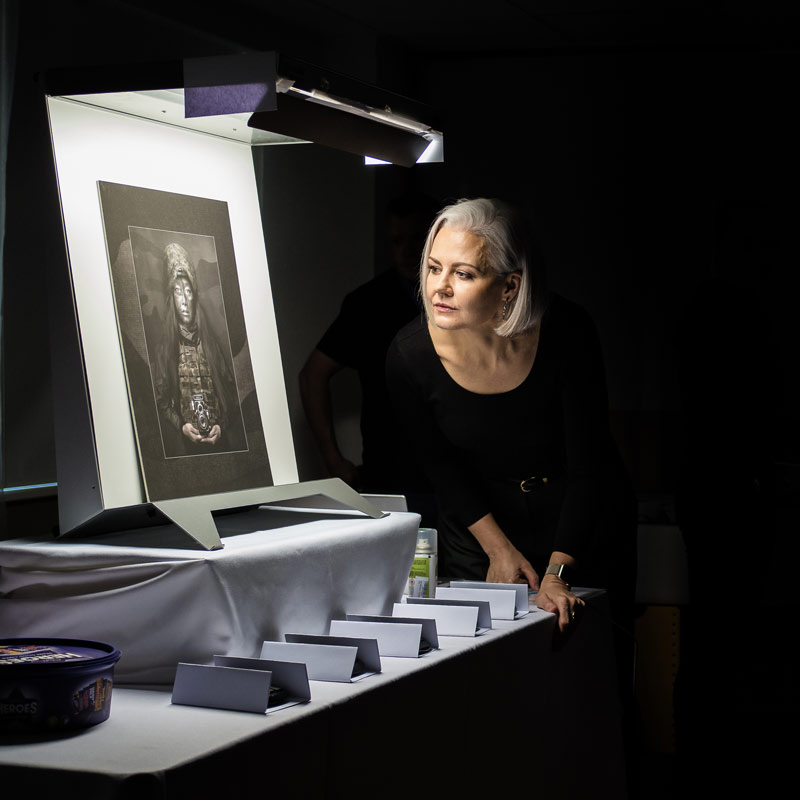
Kelly’s experience of sitting in judging rooms has been particularly influential in developing her own photography.
Listening to judges explain why an image works — or why it doesn’t — can teach you to analyse photographs differently.
Over time, you begin to hear those conversations in your own head when you’re editing.
You start asking:
Where does my eye go first?
What is the story?
Is anything distracting me?
Does the lighting support the subject?
Could the composition be stronger?
That self-critique is one of the most useful skills a photographer can develop.
Don’t just enter your best photograph
There’s another useful way to approach competitions.
Don’t treat every entry as a final exam.
Use competitions as an opportunity to experiment.
Try a different lighting approach.
Enter a genre you don’t normally photograph.
Push your editing.
Explore a different aspect of your creative style.
Sometimes an image that doesn’t score particularly highly can teach you more than an image that wins an award.
The point is to understand why.
Track your progress
If you’re serious about improving, keep a record of your competition results.
You don’t need to become obsessed with scores.
Instead, look for patterns.
Are your portraits consistently stronger than your landscapes?
Does your composition receive positive feedback while your technical execution needs work?
Are you repeatedly being told that your images lack impact?
Are your scores gradually improving?
This turns competition into a measurable development process.
Rather than thinking:
“I didn’t win.”
you can think:
“What did I learn, and is my work improving?”
That’s a much more productive question.
Consistency matters more than one great image
A single outstanding photograph can be exciting.
But becoming a better photographer is about producing strong work consistently.
Entering regularly gives you a reason to keep creating.
It encourages you to examine your work rather than simply moving on to the next client shoot.
Over time, those small improvements begin to accumulate.
Your lighting becomes more deliberate.
Your compositions become stronger.
Your editing becomes more refined.
Your ability to recognise a good image improves.
Eventually, you may look back at your earlier competition entries and realise just how far you’ve come.
Don’t compare your score with somebody else’s journey
Competition results can sometimes encourage unhealthy comparison.
It’s easy to see another photographer winning awards and wonder why your own work isn’t receiving the same recognition.
But you’re rarely comparing like with like.
That photographer may have been entering competitions for years.
They may specialise in a genre you’re unfamiliar with.
They may have different equipment, experience or training.
More importantly, their photographic journey isn’t yours.
Use other photographers for inspiration and learning, not as a measure of your own worth.
Competitions can raise your standards
The benefits of photography competitions extend beyond individual photographers.
When photographers challenge themselves to produce better work, standards across the industry can rise.
Competitions encourage photographers to think more carefully about their craft.
They encourage experimentation.
They create opportunities for critique.
And they provide a platform for photographers to discover work they might otherwise never have seen.
The competitive element is useful — but the learning community surrounding it can be just as valuable.
Should you enter a photography competition?
If you’ve been thinking about entering but haven’t quite found the confidence, start.
Don’t wait until you believe your photography is perfect.
It won’t be.
And that’s precisely why competitions can be useful.
Choose an image you believe in.
Read the competition rules carefully.
Look at previous successful entries if they’re available.
Submit your work.
Listen to the feedback.
Then go and make another photograph.
And another.
The aim isn’t simply to collect trophies.
It’s to become a better photographer.
About Kelly Brown

Kelly Brown is an award-winning newborn photographer, educator and mentor to more than 70,000 photographers worldwide.
A Canon Master, SWPP Fellow and Master Photographer, she shares her expertise through her training platforms, helping photographers develop both creatively and professionally.