
LED Lighting for Photography: Colour Quality, CRI and Continuous Light
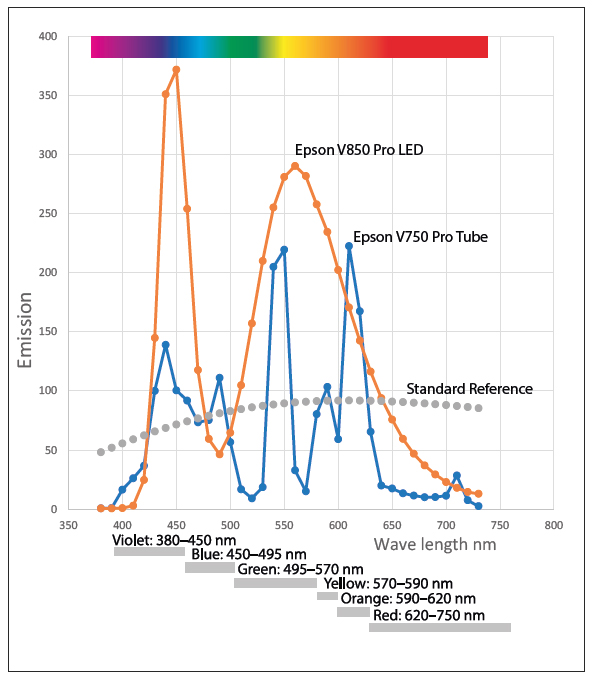
Lighting technology has changed dramatically over the past decade. For photographers, one of the biggest changes has been the move away from fluorescent and other traditional light sources towards increasingly sophisticated LED lighting.
The change isn’t simply about using less electricity. Modern LEDs can offer excellent colour rendering, controllable colour temperature, long operating lives and enough output to become genuinely useful photographic light sources.
For photographers, this raises an important question: what actually makes a good continuous light source?
Why lighting technology matters to photographers
A light source does much more than determine how bright a scene is.
Its spectral characteristics affect how colours appear, how skin tones are rendered and how accurately we can judge the relationship between different coloured objects.
This becomes particularly important when photographing products, artwork, fabrics, cosmetics, food or anything where colour accuracy matters.
It also matters when a continuous light is being used alongside other sources. A mismatch between light sources can produce unwanted colour differences across a photograph that are difficult to correct later.
The move towards LED technology has therefore been particularly significant for photographers.
From fluorescent tubes to modern LEDs
Fluorescent lighting was once widely used for continuous illumination, including applications where consistent colour was important.
The quality varied enormously, however. Lower-grade fluorescent tubes could produce noticeable colour casts, while specialist photographic and graphic-arts tubes were designed to provide much more controlled illumination.
LED technology has changed the landscape considerably.
Modern premium LED sources can be engineered to provide much more consistent spectral output than many early LED products. They are also available in a wide range of colour temperatures and, in photographic equipment, can often be adjusted precisely.
The result is a much wider choice of practical continuous lighting for photographers.
The UK has also moved away from many traditional fluorescent lamps as part of its restrictions on hazardous substances and energy efficiency. Most fluorescent lamps for general lighting were removed from the market from 2023, although specific exemptions and specialist categories have different requirements.
For photographers, the important point is less the regulation itself and more the technological transition that has accompanied it.
What is colour rendering?
One of the most important specifications to understand when buying a continuous light is colour rendering.
A light source can have a colour temperature that appears correct while still rendering individual colours poorly.
Colour rendering describes how colours appear when illuminated by a particular light source compared with a reference illuminant. The familiar Colour Rendering Index (CRI) is one way of describing this.
A higher CRI generally indicates better colour fidelity, which is why photographers will often see high-CRI or CRI 90+ specifications on professional lighting equipment.
However, CRI isn’t a complete description of colour quality.
The CIE has highlighted limitations in the traditional CRI system, particularly for some LED sources, and more recent approaches have been developed to provide additional information about colour rendition.
So don’t buy a light simply because it has a high CRI number.
Look at the manufacturer’s complete colour-quality specifications and, where possible, assess the light with real photographic subjects.
Colour temperature is only part of the story
Photographers are familiar with colour temperature, usually expressed in Kelvin.
A daylight-balanced source might be around 5500–5600K, while warmer sources have lower colour temperatures.
But two lights with the same nominal colour temperature can still render colours differently.
This is because colour temperature describes the overall colour appearance of the light, not the complete spectral distribution.
For photography, that distinction matters.
A light can be described as daylight balanced while still producing subtle differences in how particular colours, materials and skin tones appear.
This is one reason professional photographers should consider both colour temperature and colour rendering when choosing continuous lighting.
Why LED lighting is useful for photographers
LEDs have several practical advantages.
Low power consumption
LED sources generally require considerably less electrical power than older technologies for a comparable amount of useful light.
This is particularly useful when lighting a studio for long periods or when working on location.
Long operating life
Good-quality LED products can have very long rated operating lives, reducing the frequency with which lamps need replacing.
No hot tungsten filament
LEDs can also produce much less radiant heat than traditional tungsten sources.
That can make a considerable difference when working with people, products, food or in a small studio.
Controllable colour
Many photographic LED fixtures allow the colour temperature to be adjusted.
Some also provide RGB or other colour-control systems, allowing photographers to introduce controlled colour into the lighting itself.
Battery operation
The development of efficient LEDs has also helped make powerful battery-powered continuous lighting practical.
Photographers can now work with compact fixtures that would previously have required mains power or much larger battery systems.
LED modelling lights and flash
LED technology isn’t restricted to dedicated continuous-light fixtures.
Modern flash equipment increasingly incorporates powerful LED modelling lights.
This gives photographers the ability to preview the direction and character of the light before making the exposure.
That can be particularly valuable when working with complex lighting arrangements.
Rather than simply guessing where a flash will illuminate the subject, you can use the modelling light to assess shadows, highlights, reflections and the overall shape of the illumination.
Don’t judge a light by brightness alone
It is tempting to compare lighting equipment by looking only at its maximum output.
But brightness is just one specification.
For photography, consider:
- Colour temperature
- Colour rendering
- Spectral quality
- Output consistency
- Flicker performance
- Dimming behaviour
- Beam angle
- Light modification options
- Power requirements
- Battery compatibility
- Heat management
- Noise from cooling fans
- Build quality
- Control options
For video and hybrid photographers, flicker can be particularly important because a light that appears perfectly steady to the eye may still create problems with certain shutter speeds or frame rates.
High-quality light makes colour management easier
Good lighting cannot compensate for every colour-management problem, but poor lighting can make colour judgement much harder.
This matters when photographing artwork, prints, products and other subjects where colour accuracy is important.
The same principle applies when evaluating printed photographs.
The light under which you view a print affects your perception of its colour. This is why controlled viewing conditions are important in professional imaging and print workflows.
Photographers who work across capture, editing and printing should therefore think about lighting as part of the entire colour-management chain rather than treating it as something that ends when the photograph is taken.
The importance of buying quality
The rapid development of LED technology has created a huge range of products.
At one end are inexpensive consumer lights. At the other are professional photographic and colour-critical lighting systems.
There can be a substantial difference between them.
A cheap LED panel may provide plenty of illumination, but that doesn’t automatically make it a good photographic light.
Look beyond the wattage or maximum brightness.
Check the manufacturer’s colour specifications, consistency, control options and intended application.
For critical photographic work, the quality of the light can be far more important than simply having more of it.
Continuous light has become much more useful
One of the biggest changes brought about by modern LEDs is that continuous lighting is no longer limited to relatively specialised applications.
Compact LED fixtures can now provide useful amounts of controllable light for portraits, product photography, still life, macro work, video and hybrid shooting.
There is also a creative advantage.
Because the light is continuous, you can see the effect directly.
You can move the source, alter its height, change its distance, add a modifier and immediately observe what happens to the subject.
For photographers learning lighting, that can be an extremely powerful way to understand the relationship between light and shadow.
Think about the whole lighting system
The best lighting isn’t necessarily the most expensive light or the light with the highest specification.
It is the light that works for the job.
A portrait photographer may prioritise flattering skin tones, quiet operation and controllable output.
A product photographer may prioritise colour accuracy and consistency.
A photographer reproducing artwork may have much more demanding colour requirements.
A wedding photographer working on location may value battery operation, portability and speed.
A hybrid photographer may need excellent continuous output and reliable flicker performance for both stills and video.
The specification should therefore start with the subject and the intended use.
The future of photographic lighting
The move from fluorescent and traditional light sources to LED is more than a simple change of bulb technology.
It represents a broader shift towards lighting that is more efficient, controllable and adaptable.
For photographers, the most interesting development is the increasing ability to control not just the quantity of light, but its colour, quality, direction and behaviour.
That gives us more opportunities to shape the photograph before the shutter is pressed.
And ultimately, that is what good lighting technology should do: give the photographer greater control over the image.