Finding Inspiration: How Art Can Transform Your Photography
By Cristina Pascu-Tulbure
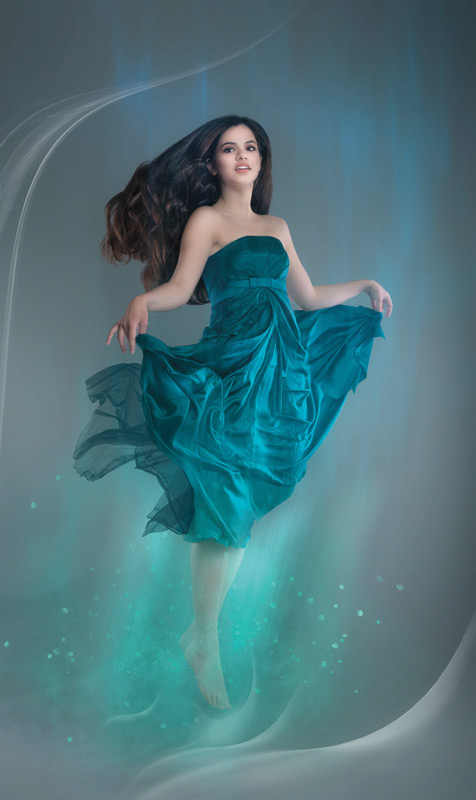
Where do photographic ideas come from? For Cristina Pascu-Tulbure, one of the richest sources of inspiration has always been art. Here she explains how the paintings of Edward Burne-Jones helped transform a simple idea involving a green silk dress into an elaborate photographic artwork.
Where does inspiration come from?
For photographers, it can be tempting to look almost exclusively at other photography for ideas. We browse galleries, social media and photography websites, study the work of photographers we admire and save images that catch our eye.
But inspiration doesn’t have to come from photography.
Paintings, films, theatre, architecture, literature, fashion, music and even everyday objects can all provide the starting point for a photographic idea.
The important thing isn’t necessarily to copy what you see. Instead, look at why something catches your attention and consider how you could translate that quality into your own photography.
For me, one such source of inspiration has been the work of the British artist Edward Burne-Jones.
An idea begins with a green silk dress
I had wanted for some time to photograph a light, floating dress, perhaps with the model jumping so that the fabric appeared suspended around her.
I wanted the resulting image to be more than simply a pretty dress and a beautiful model. I wanted something intriguing and enigmatic, although at that stage I wasn’t entirely sure what that something would be.
Then, one afternoon, I came across a green silk dress.
Suddenly, things began to fall into place.
I arranged a shoot with Mara, a friend’s daughter, and photographed her wearing the dress. Some of the resulting images had an interesting sense of weightlessness. She appeared almost suspended in the air, caught somewhere between movement and stillness.
Looking at the images reminded me of the enigmatic female figures in the paintings of Edward Burne-Jones.
The colour was particularly significant. The blue-green of the dress immediately suggested some of his paintings, including The Depths of the Sea and The Sirens.
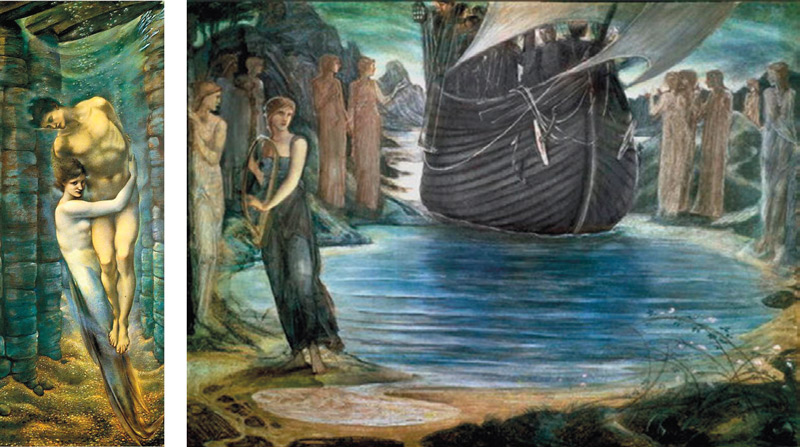
I initially experimented with creating an underwater atmosphere in Photoshop, researching ways of introducing the appearance of water, ripples and bubbles.
The result wasn’t quite the finished idea, but it gave me something important: a direction.
The sense of stillness, unease, floating figures and water became ingredients that I could carry forward.
Look beyond the obvious
This is one of the most useful lessons I have learned about creative photography.
When something inspires you, don’t necessarily try to reproduce it.
Instead, break it down.
Ask yourself:
- Is it the colour that attracts me?
- Is it the composition?
- Is it the lighting?
- Is it the sense of movement?
- Is it the subject?
- Is it the atmosphere?
- Is it the relationship between the figures?
- Is there a particular emotion?
- Is there something ambiguous that makes me want to look for longer?
Once you understand what attracts you, you can start thinking about how to use that quality in your own work.
In my case, I wasn’t trying to make a photograph that looked like a Burne-Jones painting. I was taking individual ideas from his work and combining them with my own photographic approach.
Experimenting with composition
I had also wanted to experiment with a particularly tall vertical composition.
Rather than simply using a conventional portrait orientation, I wanted a much taller space, roughly equivalent to two squares stacked on top of one another.
Looking again at Burne-Jones’s work provided further inspiration.
His figures are often arranged almost rhythmically within the picture. They aren’t necessarily there simply to represent individual people; their repetition and positioning become part of the composition itself.
That suggested another possibility.
Why not use several versions of the same person?
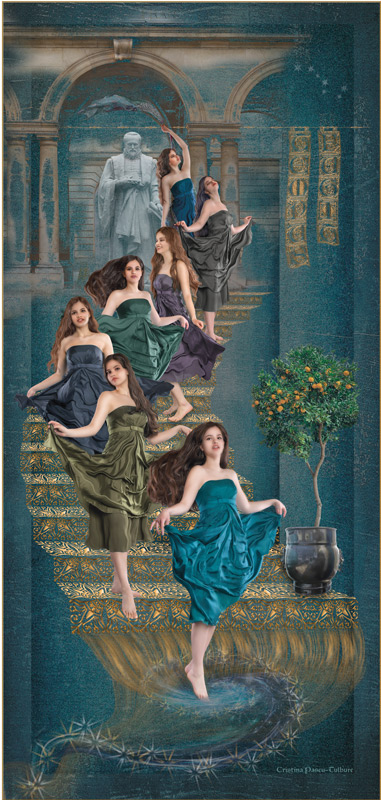
Instead of photographing seven different models, I could photograph Mara in different positions and combine the resulting images into one composition.
The idea began to develop.
Seven figures appeared to float through the image, creating a sense of movement and depth.
But something was still missing.
Building the idea
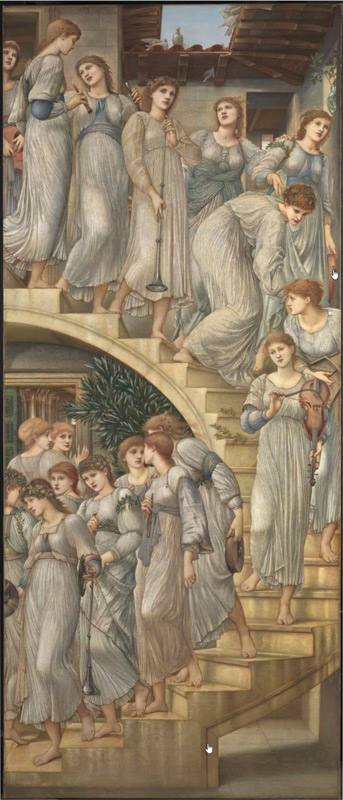
Another Burne-Jones painting, The Golden Stairs, provided the next piece of the puzzle.
The painting features a winding staircase and repeated female figures descending through the composition.
The idea of descending figures appealed to me because it introduced another layer of meaning.
Why are they going down rather than up?
Could the movement represent something beyond the physical action?
I began experimenting with staircases, including real locations, but eventually decided to create my own.
The staircase became a major visual element in the composition.
I also introduced arches, colour and other elements inspired by Burne-Jones’s work, while allowing the photograph to develop into something of its own.
This is an important part of creative work: the original inspiration doesn’t have to determine the final image.
An idea can change considerably between the moment you first encounter it and the moment you finish the photograph.
Finding the meaning
As the composition developed, I began thinking about time.
The seven figures could represent the seven days of the week. Their descent could represent the passing of time, disappearing into a space that seemed to collapse below them.
That led to the title Tempus Fugit – Latin for “time flies”.
The title then helped me identify further elements that could support the concept.
A statue of Guillaume Budé, a Renaissance scholar associated with the study of ancient measurements, became a symbolic figure at the top of the staircase.
A constellation was introduced.
The staircase appeared to disappear into a distorted, almost liquid space.
The different elements were no longer simply decorative. They were beginning to contribute to the story.
This is where inspiration becomes visual storytelling.
You don’t have to understand everything immediately
One of the most useful things about this process was that I didn’t begin with a complete concept.
I started with a dress.
Then came the feeling of weightlessness.
That led to Burne-Jones.
His colour palette and figures suggested water and stillness.
That led to the vertical composition.
The repeated figures suggested a staircase.
The staircase suggested descent.
The descent suggested time.
Eventually, Tempus Fugit emerged.
Creative projects don’t always develop in a straight line.
Sometimes the best approach is to allow an idea to evolve and see where it takes you.
Inspiration isn’t imitation
Studying other artists doesn’t mean copying their work.
In fact, one of the most productive ways to use inspiration is to identify the underlying principles rather than the finished image.
You might look at a painting and be fascinated by its colour palette.
Another might inspire you because of its use of negative space.
A film might give you an idea for lighting.
A piece of architecture might suggest a composition.
A piece of music might inspire the mood of a portrait.
The final photograph can then become something entirely different.
For Tempus Fugit, I borrowed ideas about composition, colour, symbolism, repeated figures and movement from Burne-Jones, but the final image became my own photographic interpretation.
Try an inspiration exercise
The next time you are struggling for a photographic idea, don’t immediately open Instagram or Pinterest.
Choose something completely different.
Visit an art gallery.
Look through a book of paintings.
Watch a film without concentrating on the story.
Study a building.
Look at theatre posters or album covers.
Then choose one thing that catches your attention and ask yourself:
What exactly do I like about this?
Don’t stop at “I like it”.
Try to identify the individual ingredients.
Is it the colour?
The lighting?
The composition?
The repetition?
The atmosphere?
The symbolism?
The movement?
The scale?
Then take one or two of those ideas and see how you could translate them into photography.
You don’t need to reproduce the original.
You need to understand what made it work for you.
Let the idea develop
One of the dangers of creative photography is trying to work everything out before you begin.
Sometimes it is better to start with one small idea and allow it to develop.
A dress can become a colour palette.
A colour palette can lead to a painting.
A painting can lead to a composition.
A composition can suggest a narrative.
And a narrative can ultimately lead to an image you could never have imagined at the beginning.
That is the exciting part of creative photography.
Don’t just photograph what you see. Look at what inspires you, understand why it inspires you, and then use those ideas to create something of your own.
Practical ways to find photographic inspiration
- Visit art galleries and study paintings.
- Watch films and pay attention to lighting, composition and colour.
- Look at theatre sets, costumes and stage design.
- Study architecture for unusual shapes and perspectives.
- Read literature and look for visual ideas within descriptions.
- Keep a notebook or digital collection of ideas.
- Don’t restrict yourself to photographers working in your own genre.
- When an image catches your attention, ask yourself why.
- Experiment with one idea rather than trying to create the perfect finished image immediately.
- Allow your original concept to change as you work.
About Cristina Pascu-Tulbure
Cristina Pascu-Tulbure has a lifelong interest in the relationship between text and image and specialises in 19th-century literature and visual culture. Her academic work included research into Edward Burne-Jones, the Pre-Raphaelite movement and his position within the British and international art scene.