Photographing the Ryder Cup: Inside the 2014 Gleneagles Assignment
by Ian Cook
I can’t believe that it has been four years since I was walking around the Celtic Manor Twenty Ten course, covering the first ever Ryder Cup in Wales. Four years later, here I am covering the same event again, but this time in Scotland and at the stunning Gleneagles course.
It’s been a totally mad year for me: the Champions League Final in Lisbon, the Commonwealth Games in Glasgow and now the Ryder Cup.
Once I knew I had a pass for the Ryder Cup, the panic set in. Accommodation, flights and driving arrangements all needed to be arranged. I managed to book a fairly cheap B&B in the heart of Glasgow, about a mile from one of the designated media hotels.
For the record, the reason I didn’t stay in one of these designated hotels was the cost of the rooms. They are expensive at the best of times.
So, like the Commonwealth Games, it was a case of ensuring all my camera gear was ready, wet-weather gear was packed and plenty of clothes were available. The gear is pretty much standard and I took the following:
- Nikon D4 and D3
- Nikon 70-200mm f/2.8
- Nikon 24-70mm f/2.8
- Nikon 300mm f/2.8 with 1.4x converter (420mm f/4)
- Nikon SB-910 x 2
- Panasonic Lumix GH4
- Panasonic 8mm f/3.5 fisheye
- Panasonic 7-14mm f/4
- Panasonic 12-35mm f/2.8
- Panasonic 35-100mm f/2.8
- Panasonic 100-300mm f/4-5.6
- MacBook Pro
- Card readers x 2
- Monopods x 2
- Battery chargers
As I was getting the plans in place to cover what would be my second Ryder Cup, I started to realise I would have to drive to Scotland again. I had sworn that I would never drive to Scotland again after the Commonwealth Games, but as my kit list was growing I had no choice.
So that was it. I was driving.
Arriving at Gleneagles
From a media point of view, the Ryder Cup runs from Monday until Sunday and is broken up into four practice rounds and three competition days: foursomes, four-ball and then singles matches.
I arrived in Scotland on the Wednesday, which gave me a chance to get my bearings and book into the B&B.
On Thursday morning I took myself and my gear to the media pick-up point and jumped onto the coach. One hour and 20 minutes later I arrived at Gleneagles.
I was greeted by the same airport-style security measures that had been used during the Olympics and Commonwealth Games. Once through security, it was a case of trying to find the media centre. I had no clue where it was!
After asking security staff, I found the media centre, showed my accreditation letter, picked up my pass, meal band — very important — and Wi-Fi login details.
Then it was a case of finding my workspace, getting the camera gear ready and heading out onto the course.
Here is where the challenges started for me.
When I covered the Ryder Cup in 2010, I knew the course like the back of my hand. I knew where all the shortcuts were to get to various holes. At Gleneagles, however, I had no clue about the layout, so the practice day was more of a scouting mission around the course.
An email was received from the Ryder Cup media team telling us that a section of the main stand had been allocated to media on a first-come, first-served basis.
I already had a plan to get a particular shot, so I knew Friday was going to be an early start followed by a long day.
3:30am start
Friday, 3:30am. My alarm rang and, after my shower, I caught a taxi to the media drop-off point.
The first media bus was at 4:30am and I was one of the first on it. Because of the early morning and lack of traffic, we made good progress and arrived at the course at about 5:45am.
I got myself sorted — weather gear on, Think Tank modular belt system on — and headed out to get to the back of the grandstand.
It was really scary getting up the metal steps carrying loads of kit.
I was one of the first people on the stand, picked my spot right in the middle and the waiting game began.
The Ryder Cup is one of the best atmospheres I have been lucky enough to witness. It makes the hairs on the back of your neck stand up.
As the time got nearer for the first tee-off at 7:30am, the stands were filling quickly.
It soon became apparent that I would not get the shot I wanted, as I wasn’t tall enough, even though I was on the highest step.
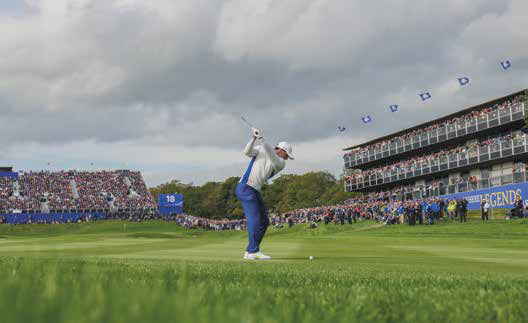
So I got my Lumix GH4 and put on the 8mm fisheye, which is equivalent to a 16mm fisheye in 35mm terms.
Due to the Wi-Fi capabilities of the camera, I could use my smartphone to change all the settings and see what the camera was seeing. I put it on the monopod and positioned it about six feet in the air.
The light was getting brighter by the minute leading up to the first match, but because I could change the settings on the smartphone, this wasn’t a problem for me.
Once the players arrived on the tee, the place erupted. It was electric.
But I was prepared and, as the European team lined up to tee off, I was ready and fired the camera from the phone.
As soon as I got this shot and checked it, it was a case of working my way through the crowd to get down onto the course.
The course was full of spectators and luckily I managed to get hold of inside-the-ropes access, which meant I didn’t have to fight the crowds.
Being Welsh, I decided to follow newcomer to the Ryder Cup, Jamie Donaldson.
Following the action
The Ryder Cup is broken up into two sessions, mornings and afternoons — four-balls in the morning and foursomes in the afternoon. This repeats on the Saturday, with Sunday being singles day.
The Friday and Saturday were spent trying to get images of every golfer, plus a mix of fans and landscape shots.
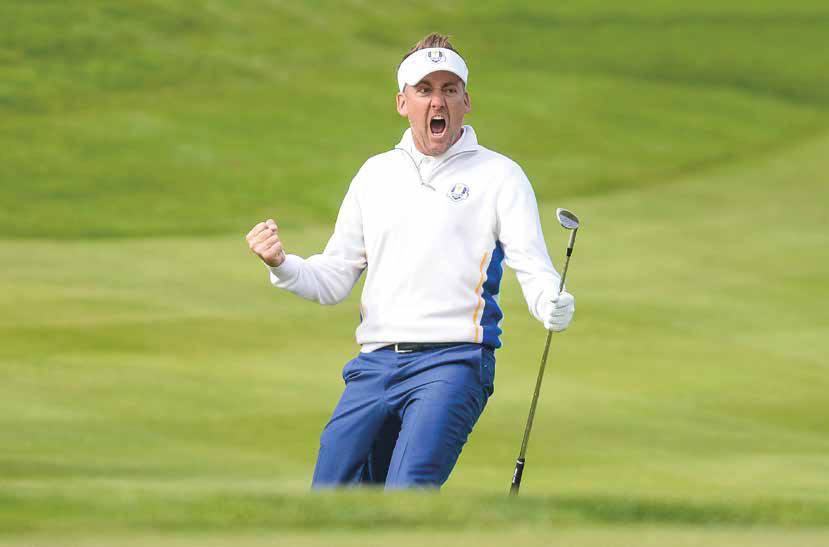
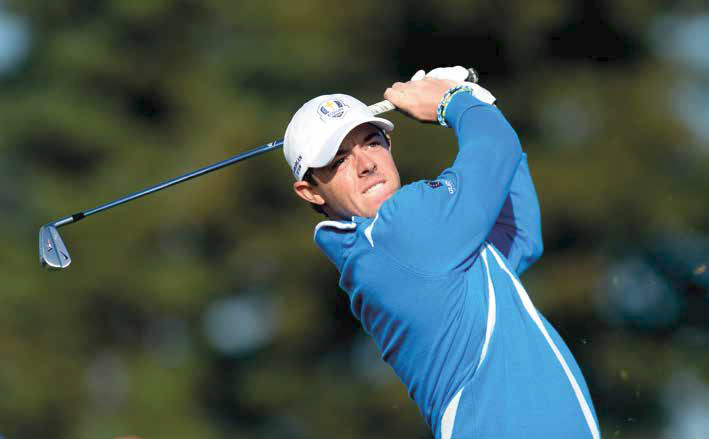
The Saturday session seemed very routine, but I was following Rory McIlroy and Ian Poulter down to the 18th, which was a dogleg right.
Poulter had ended up in the rough on the left-hand side of the fairway, so I got up close and got an OK shot of him hitting out.
Then it was McIlroy’s turn.
I saw a TV crew standing in the rough about 20 feet or so from him. I got my Lumix GH4, which has a silent shutter, and dived onto the grass next to the TV crew.
I was soon joined by another photographer who had the same thought as me, except he had a 1D X and I had a GH4.
This meant I got the shot of McIlroy on his backswing and not the one of him after he’d struck the ball.
People ask me why I like this shot. It’s because there is a media regulation in golf that you are not allowed to photograph the player until the ball has been struck, as the noise of the shutter can put the players off.
So, apart from broadcast, I have the only shot of McIlroy — that I know of — on his backswing on the 18th.
Singles day
When Sunday came around, it was tough getting the body to move as I was struggling from all the walking I had done during the previous four days.
But this was singles day.
This is the day that makes or breaks the situation.
Europe were in a strong position, but two years previously the USA had been miles ahead and only needed a handful of points to win. Europe found strength from somewhere and had the mother of all comebacks to win.
So this was at the back of everyone’s mind.
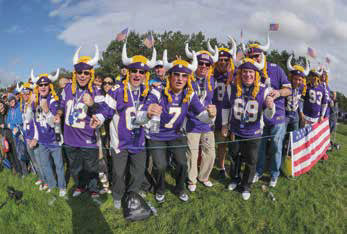
When the teams started teeing off, the atmosphere was electric.
I heard the crowd singing when GMAC, Graeme McDowell, walked onto the tee:
“You got Big Mac, we’ve got GMAC.”
It made everyone laugh.
I managed to get hold of a radio so that I could listen to the commentary throughout the day, as I knew the Cup could be won if results went our way.
At first Europe were doing OK, but Graeme McDowell was three down, so it looked as though he wouldn’t be getting one of the required points for Europe.
Being the only Welsh photographer at the Ryder Cup and having the only Welsh player, Jamie Donaldson, I thought I would wait at least until he teed off.
Once Jamie had left the tee, I followed him down to the second green, where the ninth runs alongside.
At this point I jumped across to the ninth to catch whoever was coming through.
This was a good location as it meant I didn’t have to travel as far to get to the 12th.
I had missed McDowell and saw that Stenson was coming down the ninth. I followed him down to the green, where I waited for Rory McIlroy to come through.
At this point McDowell was two up in his round — bearing in mind he had been three down after six or so holes — but Rory was four up, which meant he could potentially win his round on the 13th or 14th hole.
So I waited and followed McIlroy around until I got to the 13th, and then made a decision to jump across to the 15th green and wait for him to hopefully win it on the 15th.
My plan backfired because McIlroy went and won his match on the 14th.
Disaster.
But hey, sometimes that’s how it goes.
The final stages
At this point it was a case of two more points being required.
Kaymer was three up and could win on the 15th or 16th if he held his nerve.
I picked up Kaymer on the 14th fairway and followed him down, but both the 14th and 15th holes were squared.
So I continued to follow him down onto the 16th, where Kaymer had hit his shot into the rough, just to the right of the green. Watson was just short of the green.
I positioned myself opposite Kaymer’s position and was on a wide lens as the crowds were all assembled on the embankment.
I was thinking this would be a great shot if he pulled this chip off.
My thoughts of a wide shot were quickly ruined by two TV crews who stood about 10 yards in front of me. I had no time to move, so I quickly picked up my 300mm lens and went in tight on Kaymer.
He holed the chip.
The place went crazy.
So did Kaymer.
I got nice celebration shots of him, but I wanted the wide shot, so at that point I was pretty annoyed with the TV crews.
Kaymer had won his point for Europe and now only one more was needed.
I looked at the scores. Thomas Bjorn was losing his game, Garcia was all square at that point, only Poulter and Donaldson were up in their games, and then I noticed Donaldson had moved to four up.
The way the scores stood, Poulter would need to finish on the 18th to win his point, but Donaldson could win on the 13th, 14th or 15th.
I picked myself up.
I was feeling very weak and tired at this point. I had finished all my water supplies and had no food.
Anyway, I made my way up to the 13th tee, which was about a quarter of a mile away.
I got there and Donaldson had teed off and was halfway up the fairway. I walked as quickly as I could to catch up.
Donaldson won another hole and went five up, meaning the next hole could be all over.
I doubt there were any photographers elsewhere on the course. The green was surrounded by snappers and we were all waiting for Donaldson to hole his putt and then for all hell to break loose.
He missed the putt and the hole was all-square.
It moved onto the 14th and this time the US won a point back.
I was thinking Donaldson’s head had gone and he was going to fold.
I started to think that maybe Poulter could get the vital point if he had a good run on the last few holes.
All these thoughts were going around in my head.
I followed the crowd of photographers down onto the 15th green, and at this point no one was photographing the players teeing off. It was a case of trying to get onto the green to get the best position possible.
I arrived on the green and positioned myself to the back right of the green and sat down.
Donaldson was just a speck up the fairway.
He hit his shot and it landed about three feet from the pin.
The place went nuts.
I was tracking Donaldson’s walk down to the green and hoping to see him finish and putt to win the point, but the US player, Bradley, conceded and all hell broke loose from a photographer’s standpoint — the scrum, as we call it.
I stay away from them as it’s dangerous. I pay for my own kit and don’t want it damaged.
What I didn’t realise was that McIlroy, Garcia and Stenson were standing beside me.
I was caught right in the middle of a mini scrum.
So I grabbed the Lumix GH4, which had my widest lens, and started shooting.
Then it all calmed down because play was still going on in the other matches. Lee Westwood was making his way down the fairway in his game.
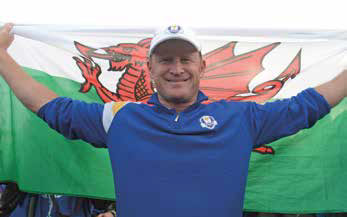
I managed to get up to Donaldson and briefly spoke to him, explaining that I was the only Welsh photographer there.
I asked if he would hold the Welsh flag.
He did.