Shooting the Six Nations: Inside the World of International Rugby Photography
by James Gunn
I have been a part-time, freelance sports photographer since 2008, capturing sporting action in Caithness for local, regional and national newspapers. I live near Thurso on the north coast of Scotland, not far from John O’ Groats, well away from the country’s big towns and cities where all the major sporting action takes place.
However, I have had the fantastic opportunity to cover Scotland’s home matches in the RBS Six Nations Rugby Championship since 2010, and was delighted to gain media accreditation to cover the 2013 championship.
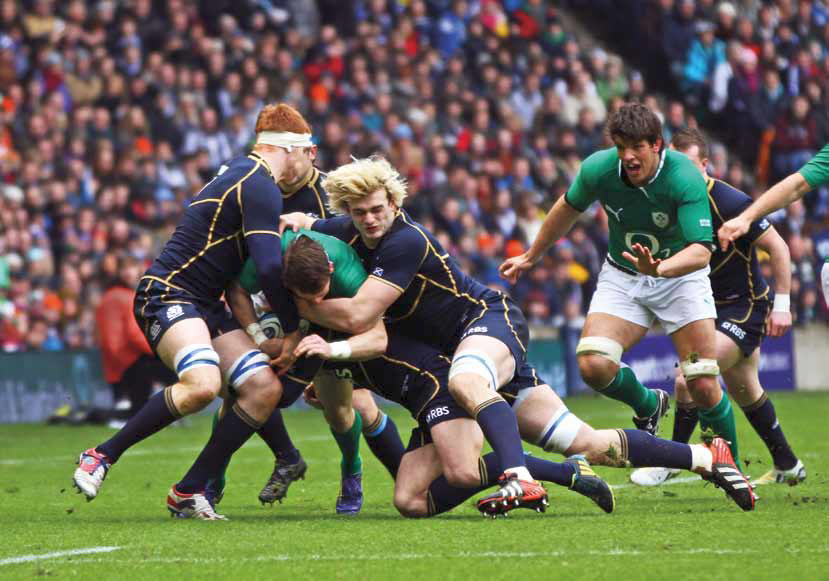
Scotland had three home games: against Italy, Ireland and reigning champions Wales. The championship is described by many rugby commentators and purists as the greatest annual rugby tournament in the world. This is due to the highly competitive nature of the six evenly matched sides, the sell-out crowds that fill the large stadia and the huge worldwide television audience.
The only slight problem is that the matches are played at Murrayfield Stadium in Edinburgh, which means a six-hour drive down the notorious A9. With the games being played in February and early March, there was always a risk of snow causing chaos on the road. Fortunately, conditions were good for my journeys. The car was full on these trips, as my wife and children took the opportunity to visit relatives and spend money in the big city shops!
For the Ireland match I travelled by Citylink public bus. During February they had a fantastic offer of travelling anywhere in Scotland for only £2, a massive saving from the normal £49 single fare. The journey took nearly eight hours, but it was the most relaxing and enjoyable trip on the A9 that I have ever had. I just sat back, read some photography magazines and admired the beautiful and rugged Scottish scenery. It was great to let someone else deal with all the hassles of driving.
Parking at Murrayfield is a big problem due to the lack of space and I’m fortunate to have a relative who gives me a lift and drops me off near the stadium. Having my heavy gear packed in a trolley case is a real boon when walking the half mile to the ground alongside the fans.
I pack my Canon 7D and 40D along with my Canon 70-200mm f/2.8L IS USM II, Canon 300mm f/4L USM, Sigma 18-50mm f/2.8 EX DC and Sigma 10-22mm f/3.5 EX DC HSM. I also carry a Canon 580EX II Speedlite, laptop, spare batteries and cards, two monopods, two rain covers, gloves, hat, scarf, weatherproofs and a folding tripod stool.
As the temperature barely rose above five or six degrees for any of the games, I wore thermals and four other layers to keep the cold wind at bay.
Getting accredited
My first task is to pick up my accreditation pass and press vest from the press office located next to the north gates. There are various differently coloured vests and each colour gives access to a certain area when the match is being played.
If I want to swap ends at half-time, I have to swap vests with a photographer from the other end. With the foreign photographers, the language barrier is often overcome by lots of sign language, gestures and big smiles!
I normally arrive two hours before kick-off and drop off my gear in the photographer’s room before having a quick bite to eat in the busy press hospitality suite. The photographer’s room is small and gets very crowded with everyone’s gear strewn over the limited floor space.
Tea and coffee are always provided in this room and sometimes a selection of sandwiches appears at the end of the match. A match programme and the official team lines are also provided free of charge.
The stadium is geared for the early arrival of fans and there are plenty of bars, fast-food stalls, rugby sports shops and live music entertainment. Unlike football matches, the fans from both sides freely mix with each other and enjoy a beer or two along with some friendly banter.
Many fans make the effort to dress up for the occasion, normally in a theme that matches their country. Welsh fans have daffodil or dragon costumes, the French sometimes dress as Asterix the Gaul or cockerels, the English as medieval knights and the Irish as leprechauns complete with Guinness hats. It all adds to the atmosphere and I often take the opportunity to wander around before the match and photograph the more colourful characters.
Getting the exposure right
Around 40 minutes prior to kick-off, both teams come onto the pitch to undertake a warm-up. This gives me an opportunity to set up my camera, take a few practice shots and get tuned in.
All three matches were played in grey and dull conditions and this meant that an ISO setting of around 1,250 was needed to get a shutter speed of 1/1000sec at f/2.8. However, as the matches progressed into the late afternoon, the daylight started to fade and the ISO had to be increased to compensate.
When the floodlights start to dominate over the daylight, it is time to change the white balance from daylight to a lower Kelvin value. The tungsten or fluorescent WB settings can often give the right skin tone, but sometimes it is a matter of manually dialling in a value of between 4,000 and 5,000K.
If the WB setting is not changed when the floodlights are dominant, the skin tone becomes too orange or yellow in colour, even when in Auto WB mode.
I like to freeze the action at 1/1000sec, but during floodlit night matches or really dull days, I have been known to drop down to 1/640sec to avoid racking up the ISO and the resulting noisy images.
The good thing about an overcast day is that it results in even lighting and harsh shadows are avoided. When half of the stadium is brightly lit by the sun and the other half is in shadow, it plays havoc with getting the right exposure.
In these situations, turning the ISO setting to Auto and manually setting the shutter speed and aperture means that the camera automatically does the work to get the correct exposure as the light changes.
When the teams line up for the national anthems, it is a good time to zoom in and get clean portrait shots of each player. These can sometimes be used as stock images by newspapers.
Finding the right position
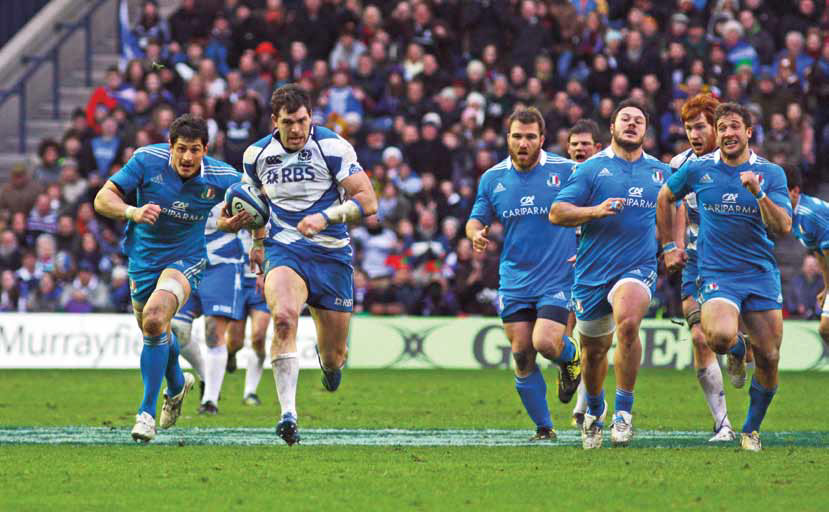
My coloured bib for the three matches put me behind a try line. This suited me as I like to have the players running towards me in full flow.
I position my seat halfway between the corner flag and the goal posts to catch the action in that quarter of the pitch with my 70-200mm lens. I also have my 300mm lens set up on my second camera and use this one when the action is more than 40m away.
I have both rigs on monopods and when it is time to swap over, I simply drop one onto my knee and pick the other one up from my other knee. This takes around four seconds and usually means I don’t miss any of the action – but not always!
My lenses are too short to capture the action at the other end of the pitch and it can be frustrating at times, especially when the team playing towards the other end is totally dominant. Despite all the preparation and planning, lady luck is involved in being in the right spot at the right time.
To take advantage of that luck, total concentration is needed at all times and my eye and trigger finger are always poised in position on the camera.
It can be difficult to enjoy the game when having to view it through the viewfinder for most of the time. At the end of a match, my eyesight can take a while to adjust back to normal viewing.
When autofocus lets you down
The games in 2013 were the best yet in terms of atmosphere, as Scotland actually played their best rugby for many years, beating Italy 34-10 and Ireland 12-8, while also giving champions Wales a good run for their money, losing 18-28.
The Italy game was particularly good as five tries were scored and there was lots of fast, open play. This game had an added bonus as one of the match mascots was the son of work colleagues. They asked me to take photographs of his big moment when the 22 mascots lined up in front of the players to sing the national anthem, Flower of Scotland. My photograph made the front page of two local newspapers.
The three games were very different. The best and most exciting was the Italy match as Scotland scored four tries to Italy’s one. It was the first time in 10 years that the Scots had scored four tries. They scored three breakaway tries at my end of the pitch and I managed to get a good, clear shot of Matt Scott’s touchdown.
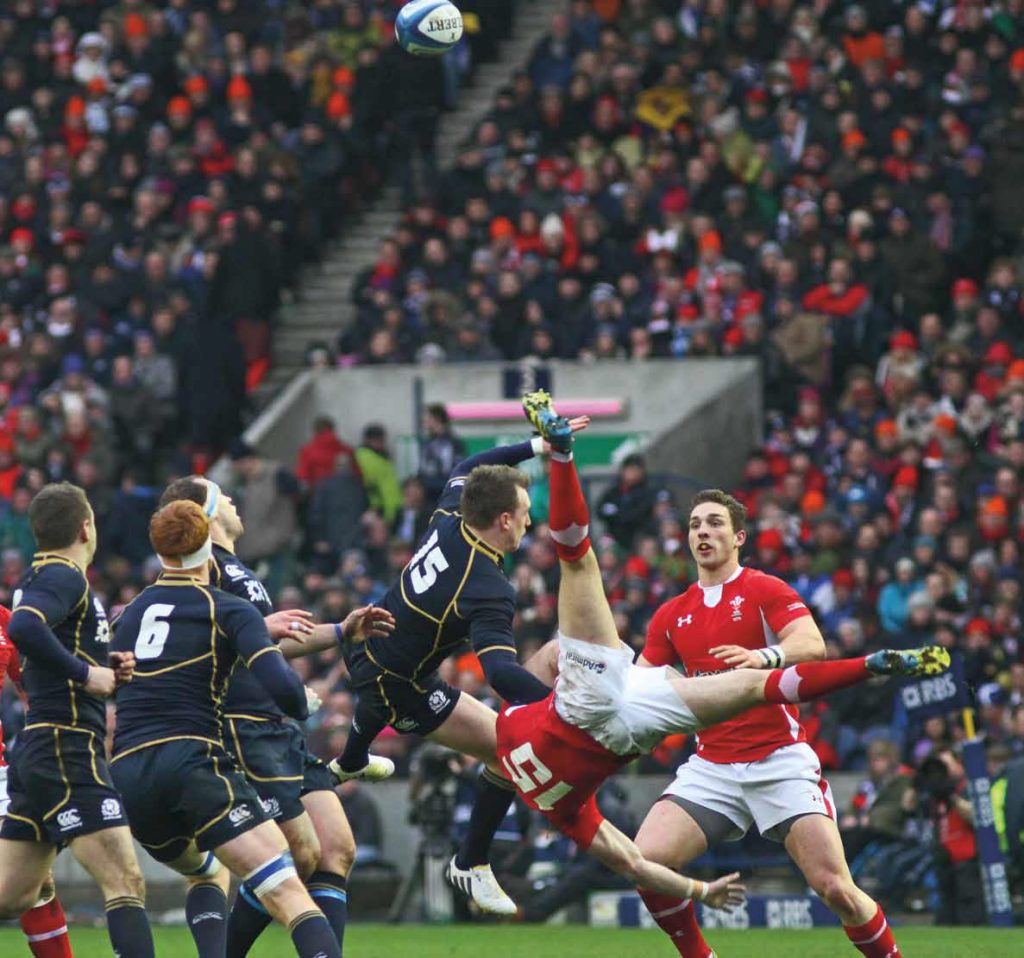
However, the most spectacular touchdown was when Stuart Hogg flew through the air as he crossed the line. Unfortunately, my pictures of this were out of focus.
I only activate the camera’s centre focus point as it is the quickest reacting and most accurate. The downside is that I have to be really accurate in pointing the centre of the viewfinder at the player with the ball when I press the shutter.
Hogg was quite a distance away and therefore small in the frame. I inadvertently focused on the front row of the crowd, which was 10m behind him. Even though I tracked him in AI Servo mode and high continuous shutter speed at 8fps, the camera never readjusted.
I find that this problem happens once or twice in any game. One way around this is to repeatedly ‘feather’ the shutter button. As I track a player in AI Servo mode, with the shutter button half or fully depressed, I take the pressure off the shutter button, readjust to point the centre of the frame at the player’s torso and quickly depress again.
This deactivates and then reactivates the focusing mechanism and minimises errors.
The natural reaction during an action sequence is to keep the trigger fully depressed while in continuous mode, with the hope that the vital moment will be perfectly captured. However, with practice, feathering can be very quick and efficient.
Learning from every game
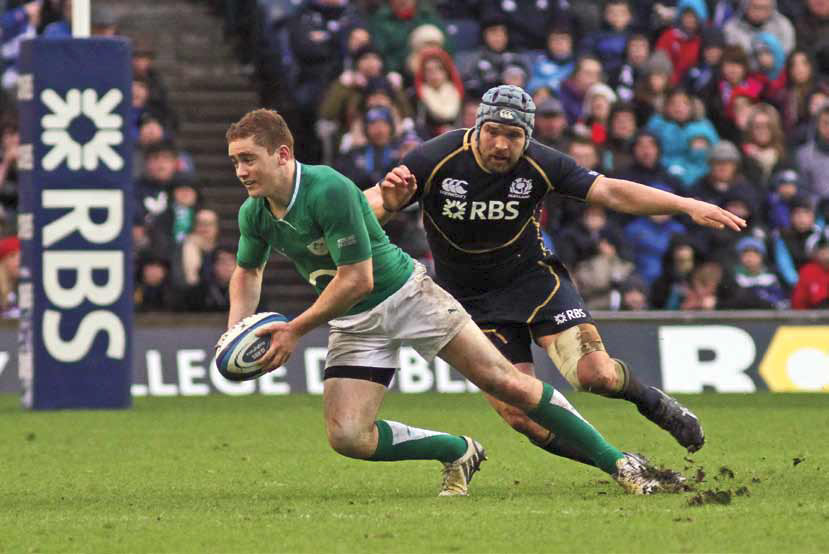
For the second game, on 24 February, it was a total mystery as to how Scotland beat Ireland 12-8. The Irish were totally dominant, having 70% possession and territory, 124 carries to Scotland’s 35, 310 metres made to Scotland’s 122 and 44 tackles to the Scots’ mind-boggling 128.
Talk about backs to the wall! It just goes to show that the only statistics that count are the points on the board, and these were all thanks to the boot of Greig Laidlaw. Ireland scored the only try and it was at the other end of the pitch.
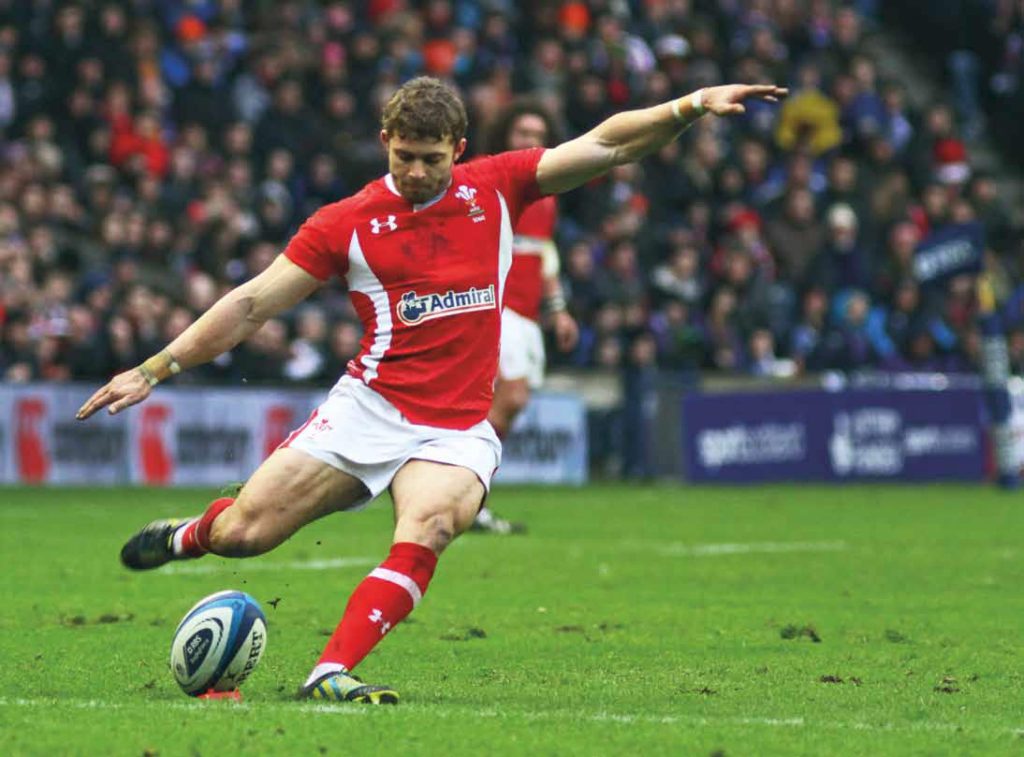
The Wales game was a boring, stop-start affair with a mind-numbing 28 penalties awarded. This statistic is apparently a world record for an international game. However, it meant that I got some good, clear shots of Wales’ Leigh Halfpenny and Scotland’s Greig Laidlaw kicking for goal.
It is good to capture all aspects of a rugby match and kicking is often a vital factor in winning a match.
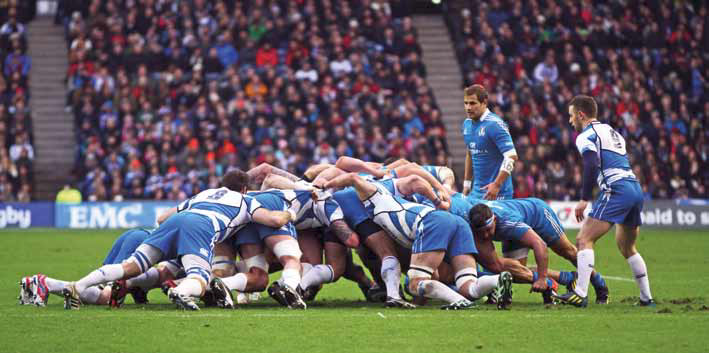
The scrum is another vital component, but it is very difficult to snap a good image as scrums are generally static and all you can see are legs, arms and bums!
Lineouts offer a good opportunity for an eye-catching image, from either a side-on view or a direct frontal view. My position at Murrayfield meant that I could only capture a side view.
The teams have lots of tactics at lineouts and the ball can be thrown just about anywhere for both height and length. This uncertainty makes it difficult to capture an image with good composition and sharp focus.
A trick is to close down the aperture from the normal f/2.8 to f/4 to increase the depth of field and thus give a better chance of a sharp image. Also, go for a wider view to increase the likelihood of capturing the ball in the picture.
If too wide, a tight crop can easily be made on the computer. If too narrow and there is no ball in the frame, there is no chance of recovery. For ball games, it is normally essential to capture the ball in the image to show instantly what game is being played.
Looking for something different
I’m always on the lookout for something different that will catch the viewer’s eye.
The Wales game produced an unusually high number of opportunities. The first was when a Welsh player was down injured and the physio treated the groin area with a tin of spray that created a mini white cloud.
The second was when Scotland’s Ritchie Gray was injured and had to be stretchered off on a four-wheeled buggy.
The third happened when Scotland full-back Stuart Hogg was warming up for the second half by doing a series of kangaroo-type jumps. I managed to catch him in mid-air with his knees at chest level.
Wales scored the only try of the game and it was at my end of the pitch this time. However, it was a push-over try through a mass of players and a clear view was not possible. So no luck yet again!
The tremendous roar from the 67,000 crowd when Scotland were on the attack was something special and made the hairs on my arms stand up.
International rugby is a totally different experience from snapping the action in Thurso’s local park when Caithness RFC play in front of a crowd of 50.
Despite the long distance, time and effort involved in capturing the action in Edinburgh, the experience is a sports photographer’s dream.
It can only be topped by getting a commission to capture the British Lions tour of Australia. Unfortunately, that really is just a dream!