Documentary Wedding Photography: How to Capture Real Moments
By Kevin Mullins
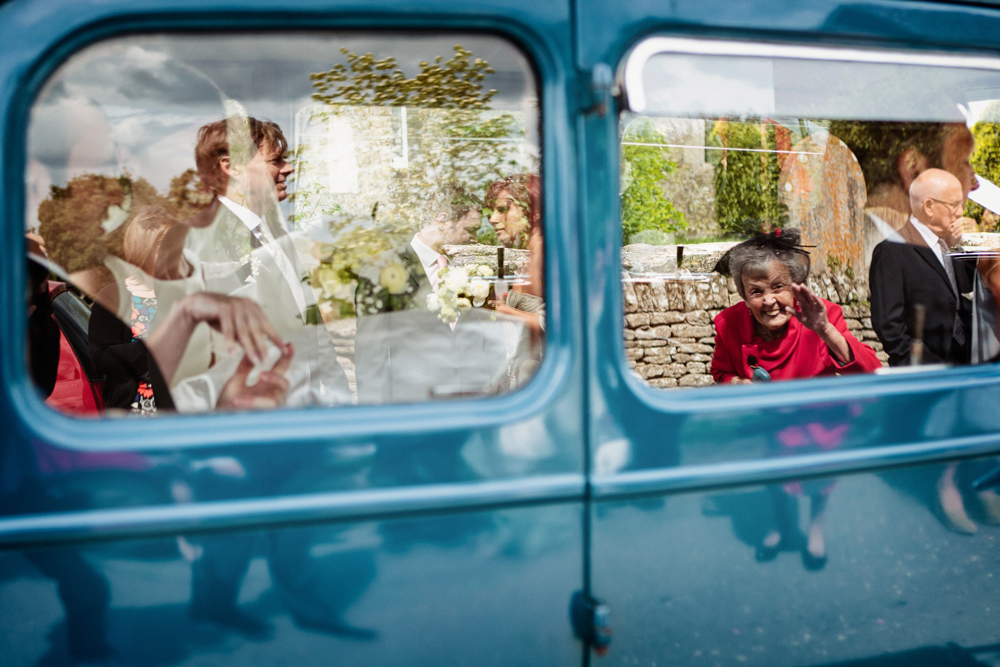
Documentary wedding photography is ultimately about seeing.
You can have the best camera, the fastest lens and all the technical knowledge in the world, but none of that guarantees that you’ll recognise the moment worth photographing.
The appeal of documentary or reportage wedding photography is that the photographer isn’t trying to manufacture every photograph. Instead, the aim is to observe the day as it happens, anticipate what might happen next and be ready when an important, funny, emotional or unexpected moment appears.
That doesn’t mean simply standing in the corner and hoping something happens.
Good documentary photography requires a great deal of observation, positioning and decision-making.
Don’t just look through the viewfinder
One of the most useful skills for photographing real moments is learning to observe the entire scene rather than concentrating solely on what’s inside the frame.
At a wedding, something interesting may be happening just outside your view.
Listen for laughter, movement or a change in the atmosphere. Watch people’s reactions. Look at what is happening behind your main subject. Notice who is looking at whom.
Keeping both eyes open while photographing can help with this.
One eye can be concentrating on the photograph while the other gives you a wider view of what is developing around you.
It takes some practice, but eventually it becomes much easier to monitor the wider scene while still composing an image.
The result is that you’re more likely to notice something before it happens rather than reacting after the moment has already passed.
Anticipate rather than manufacture
The best documentary photographs often aren’t completely unexpected.
The exact moment may be unpredictable, but the circumstances leading up to it are often visible.
Imagine seeing a bride waving to a relative approaching a wedding car.
You don’t know exactly what will happen next, but you can make an educated guess. The relative may wave back. They may approach the bride. Someone else may enter the scene.
Rather than immediately taking one photograph and moving on, stay alert.
Watch.
Wait.
Give the scene a chance to develop.
You aren’t directing the people involved. You’re simply recognising that something may happen and putting yourself in a position where you can photograph it.
That is one of the key differences between luck and anticipation.
Get into the right position
Being in the right place is often more important than having the perfect camera setting.
At a wedding, you may only have a few seconds to make a decision.
Do you stay where you are?
Move closer?
Change your angle?
Look for a reflection?
Move around the back of the group?
Get lower?
Wait for someone to enter the frame?
These decisions become easier when you’ve already studied the environment.
Look at the venue when you arrive. Notice doorways, windows, reflective surfaces, paths and places where people naturally gather.
You may see a particular viewpoint that could work later in the day.
Then, when the right people move through that space, you’re ready.
Look for relationships
A wedding is full of relationships, and they provide some of the richest opportunities for documentary photography.
Don’t concentrate only on the bride and groom.
Look at parents, grandparents, children, friends and members of the wedding party.
Watch how people interact.
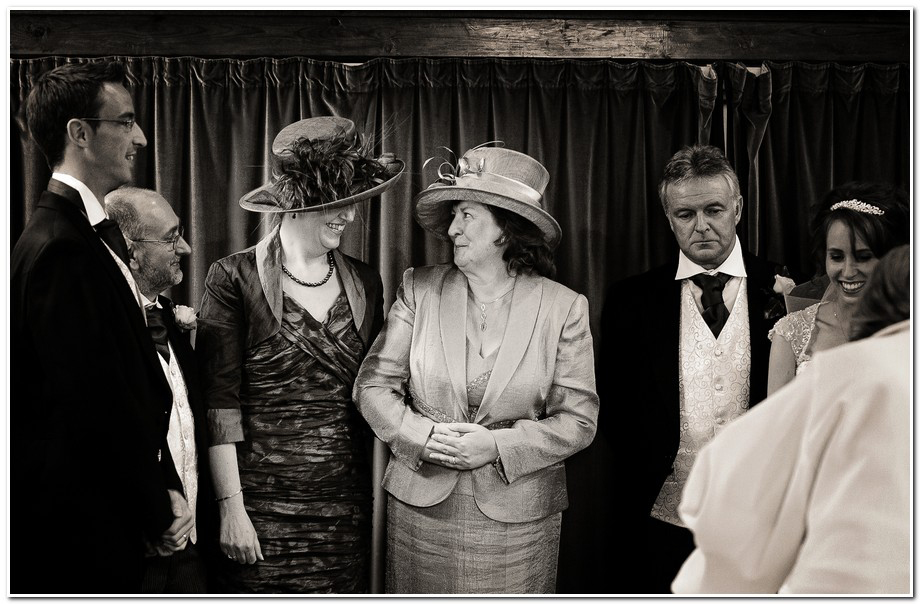
A glance between two people can say more about their relationship than a carefully arranged portrait.
A parent watching their child walk down the aisle.
A grandparent reacting to a speech.
Friends laughing together.
Two families meeting for the first time.
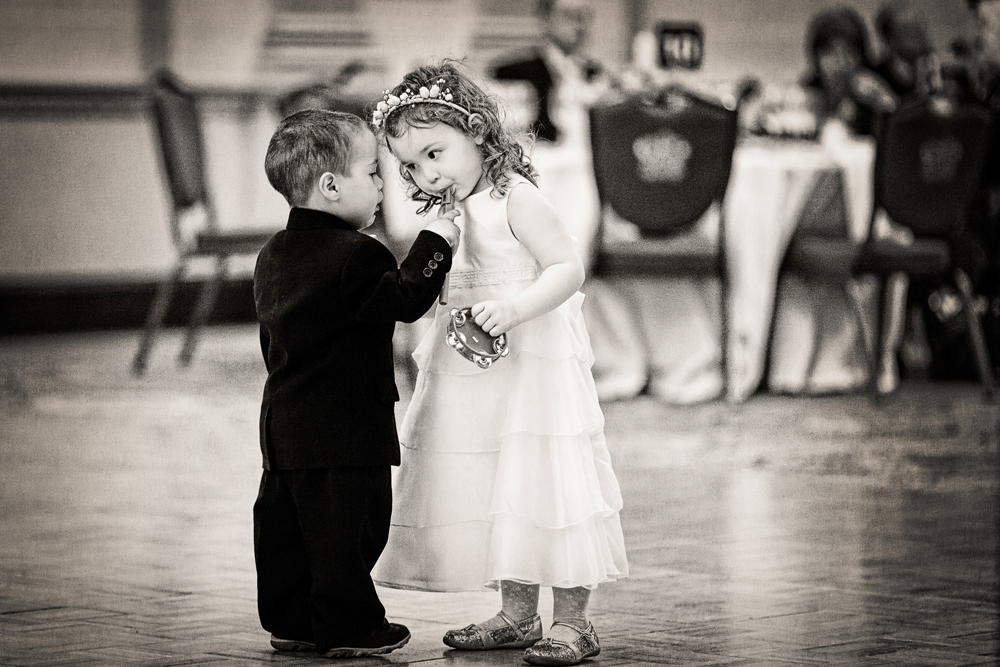
Children becoming completely absorbed in whatever is happening around them.
These moments give the photographs context and help tell the story of the day.
Context can make the photograph
There is a temptation in portrait photography to isolate your subject and remove everything else from the frame.
Documentary photography often benefits from doing the opposite.
Sometimes the people around your subject are an important part of the photograph.
A wide view of a ceremony can show the scale and atmosphere of the venue. A photograph of the bride and groom surrounded by their guests can communicate more about the day than a tightly cropped portrait.
Don’t automatically remove distractions.
Ask yourself whether they are actually distractions, or whether they help explain what was happening.
Don’t give up too early
Some of the best moments happen after you’ve been waiting for them.
A wedding reception can provide a good example.
The first dance might be relatively uneventful. The couple may simply move slowly around the dance floor while everyone watches.
It would be easy to decide that you’ve already photographed it and move on.
But stay alert.
The couple might suddenly laugh. Someone might join them. A guest might react. The groom might do something unexpected.
The photograph you want may happen in the final few seconds.
That doesn’t mean you need to photograph everything continuously. It means you should learn to recognise when a situation still has potential.
Accept imperfection
Documentary photographs aren’t always technically perfect.
They may contain movement, high ISO noise, unusual compositions, awkward backgrounds or imperfect focus.
That doesn’t automatically make them bad photographs.
Technical quality matters, but it is only one part of an image.
A photograph that captures a genuine moment and means something to the people in it can have far more value than a technically flawless photograph that says very little.
The aim isn’t to use poor technique as an excuse.
It’s to understand which imperfections matter and which don’t.
If increasing your ISO allows you to photograph something that would otherwise be lost, that may be a worthwhile trade-off.
If moving quickly means the composition isn’t textbook-perfect but you capture an irreplaceable moment, the moment may matter more.
Learn the technical side thoroughly so you can make those decisions deliberately.
Photograph the photographs people expect
Being a documentary wedding photographer doesn’t necessarily mean refusing every traditional photograph.
Couples may still want photographs of their families, the ceremony, the wedding party and the two of them together.
Those photographs can also be approached with a documentary mindset.
Instead of looking only for perfectly posed expressions, watch for genuine interactions.
Rather than photographing every moment from the same height and distance, consider whether changing your viewpoint adds something to the story.
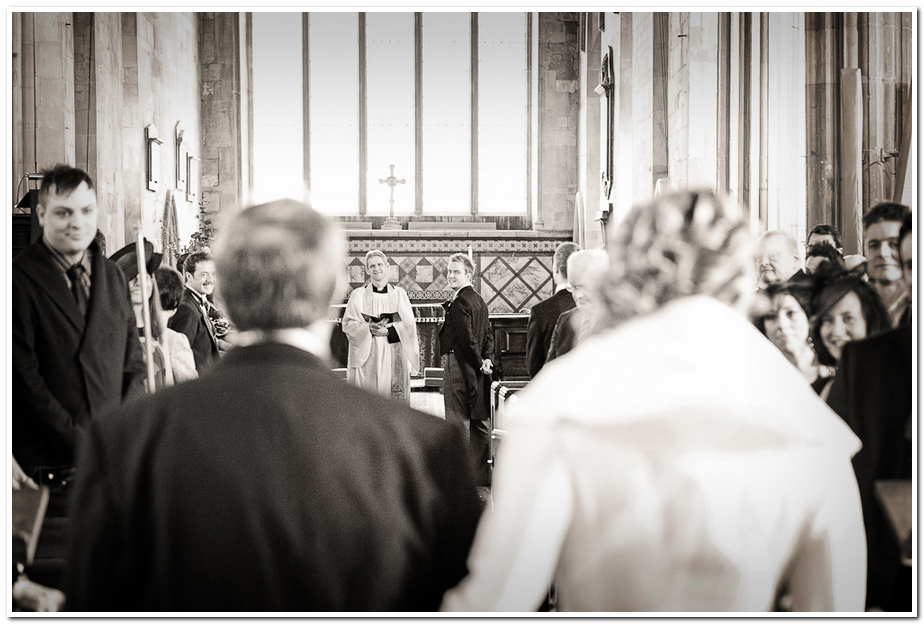
A photograph from behind the bride as she walks down the aisle can show both her and the groom’s reaction.
A wider view of the ceremony can put the couple into the context of the building.
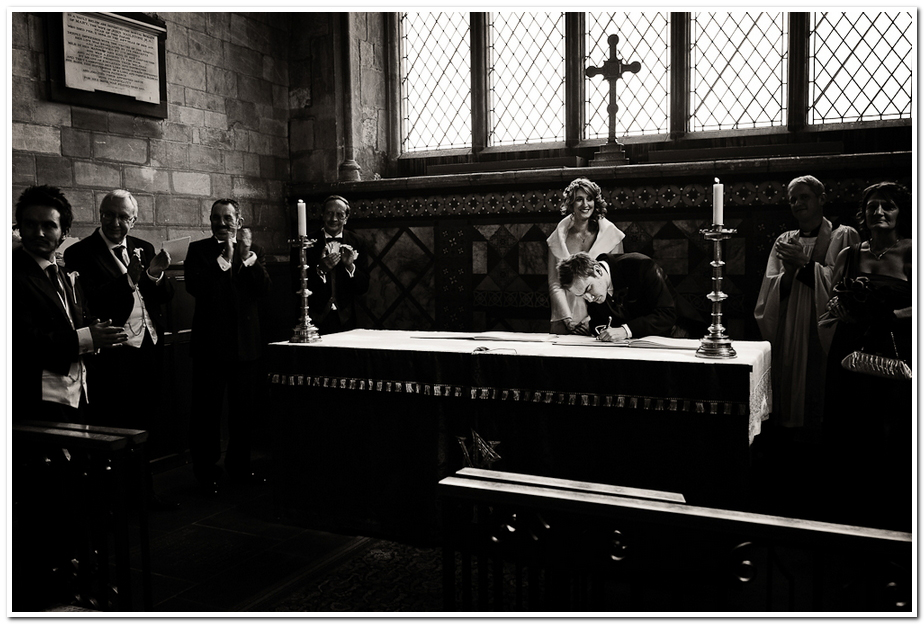
A photograph of the register being signed can show the atmosphere around the moment rather than simply recording the signatures.
The formal photograph and the documentary photograph don’t have to be completely separate things.
Learn to make decisions when working alone
When you’re the only photographer at a wedding, you can’t be everywhere.
That means constantly deciding where your attention will have the greatest value.
If the bride arrives at the church, do you stay inside to photograph the reaction of the guests?
Or do you position yourself outside to photograph her arrival?
If something important is happening in one room while something potentially interesting is developing somewhere else, you have to choose.
There is no perfect answer.
The important thing is to make the decision rather than drifting between situations and missing both.
Experience helps because you begin to recognise which moments are likely to develop and which can safely be left alone.
Use your ears as well as your eyes
Wedding photographers spend a lot of time looking.
But listening can be just as useful.
Laughter from another room.
A sudden cheer.
Music starting.
A speech changing tone.
A group of children becoming excited.
These sounds can alert you to something worth investigating before you can see it.
You don’t need to photograph every sound you hear. But it can act as an early warning system.
Follow the action.
The camera is the easy part
Once you’ve learned your camera and understand exposure, focus and lenses, the mechanics of taking a photograph become relatively straightforward.
The difficult part is deciding which moment is worth photographing.
That’s why documentary wedding photography is less about reacting quickly and more about being observant.
Watch people.
Listen.
Anticipate.
Move into position.
Wait.
Then be ready when the moment arrives.
You can’t predict exactly what will happen at a wedding, and that’s part of the appeal.
Your job isn’t to create every moment.
It’s to recognise the ones that matter and preserve them.
Tell the story, not just the highlights
A wedding album made entirely from beautiful portraits may look impressive, but a collection of photographs that tells the story of the day can become something much more personal.
Think about the small moments as well as the big ones.
The nervousness before the ceremony.
The reaction of a parent.
The chaos of the children.
The quiet moments between the formal events.
The laughter during dinner.
The unexpected interaction between two guests.
The final moments of the reception.
These are the photographs that can bring the day back to life years later.
Documentary wedding photography is therefore not simply about avoiding posed photographs.
It is about developing the ability to see what is really happening.
The more you observe, the better you become at anticipating.
And the better you become at anticipating, the more often you’ll find yourself in exactly the right place when the moment you’ve been waiting for finally happens.