How to Be More Creative in Photography: Developing Better Ideas
With Mike McNamee & Kris Anderson
Most photographers eventually reach a frustrating point where they know how to make a technically good photograph, but they want to make something more than technically good.
The exposure is right. The lighting works. The subject is sharp. The composition is competent.
But something is missing.
That something is often an idea.
Creative photography isn’t simply about adding more props, effects or Photoshop techniques. The strongest creative images usually begin with an idea and then develop through experimentation, refinement and problem-solving.
So how do you become more creative as a photographer?
What makes a photograph creative?
There is no single definition of a creative photograph, but one useful characteristic is that it gives the viewer something more to discover.
A technically accomplished portrait might have beautiful lighting, excellent posing, styling and expression. All of those things matter.
A creative portrait can take those foundations and add another layer: a story, an unexpected object, an unusual environment, symbolism, a visual metaphor or a surprising relationship between elements.
The photograph gives the viewer a reason to stop and ask:
Why is that there?
What does it mean?
How did they think of that?
That moment of discovery can be incredibly powerful.
Technical skill is the starting point, not always the destination
Technical ability shouldn’t be underestimated.
A photographer needs to understand exposure, lighting, composition, focus, colour and their equipment before they can reliably turn an idea into an image.
But technical competence alone doesn’t necessarily make a photograph distinctive.
Consider a beautifully photographed butterfly.
Excellent fieldcraft, beautiful light, perfect focus and a carefully controlled background can produce a wonderful nature photograph.
But there are potentially thousands of technically excellent photographs of the same species.
The question becomes: what can you add that makes your photograph yours?
Perhaps it is the light, the environment, the composition, the behaviour of the subject or the story surrounding it.
Creativity often begins where technical competence stops being enough.
Start with a question
One of the easiest ways to develop a creative idea is to stop asking:
“What should I photograph?”
and start asking:
“What am I trying to say?”
That small change can make a huge difference.
You might start with an emotion, a memory, a problem, a word, a piece of music, a historical event or even an everyday object.
From there, ask questions.
What does it remind me of?
What could represent that idea?
What would happen if I changed the scale?
What if I photographed it somewhere unexpected?
What could I add?
What could I remove?
What would make somebody stop and look twice?
You don’t need the final answer immediately.
The creative process is often about discovering the answer along the way.
Give yourself permission to have bad ideas
One of the biggest obstacles to creativity is rejecting an idea before it has had a chance to develop.
An idea might initially sound ridiculous.
That’s fine.
Creative brainstorming works better when you temporarily remove the requirement for every idea to be practical, affordable or sensible.
Write everything down.
Some ideas will be useless.
Some will be variations of things you’ve seen before.
But occasionally an apparently ridiculous idea will contain one interesting element.
That element can become the starting point for something much better.
Try changing one thing at a time
Kris Anderson uses a particularly useful approach to developing ideas: pivot the idea.
Start with one concept and change one element.
Then change another.
Then another.
You may eventually end up a long way from the original idea.
For example, imagine starting with a portrait of someone holding a flower.
You could change the flower.
Then change its scale.
Then replace the flower with something symbolic.
Then change the location.
Then change the relationship between the subject and the object.
Then ask what story would justify that combination.
The important part isn’t necessarily the first idea.
It is the journey between the first idea and the final photograph.
Combine things that don’t normally belong together
Unexpected combinations are one of the simplest ways to create visual interest.
A formal portrait with an unusual object.
A beautiful fashion image in an industrial environment.
A tiny object presented as though it were enormous.
A contemporary subject photographed using visual references from another period.
The combination doesn’t have to be random.
In fact, the strongest combinations usually have a reason behind them.
The viewer should eventually be able to understand why the elements belong together.
Make the prop part of the story
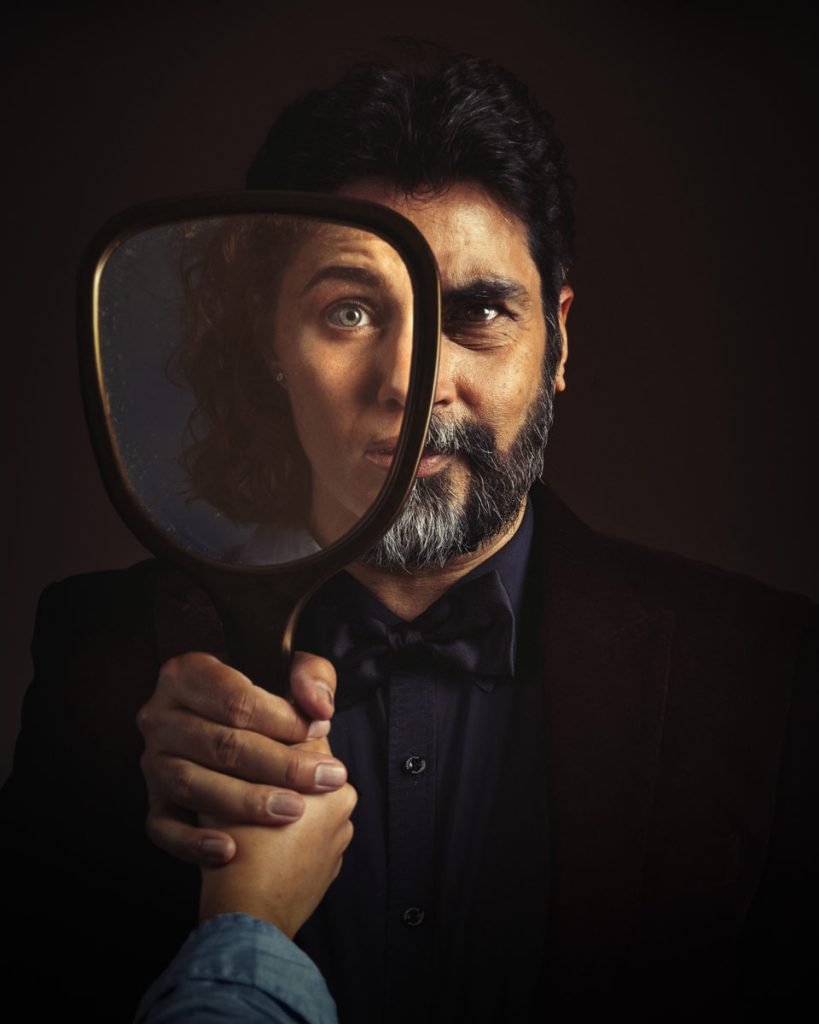
Props can be particularly powerful in creative photography.
But a prop shouldn’t simply be something interesting placed in the frame.
Ask what it contributes.
Does it tell us something about the subject?
Does it establish a period?
Does it represent an emotion?
Does it provide symbolism?
Does it create a visual contrast?
Does it change our interpretation of the photograph?
A good prop can provide an additional layer of meaning without needing to explain itself.
This is why creative photography and storytelling are so closely connected.
A simple image can contain a hidden idea
One of the most effective examples from The Societies’ competitions involved an apparently simple photograph of woodlice.
At first glance, the image showed a group of woodlice on a shelf and another isolated woodlouse at the bottom of a deep space.
The image was technically accomplished, but the real idea wasn’t immediately obvious.
The arrangement of the woodlice on the shelf represented the Morse code for SOS.
Suddenly, the photograph had another layer.
The viewer wasn’t simply looking at woodlice. They were discovering a message.
That is an important lesson in creative photography.
The idea doesn’t necessarily have to be complicated. It just needs to add something.
Don’t make the idea more complicated than necessary
There is a danger on the other side, too.
Once you discover that adding layers can make an image more interesting, it is tempting to keep adding them.
More objects.
More symbolism.
More references.
More Photoshop.
More cleverness.
Eventually, the viewer may become lost.
A creative photograph needs to give the viewer enough information to discover something, but not necessarily so much that the photograph becomes an intellectual puzzle with no satisfying conclusion.
Sometimes the simplest version of an idea is the strongest.
Titles can help
A title can be an important part of a conceptual photograph.
It shouldn’t have to explain everything, but it can provide a small nudge towards the intended interpretation.
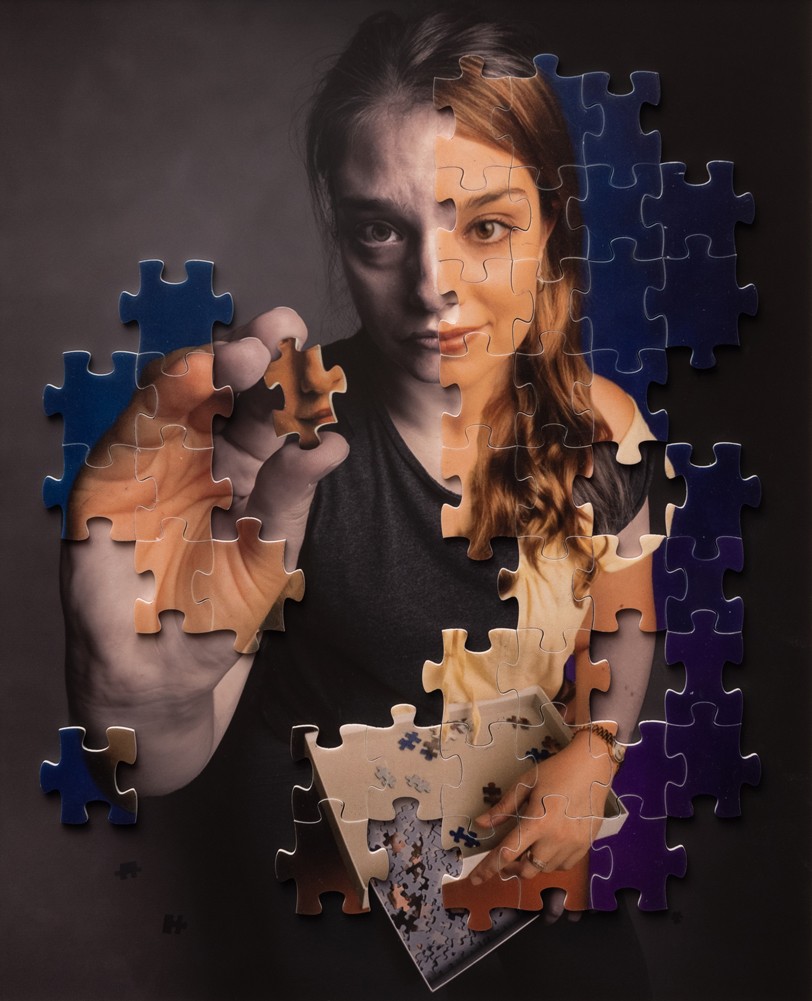
Kris Anderson’s image Solving the Puzzle is a good example.
The photograph used a physical jigsaw puzzle as part of a story about personal growth and becoming your best self.
There was a potential problem: the image could be interpreted as the subject becoming less complete rather than more complete.
The title helped reinforce the intended direction of the story without spelling it out.
A good title can therefore act as another element of the composition.
Use your surroundings as an idea bank
Creative ideas don’t always arrive while you’re holding a camera.
Keep a notebook or phone where you can record things that catch your attention.
It could be:
- An unusual building
- A particular colour combination
- A line from a book
- A piece of music
- A strange object
- An interesting face
- A conversation
- A historical photograph
- A painting
- A film
- A dream
- An unusual piece of clothing
- A landscape
- A word or phrase
Don’t worry about whether the idea is immediately usable.
You’re building a personal collection of possibilities.
Over time, you’ll probably notice that certain subjects, shapes, colours or themes keep appearing.
Those recurring interests can tell you something about your own creative voice.
Build an image library
A folder of visual references can be incredibly useful.
You might collect photographs, paintings, textures, skies, buildings, costumes, colours, landscapes, objects and other visual elements that interest you.
Pinterest and other visual-search platforms can be useful sources of inspiration, but don’t limit yourself to photography.
Look at painting, sculpture, theatre, cinema, graphic design, architecture and fashion.
Creative ideas often come from combining influences from different disciplines.
The important thing is to use these references as starting points rather than things to copy.
Work with other people
Creativity doesn’t always have to happen alone.
A group can take one idea and develop it in completely different directions.
One person suggests an idea.
Another changes something.
A third person introduces a completely unexpected element.
The process can produce combinations that none of the individuals would have reached independently.
Different personalities are particularly useful.
The quiet person in the room may have an idea that never gets heard if the discussion is dominated by the most confident voice.
Good creative sessions make room for everybody.
Overcoming the blank page
Every creative person knows the feeling.
You sit down to start something and suddenly you have absolutely no ideas.
This is often called creative block.
One solution is to remove the expectation that your first attempt must be good.
Make a list.
Write down ten ideas.
Then write ten more.
Sketch something.
Photograph something ordinary.
Change one element.
Set yourself a deliberately ridiculous challenge.
The objective is to get the creative process moving.
Once you have started, the next idea often becomes easier.
Don’t wait for inspiration
Creativity benefits from making time for it.
If every spare moment is filled with work, administration, social media and other responsibilities, there may be very little space left for experimentation.
Give yourself permission to make photographs that have no commercial purpose.
Try something that might fail.
Photograph something you wouldn’t normally photograph.
Spend an hour experimenting with light.
Create a personal project.
Go somewhere without a planned shot list.
Creativity needs room to develop.
Use constraints to stimulate creativity
It might sound counterintuitive, but limitations can actually help.
Give yourself a fixed lens.
Use only one light.
Photograph one object.
Work in one room.
Use only black and white.
Choose one colour.
Create a photograph using something you already have at home.
When the obvious options are removed, you are forced to look for alternatives.
That can lead to ideas you wouldn’t otherwise have considered.
Know when to stop

Creative development is an iterative process.
You make something.
You look at it.
You change something.
You try again.
You change something else.
This is useful, but there comes a point where more changes don’t make the photograph better.
They simply make it more complicated.
Ask yourself:
Does this change improve the story?
Does it improve the composition?
Does it make the viewer feel something?
Does it make the photograph more interesting?
If the answer is no, stop.
Sometimes the best creative decision is to remove something.
Look at your photograph through someone else’s eyes
When you’ve spent hours developing an image, it can become difficult to see what is actually in front of you.
Show it to somebody else.
Don’t immediately explain what it means.
Instead ask:
What do you see?
What do you think is happening?
What do you think the photograph is about?
Their answer can be extremely revealing.
If they see exactly what you intended, excellent.
If they see something completely different, that doesn’t necessarily mean the photograph has failed.
It may have revealed another interpretation that you hadn’t considered.
Creativity improves through practice
Creativity isn’t something that some photographers simply possess while others don’t.
It is a skill that can be exercised.
Look.
Collect ideas.
Experiment.
Question your first idea.
Combine unrelated things.
Make mistakes.
Try again.
Develop personal projects.
Study other art forms.
Work with other creative people.
And, most importantly, make photographs.
The more often you practise developing an idea rather than simply recording what is in front of you, the more naturally the process becomes.
A simple creative process to try
The next time you want to create something different, try this:
1. Start with an idea
Choose a word, emotion, story, object or question.
2. Make a list
Write down every possible interpretation, including the silly ones.
3. Pivot
Change one element and see where it takes you.
4. Combine
Look for unexpected objects, locations, colours or visual references.
5. Simplify
Remove anything that doesn’t contribute to the idea.
6. Experiment
Make rough versions before committing to the final photograph.
7. Get another opinion
Ask someone what they see without explaining the image first.
8. Refine
Adjust the lighting, composition, styling, props and expression.
9. Consider the title
If the image needs one, use it to support rather than explain the story.
10. Stop
When the photograph says what you want it to say, leave it alone.
The creative itch is worth scratching
The most memorable photographs aren’t necessarily the ones with the most complicated techniques.
Often, they are the photographs where somebody has had an idea and followed it through.
The idea might be funny, beautiful, strange, emotional, uncomfortable or thought-provoking.
It might begin with a tiny observation.
It might take dozens of attempts to develop.
It might fail completely.
That’s part of the process.
Photography gives us an extraordinary ability to turn an idea in our heads into something that another person can see.
So when you find yourself taking technically competent photographs but feeling that something is missing, don’t necessarily look for another camera or another plugin.
Look for the idea.
Kris Anderson is an award-winning Australian photographer known for creative portraiture and performing arts photography. His approach combines storytelling, visual experimentation and a willingness to develop ideas through repeated testing and refinement.