
Cricket Photography: Timing, Positioning and Capturing the Decisive Moment
by Mike McNamee
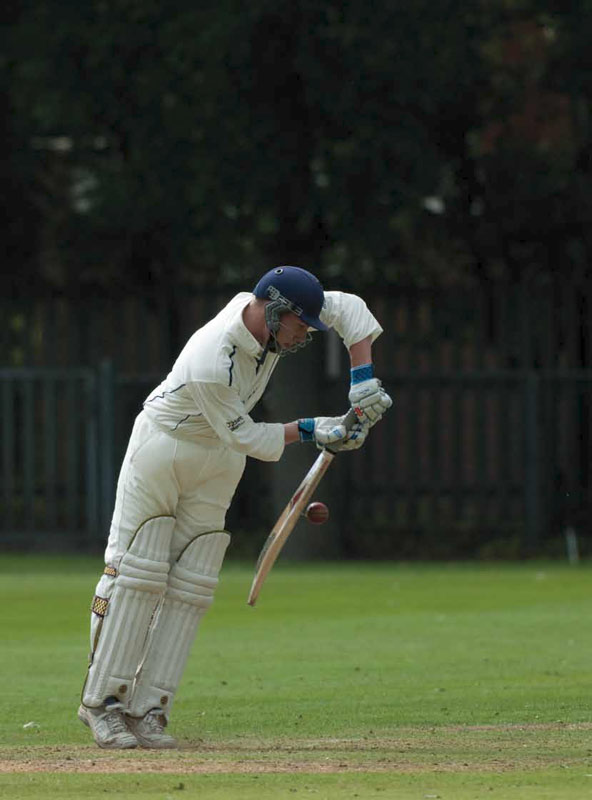
One of the myths about sports photography is that you have to hold your finger down on the shutter release and keep the motor drive running throughout the action. Nothing could be further from the truth for many sports.
There are certainly situations where a burst of frames is useful. The start of a Grand Prix, for example, is a classic situation where you might hold down the motor drive as the cars move away. Incidents frequently occur at this point in a race and, should one happen, you need to be locked into the view as it unfolds, with little opportunity to change anything other than focus.
For sports involving hitting a ball or jumping over things, however, timing becomes critically important.
In this instance, timing means synchronising the shutter with the precise moment of impact. Any moment before or after can mean missing the ball entirely in fast sports such as tennis, cricket, ice hockey, squash and badminton. It is less of a problem in sports such as football or rugby, where the ball moves more slowly.
Cricket provides an excellent example of why timing matters.
The Mathematics of Cricket Photography
Cricket has the supreme advantage that much of the action takes place in one spot — around the wicket — and that action repeats itself with every delivery.
In a 50-over match there are around 300 deliveries per innings, more if you count no-balls and fewer if there is a batting collapse. That means around 600 deliveries in the whole match.
If you shoot two or three frames per delivery, you could therefore capture between 1,200 and 1,800 frames.
Now consider dismissals.
There might be around 20 dismissals in a match. If we assume that half are catches, that leaves perhaps ten dismissals coming from bowled, stumped, lbw or run-out situations.
The maths is therefore quite simple: only around one frame in every 180 might contain the bails flying through the air.
And if you factor in a player obscuring your view of the stumps, that success rate drops even further.
This is the problem facing the professional cricket photographer. You have to photograph every delivery, just in case.
You also need more than one frame per delivery. If you time your first frame for ball-and-bat impact but the ball misses the bat, the second shot of the sequence may contain the bails in the air, a stumping or a vigorous appeal for a caught behind. All can make a good photograph.
The advantage of cricket is that the player is almost stationary and does not move very far. The disadvantage is that the action happens incredibly quickly.
Understanding the Speed of the Ball
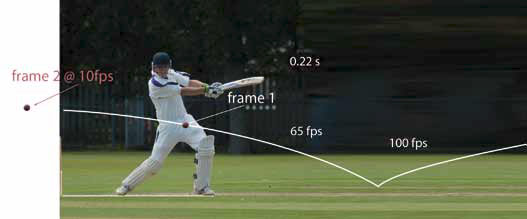
The stumps are 22 yards apart. A fast bowler can deliver the ball at around 80mph, with considerably higher speeds possible.
The ball slows as it travels through the air and slows further after bouncing before reaching the batsman.
This gives the photographer only a fraction of a second to anticipate and capture what is happening.
With a fast-moving subject, even a camera capable of shooting at a high frame rate cannot guarantee that you will capture the exact moment you want.
At lower frame rates, it is surprisingly easy to miss the action completely.
Even with a high frame rate, the ball can move several feet between frames.
This is why cricket photography is not simply about pressing the shutter as quickly as possible. You need to understand what is about to happen and time the shutter release accordingly.
Timing Is Everything
The outcome of this analysis shows why the timing of the photographer has to be almost as good as the batsman’s if you are to nail bat-to-ball contact.
If you do nail that point, however, you are also likely to get the stumps going down, should that occur, using only two or three frames.
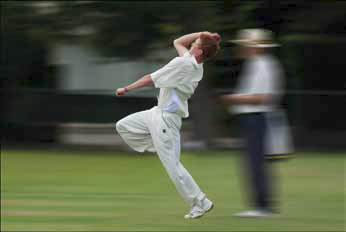
Timing is equally important if you want to catch the bowler fully off the ground.
The important point is that you should not simply react to what you see.
By the time you see the ball make contact, the decisive moment may already have passed.
You need to anticipate it.
This principle applies far beyond cricket. The best sports photographers are often photographing what they know is about to happen rather than simply reacting to what has already happened.
Choosing Your Position
You do not have to leave your creative streak in the changing rooms.
Shooting from a head-on position solves the problem of the ball disappearing out of the frame, but it brings another difficulty: the batsman may cover your view of the stumps at the far end, or the wicketkeeper at the near end.
A side-on viewpoint, where available, has the advantage of reducing this problem and also allows you to photograph deliveries from both ends of the ground.
However, you are then vulnerable to outfielders moving into your field of view.
They often stand in one location slightly away from the batting strip and then move forward as the bowler begins the run-up. This can result in a fielder getting in your way at precisely the wrong moment.
The late stages of a match can also offer opportunities that have nothing to do with the action itself. Long shadows from the fielders and warm evening light can add atmosphere and visual interest to your photographs.
Know the Game
For all these matters, a knowledge of the game is extremely useful.
If you know, for example, that a particular bowler always bowls over the wicket, you can change your position slightly as soon as the captain gives him the ball.
These changes rarely involve moving more than a couple of yards, but that small adjustment can make a considerable difference to the photograph.
If you are already a cricketer, much of this will almost be second nature.
Understanding the habits of batsmen and bowlers allows you to anticipate rather than react.
And that is one of the most important skills in sports photography.
Timing Can Be Practised
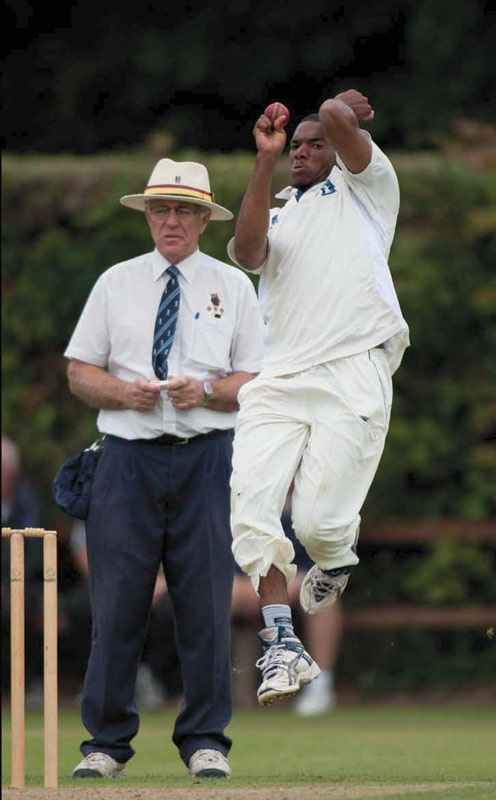
Timing is a gift, but it can also be improved with practice.
Think about people playing tennis in the park. One of the most common faults when someone fails to hit a tennis ball is not getting the racket back early enough. The timing can never catch up because the racket head is never delivered to the right place at the right time.
The same mindset applies to photography.
You have to prepare to squeeze the shutter and anticipate when the impact will occur, timing just slightly ahead of the moment.
Some people naturally have better timing than others, but practice makes a difference.
This is also why people who are highly accomplished at one sport can often excel at others. Timing is a transferable skill, rather than simply a question of raw athleticism.
One piece of good news is that, just as timing improves with practice in sport, it improves with photography too.
If you are serious about improving, practise.
Warm-up games are particularly useful because they allow you to get your eye in before the important match begins.
Working with a Long Telephoto Lens
One of the major problems when looking through a long telephoto lens is the restricted field of view.
A fast bowler starts his run some distance from the batsman. From a side-on position, trying to track the ball all the way from the bowler’s hand to the batsman through a very long lens is extremely difficult.
The ball starts from almost stationary, accelerates dramatically through the delivery and then travels towards the batsman at high speed.
Trying to follow that movement through a tightly framed 600mm or 800mm lens is unlikely to work consistently.
Instead, there is a useful technique that can help.
Use Both Eyes
Open both eyes.
Use the eye away from the viewfinder to watch the incoming bowler, while using the other eye to watch the batsman through the viewfinder.
It can feel a little strange at first, but it can be done.
The free eye tells you when you need to get ready, while you use the body language of the batsman to help time the shutter release.
From a side-on position, the batsman usually moves only slightly towards or away from the camera — often just enough to clear his body and make the stroke visible.
Most of the movement is either onto the back foot or forward over the front foot.
This also means that you can manually focus, or use autofocus and then focus-lock before pressing the shutter.
The advantage is that the camera is less likely to see the gap in front of or behind the batsman and suddenly focus on the hedge 140 yards across the pitch.
Supporting a Long Lens
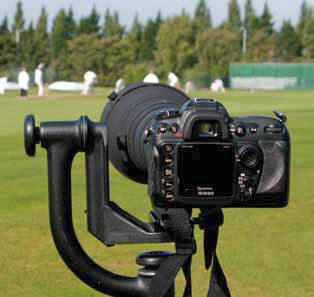
Cricket matches can last for many hours. Holding a large telephoto lens for that length of time is both tiring and difficult, particularly when you need to maintain a steady composition.
A tripod can therefore be an excellent choice for cricket photography, particularly when your position is relatively fixed.
For sports such as football or rugby, where you need greater mobility, a monopod may be more practical.
The important point is to make sure your support system is capable of comfortably handling the weight of your camera and lens, while still allowing you to track the action smoothly.
With an ultra-telephoto lens, even a small amount of unwanted movement can be enough to remove the subject from the frame.
A secure connection between the lens, camera and support is equally important. When moving with heavy equipment, take care that the camera and lens remain securely attached.
Don’t Forget the Creative Side
Technical accuracy is only part of sports photography.
It is easy to become so concerned with capturing the ball, the bat and the stumps that every image starts to look the same.
Look for opportunities beyond the obvious action.
Consider the light, shadows, expressions, gestures and relationships between the players. Look at what is happening around the main action and think about how your position can change the background and composition.
The aim is not simply to record what happened.
It is to create a photograph that tells the story of what happened.
The Decisive Moment
Cricket demonstrates one of the fundamental principles of sports photography: the decisive moment rarely waits for you.
You cannot ask the batsman to play the shot again.
You cannot ask the ball to return to the exact position it occupied a fraction of a second earlier.
You have to anticipate, prepare and react.
Understanding the sport gives you the information you need. Practice improves your timing. The right position gives you the best view. Your equipment gives you the reach and control required to capture the action.
But ultimately, it is the photographer who has to bring all of these things together.
And sometimes, getting that perfect frame is as much about timing as it is about the camera.