
NASA and The Artemis II Crew Capture Cosmic Wonder with the Nikon Z9
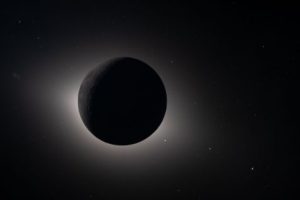
NASA has released a spectacular image from its Artemis II mission, where Nikon’s flagship camera, the Nikon Z9, was used by the crew to capture one-of-a-kind interstellar imagery from the historic lunar flyby. Titled “Artemis II in Eclipse”, the picture offers a unique perspective of the Sun eclipsed by the Moon from inside the spacecraft.
This fantastic shot was captured in April using the Nikon Z9 mirrorless camera, paired with a 35mm f/2D lens at an aperture of f/2, an exposure time of 2 s, and ISO 1600.
With this rare vantage point, the Artemis II crew witnessed the Sun hiding behind the Moon for almost an hour at a close distance (4,067 miles at closest approach) where the Moon appeared much larger than the sun. The astronauts also captured Saturn and Mars, visible to the right of the Moon within the majestic shot.
Hiroyuki Ikegami, Nikon Senior Executive Vice President, General Manager of Imaging Business Group says: “Seeing the images from the Artemis II mission return to Earth is a profound honour for all of us at Nikon. This latest research from Tokyo City University acts as a powerful reminder of what imaging can make possible when science, exploration, unrelenting effort and human curiosity come together.”
“For more than five decades, from Apollo 15 to the Artemis program, Nikon has been privileged to support NASA with cameras and lenses designed for exceptional clarity and reliability in the most demanding environments. The Nikon Z9’s high resolution, expansive dynamic range and outstanding low-light performance are helping crews capture incredible details.”
If you’d like to use this image, please can you include; Credit: NASA. The image can be downloaded here: Artemis II in Eclipse
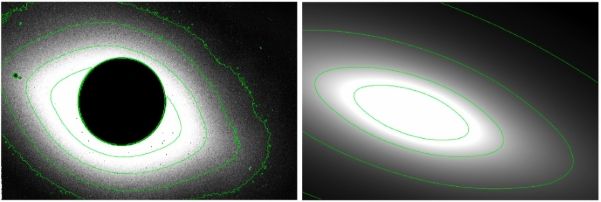
Additionally, researchers at Tokyo City University analysed solar corona images taken by the astronauts with the Nikon Z9 during the Artemis II mission. They found that the Z9’s high resolution, wide dynamic range and low-noise performance made it possible to capture even the faintest light around the sun with stunning clarity – contributing to this remarkable scientific discovery in space exploration.
Their study demonstrates that opportunistic observations from crewed lunar missions can provide valuable insights into the structure of the inner zodiacal cloud.
Kohji Tsumura, Associate Professor, Tokyo City University (currently Associate Professor, Frontier Research Institute for Interdisciplinary Sciences, Tohoku University) says: “I was amazed to learn that this remarkable image was captured by an astronaut using a commercially available Nikon Z9 with an exposure time of just two seconds—a true testament to how far digital camera technology has come. Although I was initially sceptical about analysing a JPEG image, the quality proved comparable to data used in professional astronomical observations. Astronomy is unique in that amateurs and professionals alike can make meaningful contributions, and as high-performance cameras become more accessible, I believe images taken by amateur photographers will increasingly lead to unexpected scientific discoveries. I am delighted that this research offers one such example.”
Ko Arimatsu, Co-author of the study; Senior lecturer, National Astronomical Observatory of Japan (NAOJ) says: “In this study, we investigated the properties of the F-corona—interplanetary dust scattering sunlight near the Moon—using images taken by an astronaut with a commercially available Nikon Z9. The findings demonstrate that scientifically valuable data can be extracted from consumer camera images when properly calibrated and analysed. This suggests that high-performance consumer cameras could serve not only for documentation during future space exploration, but also as tools for unexpected scientific discoveries.”